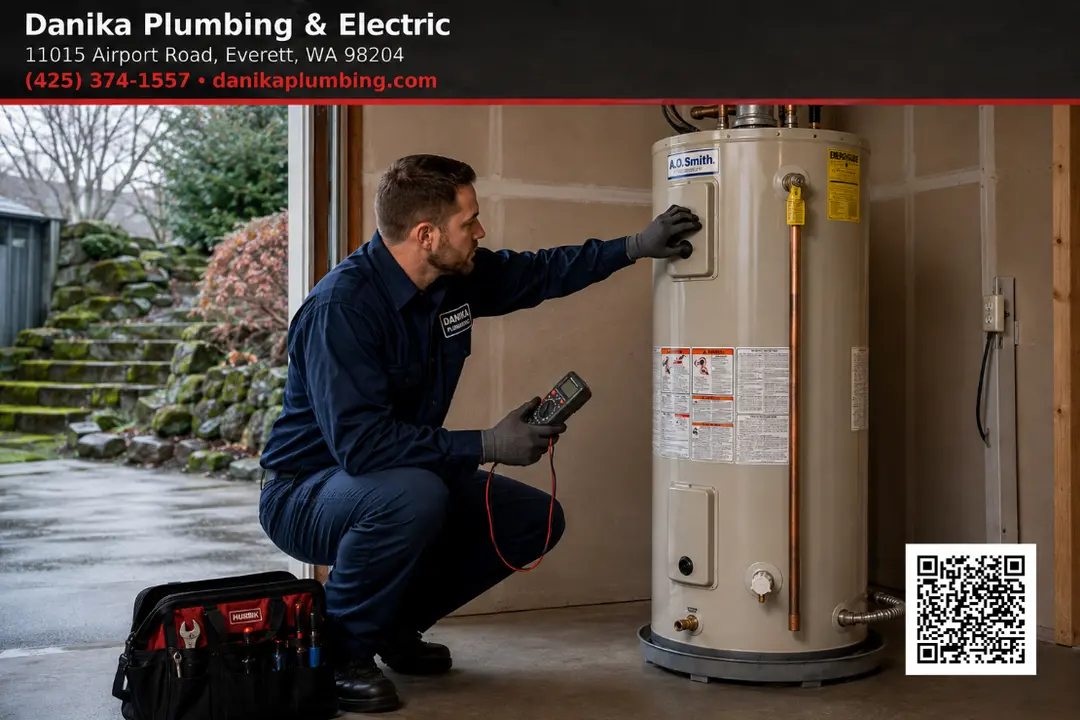
You reach into the shower expecting warmth and get a slap of cold instead. Nobody eases into that discovery gently.
A water heater not heating is one of our more common calls, and the good news is that it fails in predictable ways. Sometimes it’s a five-minute fix you can handle in a bathrobe. Sometimes it’s the tank quietly telling you its run is over. We’ve chased this complaint through garages all over Everett — from the older bungalows near Legion Park to newer builds out by Silver Lake — and the culprit almost always sits in a short, knowable lineup. Let’s walk it.
Water Heater Not Heating? The 30-Second Answer
If there’s no hot water at all, the cause is usually a loss of power or fuel — a tripped breaker or a popped reset button on an electric unit, or a pilot light that’s gone out on a gas one. If the water gets warm but never truly hot, or runs out fast, the likely suspects shift to a worn heating element, a drifting thermostat, or a layer of sediment sitting on the bottom of the tank.
Start simple. Check the breaker or the pilot before you touch anything else. And if you spot water pooling at the base of the tank, stop troubleshooting and call — that’s not a heating problem anymore, that’s a leaking-tank problem, and it doesn’t get better on its own.
What’s the First Thing to Check When the Hot Water Quits?
Power or fuel. Every time. It’s the most common reason a heater stops making hot water, and it’s the one that costs nothing to rule out.
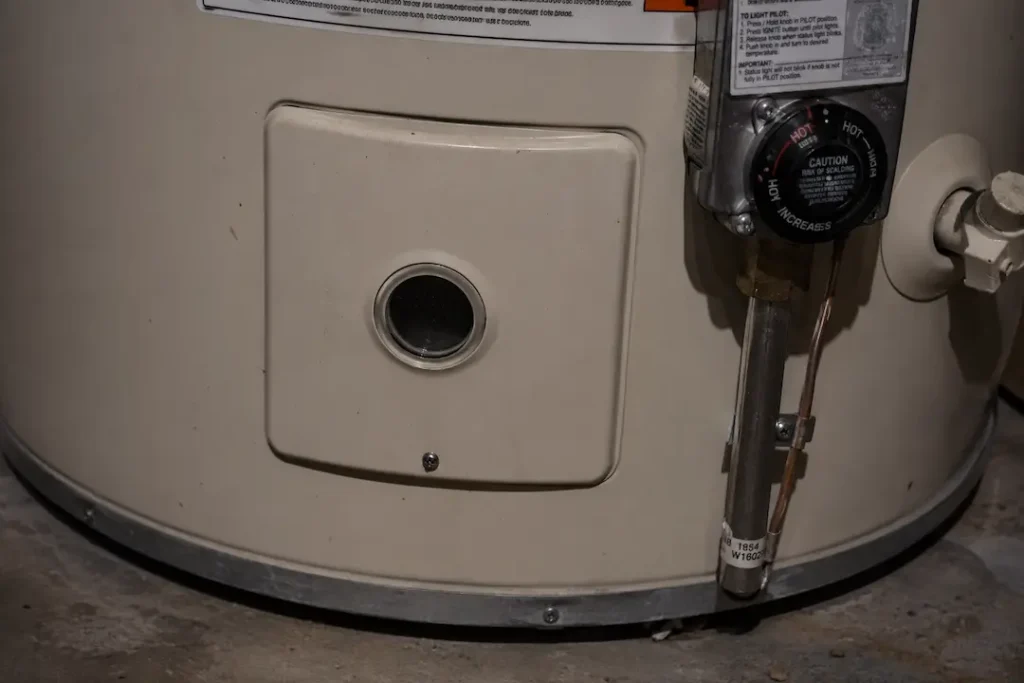
On an electric tank, head to your panel and look for a tripped breaker — sometimes it sits in a middle, half-on position that’s easy to miss. Flip it fully off, then back on. Still nothing? There’s a red reset button on the unit itself we’ll get to in a second.
On a gas tank, look through the little sight window near the bottom for a flame. No flame means the pilot is out, and relighting it per the label instructions gets a lot of people their hot water back before lunch. If it lights then dies moments later, that points at the thermocouple — the safety sensor that shuts the gas off when it doesn’t sense heat — and that’s a part swap, not a relight. If yours is a gas unit and this keeps happening, our full gas water heater troubleshooting guide walks through the pilot, thermocouple, and burner in more depth than we can cover here.
We once drove across town to a “dead” heater that turned out to be a breaker someone bumped while hanging garage shelving. Two seconds at the panel. Check the boring stuff first.
Where’s the Reset Button, and How Do I Push It Safely?
On an electric water heater, there’s a red button called the high-temperature limit switch, and it hides behind the upper access panel — the metal cover on the side of the tank, usually with a layer of insulation tucked underneath. When the water overheats, that switch trips and cuts power on purpose.
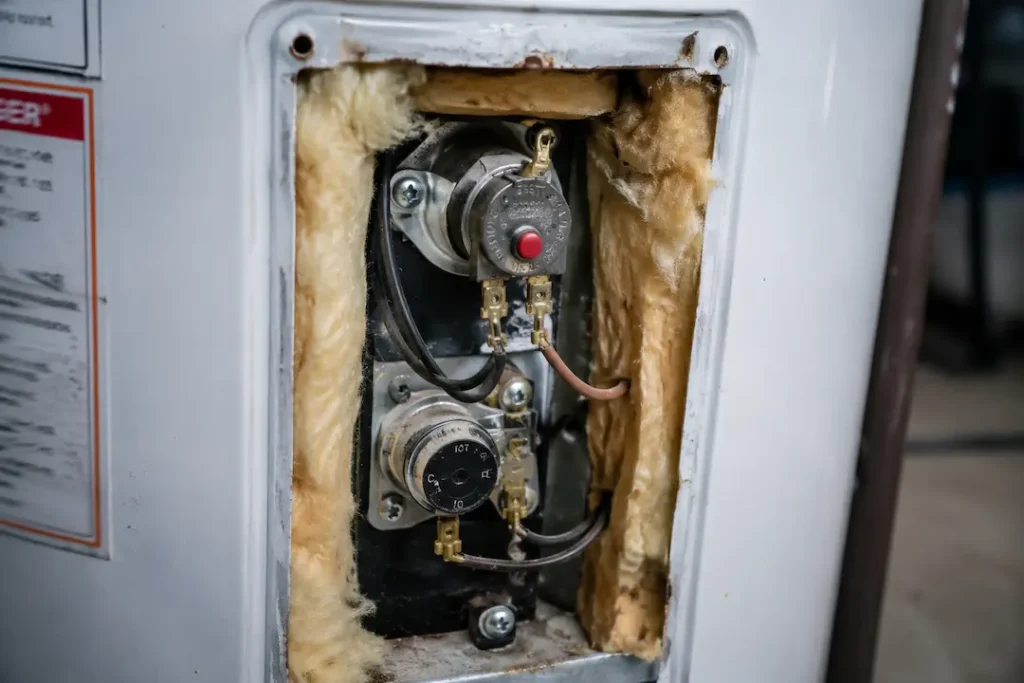
Here’s the part people skip, and it matters: kill the power at the breaker before you unscrew that panel. You’ll be working next to live electrical terminals, and the panel comes off to expose them. Breaker off, panel off, press the red button until it clicks, then reassemble and restore power.
One click and you’re done — fine. But a reset button that trips again a day or a week later is trying to tell you something. Usually it’s a failing thermostat or element letting the water run hot enough to keep tripping the safety. That’s the point to bring in a pro rather than keep resetting; the switch is doing its job, and overriding it repeatedly isn’t the move.
Why Is the Water Warm but Never Actually Hot?
Lukewarm is a different story than stone cold, and it usually means the heater is half working.
Most electric tanks run two heating elements — an upper and a lower. When the lower element burns out, the upper one keeps heating the top slice of the tank, so you get a short burst of warm-ish water that fades quick. When the upper element fails, you often get almost nothing. Either way, a warm-but-weak result is a classic single-element failure, and elements are a fairly routine replacement.
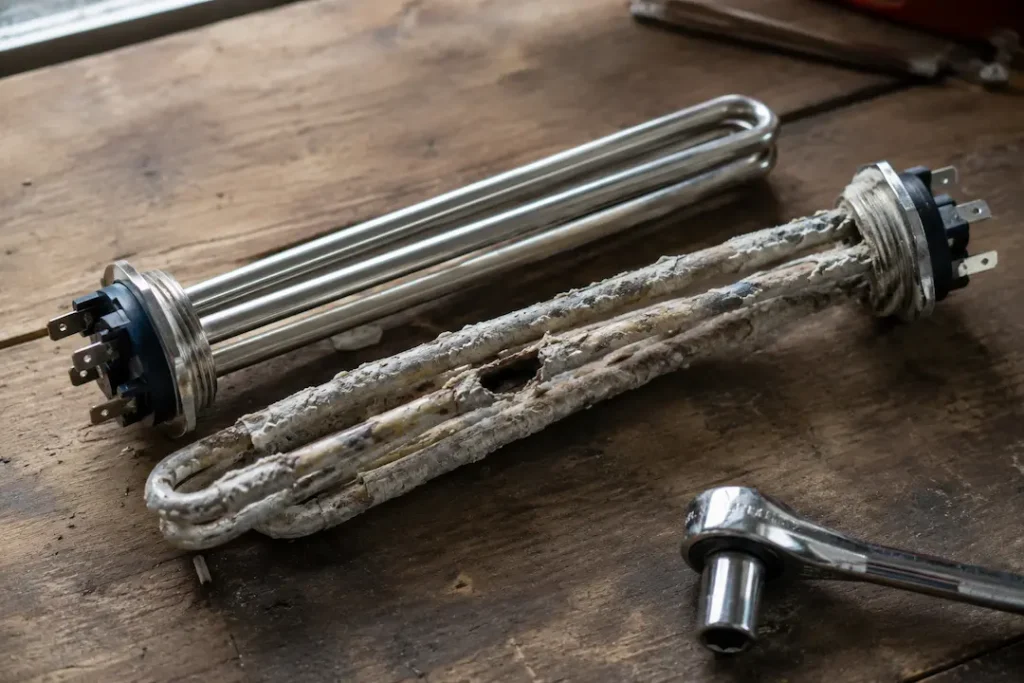
The other suspect is the thermostat drifting out of calibration, or simply set too low. The commonly recommended setting is 120 degrees Fahrenheit — worth peeking at the dial before assuming the worst. On gas units, a burner half-choked by soot or a weak gas supply leaves you with tepid water that never climbs.
My Hot Water Runs Out After About Ten Minutes — What Gives?
If the water starts hot and turns cold partway through a normal shower, the tank isn’t holding a full charge of heat. A few things do this.
A failed lower element is the big one again — the bottom two-thirds of the tank never fully heats, so you’re really only drawing off the hot top layer before cold takes over. Sediment does it too: a thick bed of mineral gunk on the tank floor takes up space that used to hold hot water, effectively shrinking your tank. And in a house with a big morning demand — showers back to back, laundry running — you might simply be outrunning a tank that’s a size too small for the household.
Worth mentioning the season. Our Puget Sound groundwater comes in cold, and colder in winter, so a heater that felt fine in August can feel undersized in January — same tank, tougher job.
Is Three Years Too Late to Flush the Tank?
Not at all — better late than never, and three years isn’t a lost cause. Flushing drains the sediment that settles on the bottom over time, and clearing it helps the heater run efficiently and buys the elements an easier life.
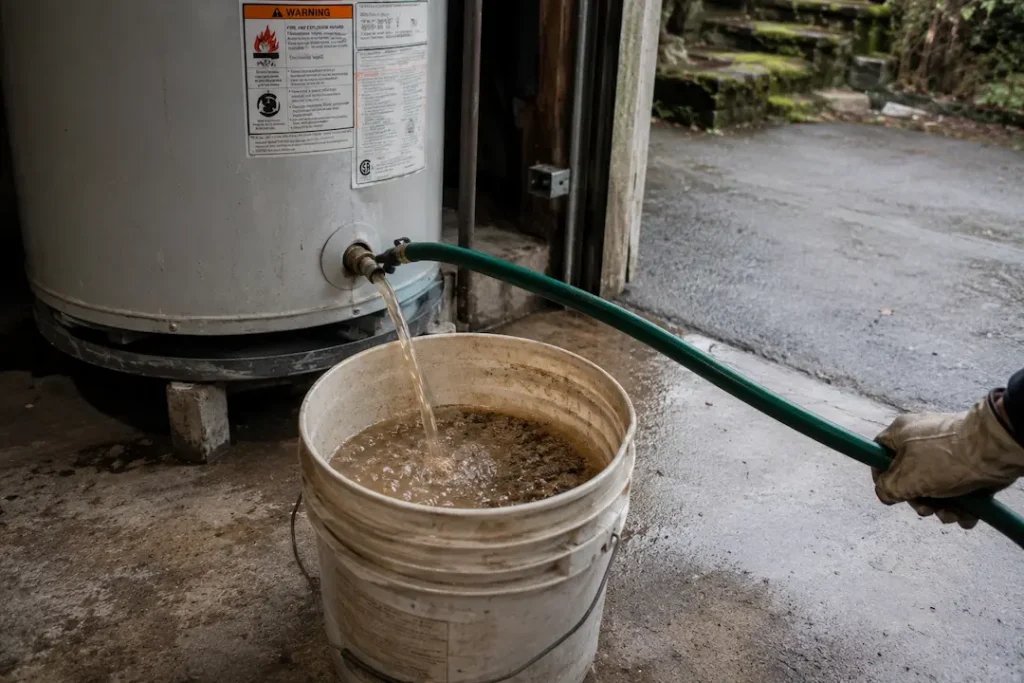
Now, an Everett wrinkle. The city’s water comes off Spada Reservoir by way of the Sultan River and lands on the soft side of the scale, so sediment builds slower here than in a hard-water town. Nice perk — but “slower” isn’t “never,” and we pull surprising amounts of grit from tanks owners swore were spotless. If yours is a few years in and never flushed, it’s low-drama maintenance. One caveat: on a tank that’s gone a very long time untouched, disturbing a heavy sediment bed can unseat things, so if you don’t know its history, let someone handle the first one.
Gas or Electric — Does the Fix Change?
It does. Electric troubles cluster around breakers, the red reset button, elements, and thermostats. Gas troubles cluster around the pilot, thermocouple, burner, and gas supply. A cold electric tank sends you to the panel; a cold gas tank sends you to the sight glass.
And the line we’ll repeat because it matters most: any water on the floor around the base changes the whole conversation. That’s tank failure, not a heating hiccup, and no amount of resetting fixes a tank that’s split. If the tank itself is the problem rather than a part inside it, it helps to know the signals that a tank is nearing the end of its life before you sink money into repairs that won’t hold.
Quick Answers to the Ones We Get Asked Most
The heater has power but still won’t heat — now what?
Power confirmed and still cold usually means a dead heating element or a failed thermostat on an electric unit, or a bad thermocouple or gas-valve issue on a gas one. These need testing with a meter to pin down, which is the point where a service call saves you buying the wrong part twice.
How long should a tank take to reheat after it runs out?
A healthy electric tank generally needs an hour or more for a full recovery; gas is usually quicker, often somewhere in the thirty-to-forty-minute range. Exact times vary with tank size, incoming water temperature, and the unit itself. If yours is dragging well past that, an element or burner isn’t pulling its weight.
Is it safe to just keep flipping the breaker to reset it?
No — a breaker or reset that keeps tripping is flagging a real fault, often a shorted element or a runaway thermostat. Repeatedly forcing it back on invites overheating. Let it stay off and get it looked at.
My gas pilot won’t stay lit no matter what — is that fixable?
Usually, yes. A pilot that lights but won’t hold almost always points at a tired thermocouple, which is an inexpensive part. If a fresh thermocouple doesn’t hold it, the gas valve is the next thing to check.
My water heater is tankless, not a tank — is this the same troubleshooting?
Not quite. A tankless unit that heats, then goes cold partway through, points at a different set of causes — flow-rate limits, a dirty inlet filter, or exhaust venting issues rather than a tank’s elements or sediment. See why a tankless unit keeps running cold for the tankless-specific version of this guide.
Cold Shower This Morning? Let’s Warm Things Back Up
Most no-hot-water calls end better than they start — a breaker, a reset, an element, a pilot, and you’re back in business. When the simple checks come up empty, or when you spot water where water shouldn’t be, that’s our cue. We’ll test it properly, tell you straight whether it’s a repair or a replacement, and get the hot water flowing again.
For the repair itself, our expert water heater service covers both tank and tankless systems. Local and want a set of eyes on it fast? Reach our Everett water heater specialists who know these neighborhoods, or just get our team in Everett on the phone and skip the guesswork.
Call (425) 374-1557 or book a visit online — we’ll get someone out to you.
Danika Plumbing & Electric
11015 Airport Road, Everett, WA 98204
Phone: (425) 374-1557
Email: office@danikaplumbing.com
Washington License # DANIKPL839PF