
Repiping Services
A house does not decide when it needs a repipe. The material in the walls decides.
Budget, schedule, how much drywall comes off, whether we can work from the crawlspace — all of it follows from one question, and it is a question about metal and plastic. Galvanized steel closes itself off from the inside. Polybutylene lets go at the fittings. Copper of a certain vintage starts weeping pinholes in the same two rooms. Those are three different conversations, none of them answered from the curb, which is why every repiping quote we write starts with a look at what you actually have.
Reviewed by our customers
What our customers say about their repipe


The material
Start with what is actually in the walls
Galvanized steel is the one we meet most often in the older streets of Everett and the towns around it, and it fails in a way that catches people out: it does not spring a leak first, it strangles. The zinc lining wears off, the steel underneath rusts, and the rust grows inward until the working diameter is a shadow of what the pipe was made to carry. Flow drops room by room, the first draw comes out tea-coloured, and only later does a threaded joint give up where the wall is thinnest.
Polybutylene is the opposite story. Gray, sometimes blue, flexible, joined with crimped rings, it went into houses as a cheaper alternative to copper and earned a reputation for brittle failure that starts at the fittings rather than mid-run. Inspectors flag it on sight and insurers ask about it, and when we find it we say plainly that patching buys time rather than solving anything.
Copper deserves more respect than the internet gives it: sound copper installed well is an excellent supply system, and we still put it in. What shortens it is pitting corrosion, aggressive water, velocity scouring the inside of elbows, and original workmanship that was rushed. Its failure signature is the pinhole — a slow weep behind drywall, a stain on a ceiling, a repair, then the same thing again on the far side of the wall. One pinhole is a repair; a pattern of them is the system talking.
None of that is abstract in Everett, because the city was largely built in the decades those materials belonged to. Census counts put the whole stock on one page:
| Decade built | Everett housing units | Share of city stock |
|---|---|---|
| 2020 or later | 509 | 1.1% |
| 2010–2019 | 3,557 | 7.5% |
| 2000–2009 | 5,604 | 11.8% |
| 1990–1999 | 7,050 | 14.8% |
| 1980–1989 | 7,307 | 15.4% |
| 1970–1979 | 5,707 | 12.0% |
| 1960–1969 | 4,660 | 9.8% |
| 1950–1959 | 3,602 | 7.6% |
| 1940–1949 | 2,245 | 4.7% |
| 1939 or earlier | 7,258 | 15.3% |
Read the bottom half of that table and 23,472 units — 49.4% of the city — went up before 1980. The 1960 to 1989 span alone accounts for 17,674 homes, about 37%, which is exactly the window when galvanized steel was still going in, early copper was common, and polybutylene arrived at the tail end. The median owner-occupied home in Everett was built in 1974, a decade older than the median rental (Census ACS Table B25037, pulled Aug 2026) — so the typical Everett homeowner, not the typical renter, is the one living with fifty-year-old supply pipe.
Read your own plumbing
Telling one material from another without opening a wall
You need a flashlight, a magnet, and an exposed run — behind the water heater, under a vanity, or where the supply comes up from the crawlspace. Colour tells most of it, the joint the rest.
| Material | How to spot it | Verdict |
|---|---|---|
| Galvanized steel | Dull gray, threaded joints, a magnet sticks | Repipe candidate |
| Copper | Reddish-brown, soldered joints, no magnetic pull | Often repairable |
| Polybutylene | Gray or blue flexible plastic, crimped rings | Plan to replace |
| CPVC | Cream-coloured rigid plastic, glued joints | Case by case |
| PEX | Flexible red, blue or white tubing, ring fittings | Modern standard |
The tipping point
The point where patching stops paying for itself
Three signals move a house out of repair territory, and homeowners usually notice all three before anyone says the word repipe.
The first is repeat pinholes in different rooms. A single failure is bad luck or a bad solder joint. The same failure in the kitchen, then the upstairs bath, then the wall behind the laundry is the material aging at the same rate everywhere it went in, and the next one is already forming where you cannot see it. The second is colour on the first draw — that rusty tint when a tap has been sitting overnight, worst at the fixture furthest from the meter. That is corrosion product being carried out of the pipe, and it does not reverse.
The third is pressure that collapses when a second fixture opens. Run the shower, have someone start the kitchen tap, and if the shower drops to a trickle you are watching restricted pipes rather than a municipal supply problem. When all three show up together the arithmetic changes: each visit to repair one failed run is money spent on a system that will ask again. We still take that call — sometimes a repair is the right answer, and where the symptom is a hidden leak rather than an aging system the job is to pinpoint where the water is going. But once the invoices stack up in the same drawer, we would rather show you the numbers side by side than keep billing you for the losing option.
No maintenance routine reverses any of this. Flushing the water heater, swapping supply flexes before they crack, keeping the pressure regulator inside its range — all of it is worth doing, and all of it protects fixtures rather than the pipes feeding them. Scale that has closed a galvanized line down to the bore of a pencil does not come back off, and copper thinned from the inside does not thicken again. Maintenance buys time on the parts you can reach; repiping is what deals with the parts you cannot.
Materials, compared
PEX or copper, honestly
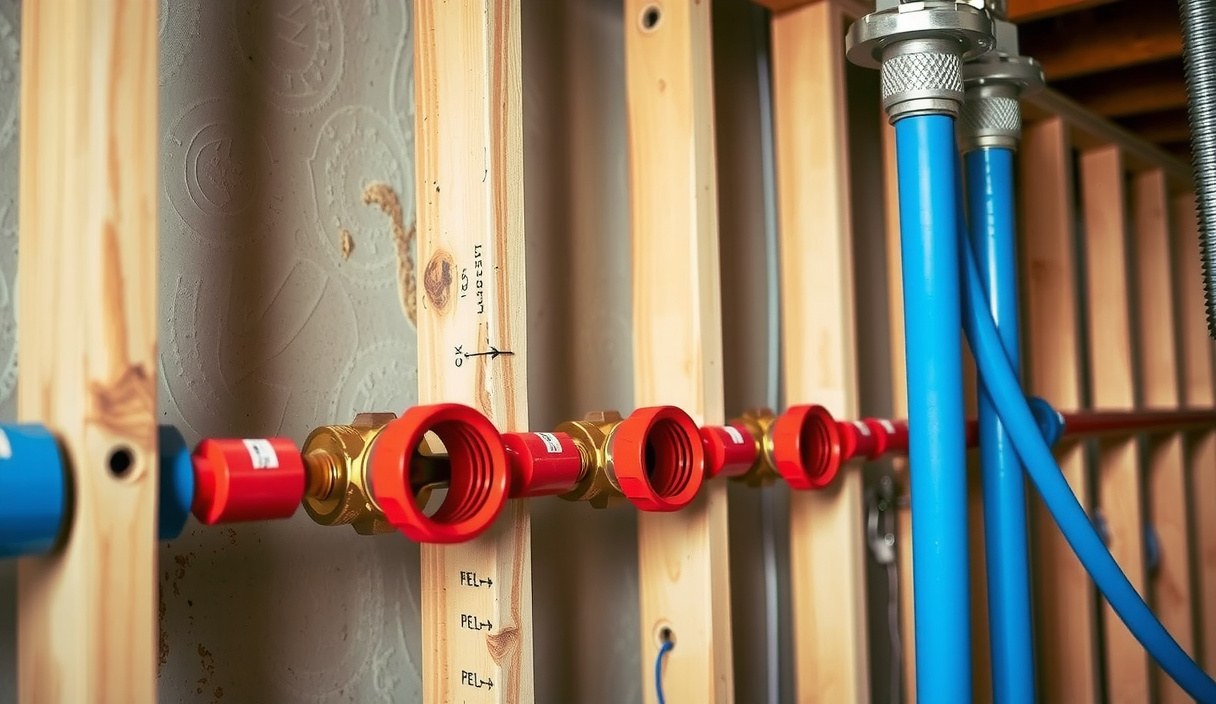
Most whole-house repiping in this county ends up in PEX, for reasons beyond cost. PEX comes off a coil, so a run from the manifold to a fixture goes in as one continuous length with no joints buried in the wall — and buried joints are where supply systems fail. It flexes, which matters in a settled crawlspace. It tolerates a freeze better than rigid pipe because it expands a little instead of splitting, which counts in a county that takes its cold snaps in short, sharp doses. It also goes in faster, and labour is the largest part of a repipe.
Copper still wins in specific places. It handles heat without complaint, so we often keep it for the first stretch off the water heater. It does not care about UV or curious rodents, which makes it the better call for exposed runs in a garage or shop. Some commercial specifications require it, and some homeowners simply want it, which is a good enough reason on its own.
We will not pretend one of them is the only defensible answer. You get a written price on the option that suits the house, a written price on the alternative if you want to compare, and the reasoning in plain language rather than brochure language.
Either way, the point of repiping is pipes you stop thinking about. The system holds pressure when two fixtures run at once, the first draw of the morning comes out clear, and what you are left with is reliable in the plain sense of the word — nothing weeping behind the drywall, no towel folded under the crawlspace hatch, no plumber’s number saved in your phone under a nickname.
What it is like
What a whole-house repipe is like to live through
This is the part homeowners want described and the part most quotes skip.
Before anything gets opened
We walk the house with you: every fixture, the water heater, the meter, the crawlspace or attic, and the route each new line takes. That walk produces the price, in writing, with the material named. We file the permit, and you are told which walls we intend to open before a single cut is made.
The open-wall days
Access is surgical, not scorched-earth. Most cuts land at fixture drops, direction changes and top plates — small, planned, and where a patch disappears. Given a clean crawlspace or attic route, whole runs go in without touching a finished wall. Furniture gets moved and covered, floors protected, and the crew cleans up at the end of each day rather than leaving you in it.
The changeover
The water goes off in planned windows we agree with you, not from breakfast to dusk because it suited the van. New lines are pressure-tested before anything is buried, and where the layout allows we stage the work to keep a bathroom live. If the household cannot be dry at certain hours — a home business, a newborn, someone working nights — say so at the walk-through and the sequence is built around it.
Inspection, then patching
The inspector sees the new pipe while the walls are still open, which is the whole point of that order. Once it passes, patching begins: drywall closed, taped and textured to match. Be clear with any contractor about where their scope ends — ours states in writing what gets patched and what gets painted, so nobody negotiates it with the tools already in the truck.
Sources: whole-house range and Seattle material rates — Angi, Seattle metro, pulled Aug 2026; labour share — Angi, national, pulled Aug 2026. Figures are published typical ranges for planning, not a Danika quote; your number comes from the walk-through in writing.Why us
Permitted, pressure-tested, patched before we leave.
A repipe touches every room, so the parts easiest to skip — permit, inspection, drywall — are exactly the ones we put in writing. We work out of Airport Road in Everett, file with the city or county ourselves, and the crew that opens your walls closes them.
(425) 374-1557Licensed & bonded
WA L&I registered, insured, accountable in writing.
Permit handled
We file it and meet the inspector. It is in the quote.
Patching in scope
What gets closed and finished is stated before we start.
Plumbing + electrical
One company for the pipe and the panel both.
Service area
Towns our repiping services cover
From the shop on Airport Road we repipe across Snohomish County and north King — Everett, Marysville, Mukilteo, Lynnwood, Edmonds, Mill Creek, Lake Stevens, Snohomish, Monroe, Mountlake Terrace, Bothell, Shoreline and Kenmore. In town it goes out under our Everett plumbers, and the rest of what we do on the plumbing side runs from the same shop.
Straight answers
Questions we hear before a repipe
How do I know if I have galvanized pipes?
Is PEX as good as copper for a whole house repipe?
How long does a whole-house repipe take?
Will you have to tear out all my walls?
Do I need a permit to repipe a house in Everett?
Can you just replace the section that keeps leaking?
A repipe is a big number in one go.
It is also the kind of work that stops costing you in leaks, water damage and emergency call-outs. Financing is available if spreading it out makes the decision easier.
Stop patching the same pipe.
One walk-through, one written price, one crew from the first cut to the last patch.
Licensed · Bonded · Insured · WA L&I Registered · 11015 Airport Road, Everett, WA 98204