
Kitchen Plumbing
Your kitchen isn't a list of fixtures. It's one water system with about seven places to fail.
Walk it in order, from the shutoffs behind the cabinet door to the drain heading out under the house, and every complaint we get called about lands somewhere on that route. Here is the walk, what tends to go at each stop, and where a remodel or a gas range changes things.
Reviewed by our customers
What Everett homeowners say about our kitchen work


Stop one
Shutoffs and supply lines, the parts nobody looks at
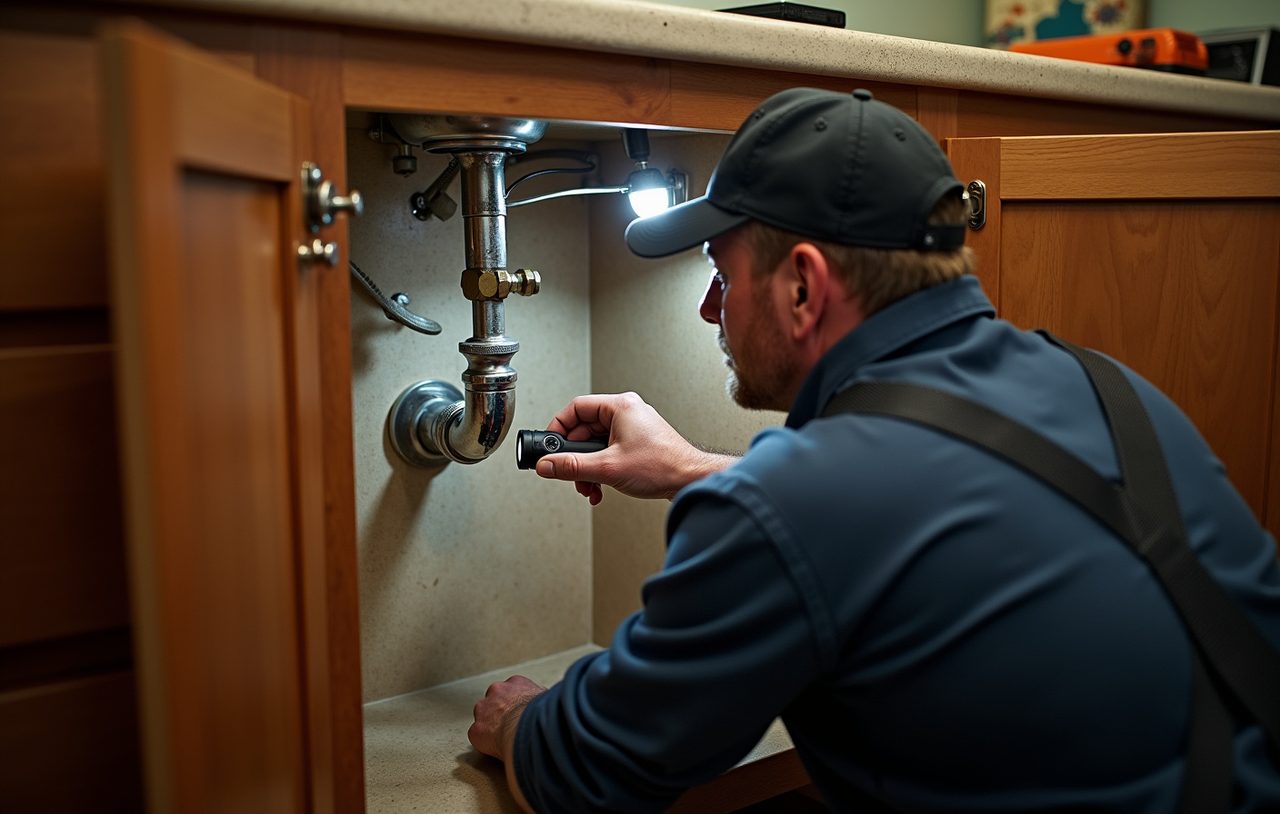
Kitchen sink plumbing begins behind the cabinet door. Open it and you will find two angle stops feeding hot and cold up to the faucet, braided connectors, and usually a tee off the cold for the dishwasher and the fridge. These sit untouched for years, which is the problem. A multi-turn stop that has not moved since the house was built often refuses to close, or closes and then weeps from the packing nut, and you learn that on the night you need it shut.
Braided stainless connectors are the other quiet risk: the braid hides the rubber core, so the failure gives no warning and it lets go at full pressure, usually while the house is empty. We replace tired stops with quarter-turn valves and swap connectors whenever a kitchen cabinet is open, because doing it costs nothing next to a floor.
Stop two
The faucet and the sprayer behind it
A kitchen faucet gets worked harder than anything else in the house. Cartridges wear and start dripping or crossing hot into cold. Pull-down sprayers lose their retracting weight, stick halfway out, or split where the hose flexes over the cabinet edge. The base plate loosens, water creeps under it, and the countertop takes the damage.
Everett's water is soft, kinder to fixtures than what plumbers face east of the mountains, so a faucet here usually dies of mechanical wear rather than scale. That shapes the repair-or-replace call: worn cartridges, seals and sprayer hoses are worth changing, a cross-threaded body or a flaking finish is not. We handle faucet repair and replacement either way, and we tell you which one you are looking at before we start.
Stop three
Sink, basket strainer, and the seal you can't see
The basket strainer is a small brass fitting sealed to the sink with putty on top and a gasket and locknut underneath, and it sits behind a good share of the "the cabinet floor is damp and I don't know why" calls. The leak is slow, runs down the outside of the tailpiece and soaks the particleboard rather than pooling. By the time the cabinet base swells, it has been weeping a long while.
Undermount sinks add their own version: the clips and adhesive holding the bowl to a quartz top let go gradually, the rim seal opens, and water tracks down between sink and counter. Both are fixable cheaply, provided somebody gets under there and looks instead of tightening the trap and hoping.
Stop four
The disposal sitting in the middle of everything
The disposal is the busiest thing under your sink, and it connects to more than people realise: the sink flange above it, the dishwasher hose entering from the side, the discharge tube heading to the trap, and a switch and receptacle on the electrical side. A fault at any of those four points presents as "the disposal is broken."
So it is worth diagnosing rather than replacing on sight, which is why we keep a separate page on disposal jams, leaks and replacement with the self-help steps written out. On a whole-kitchen visit it gets checked as part of the system, because a unit that is fine in itself can still be why the dishwasher will not drain.

Stop five
Your dishwasher touches the plumbing twice
There is a supply side and a drain side, and they fail differently. The dishwasher line on the supply side is a small hot run off the cabinet tee, and its usual complaint is a weeping compression fitting at the appliance elbow, dripping onto the subfloor behind the machine where nobody sees it until the flooring lifts.
The drain side is where the interesting problems live. That corrugated hose has to rise to a high loop or an air gap before dropping to the disposal or the tailpiece; lay it flat and dirty sink water siphons back into the machine. Add the knockout plug left in a self-installed disposal and you have the two reasons a dishwasher backs up that have nothing to do with the dishwasher.
Stop six
Past the trap: the kitchen drain itself
Everything above this point empties into one branch line, which handles the dirtiest job in the house. Fat, ground food and soap film build a sleeve on the pipe wall, and in older north Everett housing stock that branch is often cast iron, whose rough interior grabs buildup and holds it. The line narrows quietly and the sink drains slower each week until a Thanksgiving weekend finishes it.
Cabling opens a channel through a soft blockage. Jetting scours the wall back toward its original diameter, which is what a grease-loaded kitchen line needs. If it returns after a proper clean, a camera tells us whether the pipe itself is the problem: a bellied run, a dropped joint, or roots at a connection in a yard full of the firs Snohomish County is not short of.
Stop seven
If you cook on gas
A gas range brings a second utility into the room and its own rules: a shutoff the cook can reach, a sediment trap ahead of the appliance, an approved connector, and a pressure test before anyone lights it. Moving a range during a remodel, or running a new line for a household switching off electric, needs a permit in Everett and across Snohomish County, and it is inspected.
We are licensed for gas as well as water, so the range needs no separate trade and no separate visit. It is the same reason people keep us for the rest of the plumbing in the house once the kitchen is sorted.
Remodels
Kitchen plumbing services for a remodel, and when they have to happen
Renovation is where kitchen plumbing gets unforgiving, because nearly all of it has to be finished before the parts everybody is excited about arrive. Rough-in goes in while the walls and floor are open. Once the cabinets are set and the counter templated, moving a drain a few inches stops being a plumbing job and becomes demolition.
Moving a sink is the request we get most, and the supply side is the easy half. Drainage governs: the line has to fall consistently to the existing stack, and it has to be vented. An island sink cannot tee into a wall vent the way the old position could, so it needs a loop vent, or an air admittance valve where the code official permits one. That detail decides how far an island can travel from the wall.
The rulebook behind those decisions is a specific, citable document. Washington has adopted the 2021 edition of the Uniform Plumbing Code — appendices A, B, I and M included, chapters 12 and 14 excluded — as the state plumbing code, in force since 15 March 2024. That is the book an inspector is reading from when they rule on whether your island sink can take an air admittance valve, how much fall the new branch needs, and where its vent ties in. Useful to know when somebody tells you what is "normally allowed": the edition in force is newer than a fair amount of the advice circulating, and it applies statewide, whether the permit comes from the city or the county.
Source: Washington Administrative Code WAC 51-56-003, State Building Code adoption of the Uniform Plumbing Code (apps.leg.wa.gov); statewide scope; pulled 6 Aug 2026.Pot fillers are the other one. A folding filler over the range needs a cold line run inside the wall to a spot with no drain under it, so shutoff placement matters more than the tap. Lovely when planned in at rough-in, awkward as an afterthought.
Layout review
We look at the drawings before the cabinets are ordered, not after.
Permit
Filed with the city or the county, and we meet the inspector.
Rough-in
Drain, vent, supply and gas set while the walls are open.
Inspection
Signed off before anything gets covered up.
Trim-out
Sink, faucet, disposal, dishwasher and filler connected and tested.
Working to a contractor's schedule
Rough-in and trim-out are two visits with cabinetry, counters and flooring in between, so the dates belong to your general contractor. Send us the build schedule and we slot into it.
Between visits
The kitchen plumbing maintenance that actually pays for itself
A fair share of what we get called out to in a kitchen was avoidable, and the avoiding costs nothing. None of the list below needs a plumber, and all of it buys years of quiet service out of parts that are otherwise fine.
Turn the shutoffs under the sink once a year
An angle stop that has not moved since the house was built seizes in place, and you find that out on the night you need it. A minute of maintenance is what keeps a small drip from becoming an emergency service call.
Run cold water through the disposal, and keep it running afterwards
Cold keeps fat solid so it leaves the branch line instead of settling in it, and the extra few seconds is what carries the ground food clear of the trap.
Pan drippings go in a jar, not the sink
Grease is the commonest cause of a slow kitchen drain, and hot water only moves the problem further down the pipe.
Put a torch under the sink every few months
A stiff supply hose, a green crust on a fitting, a cabinet floor that has darkened — caught there it is a small repair, ignored it is the cabinet as well.
Clean the dishwasher filter and unscrew the faucet aerator
Both trap debris, both take minutes, and clearing them restores flow most households had written off.
What maintenance cannot do is extend a part past the end of its service life — a braided supply hose gone rigid, a cast-iron branch that has lost half its bore, a cartridge nobody makes any more. That is the point where our kitchen plumbing services stop being about habits and start being about replacement, and we will tell you plainly which of the two you are looking at.
The other half of the room
The part of a kitchen most plumbers have to hand off
A modern kitchen is as much circuits as pipe: countertop receptacles, the dedicated circuits a dishwasher and a disposal each want, the disposal switch, under-cabinet lighting, and the heavy circuit a range needs if a household moves off gas. On a normal remodel that means a plumber, an electrician, and a gap in the schedule where they wait on each other.
Danika Plumbing & Electric holds both licences, so pipe and wiring are one contractor's problem. The disposal gets fitted and its switch wired on one visit, a relocated range gets both its gas line and its circuit, and nobody explains that the other bit is not their department.
Why us
We look after the room you live in most.
A kitchen is not a crawlspace. It has finished cabinetry, a counter somebody chose carefully, and a family that needs to eat tonight. We protect everything we reach past, tell you before the water goes off rather than after, and leave the cabinet cleaner than we found it. The price is agreed in writing first.
(425) 374-1557Licensed & insured
WA State L&I registered, bonded, and based in Everett.
Permits pulled
We file and meet the inspector on any job that needs it.
Two trades, one invoice
Pipe, gas and wiring handled by the same crew.
Agreed in writing
Scope and price settled before the first fitting comes off.
Where we go
Snohomish County kitchens, and a few south of the line
Our kitchen plumbing services run out of the shop at 11015 Airport Road in Everett, and the vans cover Marysville, Lynnwood, Edmonds, Mukilteo, Mill Creek, Lake Stevens, Monroe, Snohomish and Mountlake Terrace, along with the north end of King County. Looking for a plumber in Everett, WA specifically? That page has the local detail. Everywhere else gets the same crew and the same standards.
Before you call
Kitchen questions we hear a lot
Can you move my kitchen sink to an island?
When does the plumbing happen in a kitchen remodel?
Do I need a permit to move kitchen plumbing in Everett?
Why does my kitchen sink smell bad?
Can you install a pot filler over my range?
Kitchen work has a way of expanding.
Once walls are open, the sensible fixes tend to reveal themselves. Financing is available so a good decision mid-project doesn’t have to wait for next year.
Kitchen giving you trouble?
One visit, one company, both trades. Tell us what the room is doing and we'll tell you what it needs.
Licensed · Bonded · Insured · WA L&I Registered · 11015 Airport Road, Everett, WA 98204