
Yard & Foundation Drainage
Rain here does not sink away and vanish. It soaks down a foot or two, meets something it cannot get through, and starts moving sideways — usually toward the lowest wall on the property.
That is the problem a french drain solves. We install them along foundations, across lawns that never dry out, and uphill of houses from Everett to Lake Stevens. Every job starts by working out where the water arrives from, where it can go, and whether a trench is honestly the right answer. Sometimes it is not.
Reviewed by our customers
What Snohomish County homeowners say about our drainage work


Where the water goes when the ground stops taking it
Put a shovel in the ground here in February and the story repeats. The soil drinks rain for a while, then the shovel stops, because it has hit a compacted layer water barely moves through. Once the soil above is charged, the next inch of rain has nowhere to sink to, so it runs along the top of that buried layer, following the slope of the hardpan rather than your lawn.
Symptoms show up long before the cause does. Turf that squelches in November and grows moss instead of grass. A low corner holding a puddle days after the rain stops. Nearer the house they get expensive: a chalky bloom on the stem wall, a damp crawl space corner every winter.
Saturated soil also pushes. Water standing against a wall takes any route through that is easier than staying put — a cold joint, a form-tie hole, a crack that used to be cosmetic. A french drain does not dry the ground out. It offers water a cheaper path than the one through your house, and water is lazy enough to take it.
A trench, a slope, and a pipe that has to end somewhere
The trench sets where you intercept. A lawn drain catching surface water can sit shallow. A drain protecting a foundation runs lower than the water it is catching, alongside the footing on the uphill side. A curtain drain does the same further out, cutting across the slope above it.
The fall decides whether it drains or stores. The trench bottom needs continuous slope to the outlet, shot with a level rather than eyeballed. A pipe with a dip in it holds water there, and most of what goes wrong later starts in that dip.
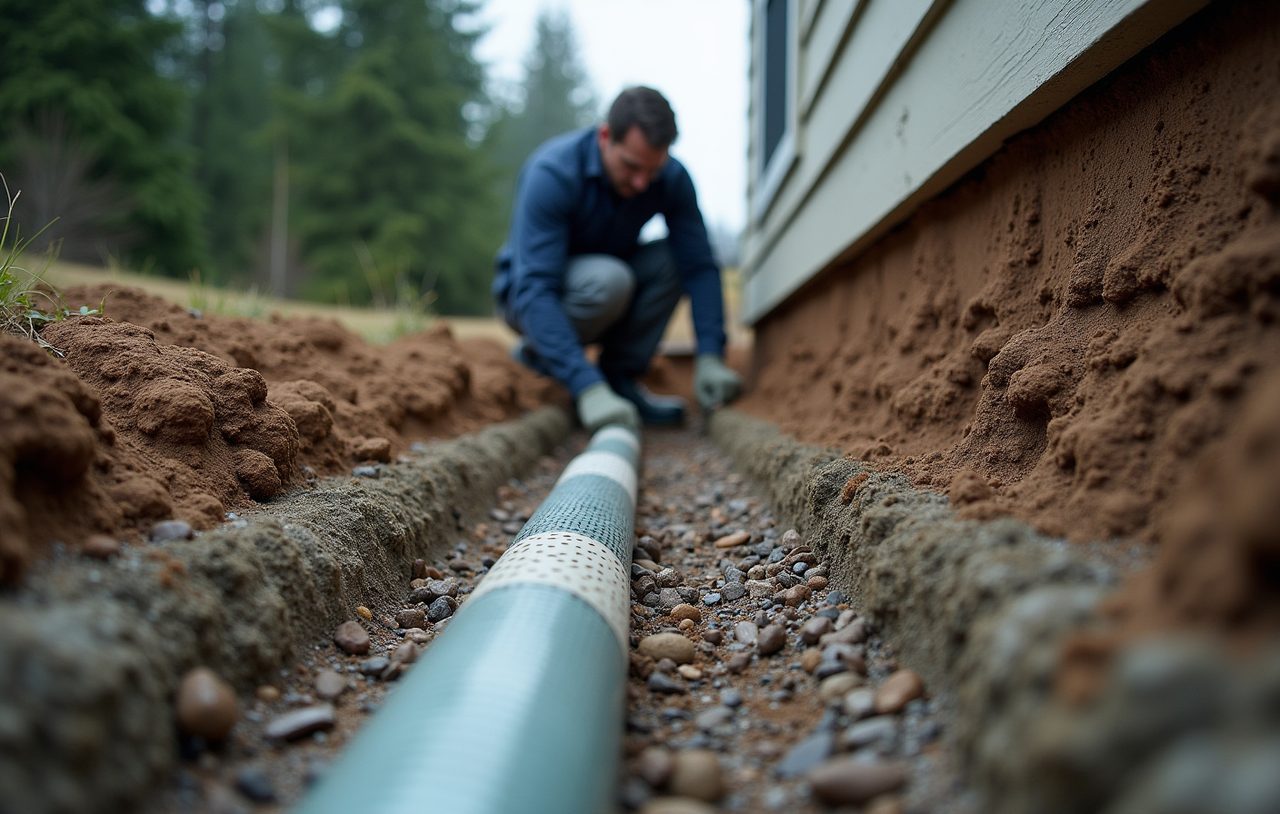
The perforations point down. Water rises into the pipe from the rock beneath it, so holes at the bottom start moving water at the lowest level. Holes facing up mean the trench must fill before the pipe carries anything.
The rock is washed and angular. Clean drain rock has voids between the stones, and those voids are the reservoir feeding the pipe. Pea gravel packs tight; material carrying fines turns to concrete over a few winters.
The outlet decides everything. Gravity to daylight is best. Where a lot has no downhill, it ends in a basin with a sump system doing the lifting. A drain carries water off when the ground gives you somewhere lower to send it; a pump gets it out when it does not.
The details that decide whether it still works in five years
Nearly every failed drain we see failed the same way: it silted up. Fine sediment travels with the water, fills the voids in the rock, then the pipe, until the trench is a buried stripe of dirty gravel. Nothing looks broken. It just stops draining.
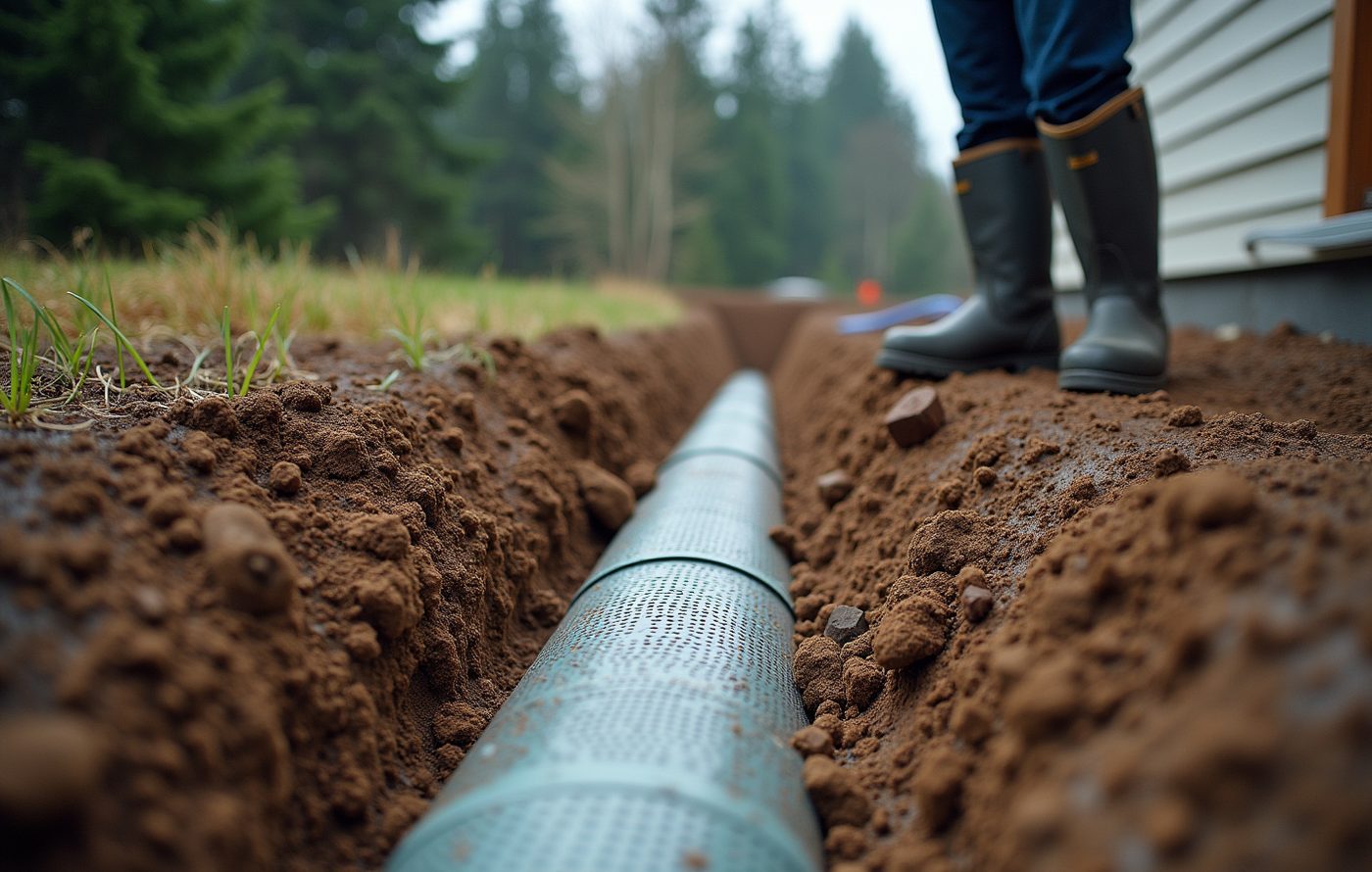
So the anti-silt details are structural, not optional. Fabric wraps the entire rock envelope, not just the pipe — a sock leaves the rock free to load up with fines. Which fabric matters as much as where it goes: a proper geotextile with a published flow rate belongs against drain rock, while the thin landscape fabric sold on a roll for weed control blinds off within a few seasons and turns the wrap into a liner. What goes on top matters too: a permeable cap lets surface water into a lawn drain, while a foundation drain gets a soil cap.
Access earns its keep years later. Cleanouts go in at the upstream end and any sharp bend, so the line can be flushed later without an excavator. Outlets get a rodent grate and sit above whatever they discharge into; an outlet the ditch can submerge becomes an inlet in the exact storm you needed it. That is the difference between a drain that runs for decades and one that buys four good winters.
Sometimes the cheapest fix is a shovel and a downspout
Three questions get asked on site before anyone quotes a trench, because they lead to very different bills.
- Is it surface water? Ground sloping back toward the house, a patio poured with the fall the wrong way, a raised bed damming the side yard. Regrading a few feet of soil beats a hundred feet of pipe.
- Is it roof water? One downspout emptying at a foundation corner concentrates an enormous volume in a single spot. Extensions and a solid buried line often settle it.
- Is it groundwater? Water arriving under pressure from uphill, in the same place every winter, largely ignoring what the sky did that week. That is what a french drain is for.
A fourth possibility costs nothing to rule out. Water under a house does not always come from the sky: a weeping supply line keeps a crawl space damp all year while the yard stays normal, and the tell is a patch that ignores the weather. The move then is to find it with listening gear before anyone rents an excavator. Older houses may have a footing drain that has merely plugged, worth flushing first.
Alderwood soil, and rain that never quite stops
Two local facts explain most of the drainage work we do, and neither is about how much rain falls. The first is what sits under the lawn: much of Snohomish County is Alderwood soil, established here in 1936 and underlain by dense glacial till. The second is the shape of the rain.
| Condition | Measured figure | What it does at your foundation |
|---|---|---|
| Perched water table, Alderwood series | 12–35 in deep, Dec–Apr | Groundwater sits at footing depth for five months |
| Dense glacial till below | 20–39 in down | Water cannot sink through it, so it goes sideways |
| Days a year with measurable rain | 178 days | One day in two; the ground rarely dries |
| Days with 0.10 in / 0.50 in or more | 92 / 16 days | Frequent light rain, not cloudbursts |
| Total annual precipitation | 33.37 in | A modest total, delivered the most soaking way |
| Share falling October–March | 23.20 of 33.37 in (70%) | Lands when the soil can least absorb it |
| Wettest against driest month | Nov 4.97 in vs Jul 0.84 in | Faults surface in late autumn |
A water table perched a foot down all wet season is not deep and abstract; it is level with your footings and crawl space vents. Arriving as 178 damp days rather than a few downpours, that rain never gives the soil a dry stretch to shed what it holds.
How the install runs, from locate to backfill
We design backwards, from the end of the pipe. Nothing upstream can be laid out until we know where the water is allowed to come out, so the first walk of a property goes to low ground, ditches, and whether a discharge lands your water on somebody else. Yard drainage never enters the sanitary sewer, and jurisdiction stormwater rules get checked before the shovel leaves the truck.
Public locates are free and take a couple of days, so we book them at quoting time and hand-probe for the lines nobody marks. Grade is shot with a level, so the fall is a number rather than an opinion.
Where we dig gets painted on the ground first, so you can see the line before a machine touches anything. Trenches stay as narrow as the work allows, and we switch to hand digging near tree roots, shallow irrigation and anything the locate flagged. Excavation follows the marked line, spoil goes into the truck rather than onto your lawn, and the trench bottom is cut and rechecked before anything goes in. Filter fabric goes down first and stays wide, then bedding rock, pipe with the perforations down, more rock, the fabric folded over the top, backfill in lifts, cleanouts set flush. Then we run a hose in the high end so you watch water leave the outlet before we do.
Putting the landscape back is part of the job rather than an afterthought. Sod lifts in strips and goes down again over the backfill, beds get their bark returned, and pavers pulled for the run are reset instead of stacked by the fence. A trench through a lawn settles for a season however well it is compacted, so we come back and top it up rather than leave you a sunken stripe over the new drainage line. If the yard needs a second dig later — another outlet, a downspout tie-in — we make that call with you while the machine is still on site, because coming back is the expensive part.
Afterwards the line asks very little of you. Walk to the outlet after the first hard autumn rain and check that water is genuinely coming out of it, then clear the grate of leaves and whatever grass has grown across it. Every few years, or sooner if the flow at the outlet drops off, we flush the run from the upstream cleanout — that is exactly what those cleanouts were put there for. Drainage that gets rinsed out occasionally lasts decades; drainage nobody ever looks at silts up quietly and only announces itself when the crawl space smells wet again.
There is no honest published figure for the drain itself — length, depth, what the trench runs into and the type of outlet all move it — so the price is written after the site visit. Where gravity cannot do the work, the pump portion prices like a sump installation: $889 to $1,667 per Angi’s Seattle figures, $1,200 to $2,800 per HomeBlue’s Everett figures, the higher end being a new basin excavated rather than one reused. Sources: Angi, Seattle metro; HomeBlue, Everett WA; both pulled Aug 2026. Ranges shown, not averaged.
Why us
The trench is only as good as where it ends.
Danika Plumbing & Electric is licensed, bonded and insured, registered with Washington State L&I, and run from a shop on Airport Road in Everett. Drainage sits between landscaping and plumbing, and being plumbers keeps us honest about the outlet.
(425) 374-1557Licensed & bonded
WA State L&I registered, insured, accountable.
Written price up front
Quoted after we walk the lot, never guessed from a photo.
Pump side handled
Basin, float, discharge and its circuit, one crew.
Tested before we leave
Water in the top end, water out the outlet, while you watch.
Coverage
Lots we drain, town by town
The trucks run from 11015 Airport Road in Everett out to Mukilteo, Lynnwood, Edmonds, Mountlake Terrace, Mill Creek, Marysville, Lake Stevens, Snohomish and Monroe, plus the ground between them. Inside the city there is a dedicated page on french drain installation in Everett, and the rest of the trade sits on the main plumbing services page.
Straight answers
What homeowners want to know before we break ground
Will a french drain fix a wet crawl space?
How deep does a french drain have to be?
Do I need a sump pump with my french drain?
How much does french drains cost in Everett?
Can I run my downspouts into the french drain?
Drainage problems announce themselves at the worst time of year.
Groundwater damage is one of the things a homeowner’s policy generally will not touch, and the winter that proves you need a drain is rarely the one you budgeted for. Financing keeps the properly built version on the table.
Point the water somewhere it cannot hurt the house.
We walk the lot, work out where it comes from, and price the fix that matches the cause.
Licensed · Bonded · Insured · WA L&I Registered · 11015 Airport Road, Everett, WA 98204