Most tank water heaters last 8 to 12 years. Tankless units stretch to 18 to 22 with annual service. If yours is anywhere close to those numbers, the question is not whether it will need replacing but whether you will see it coming or find out in a cold shower in February. If you live off Silver Lake Rd or along 19th Ave SE in Everett, WA 98208, this is the point where you decide whether you are shopping for water heater repair in Silver Lake or for a new tank. The warning signs below are the same ones we see in garages and utility closets all over the Silver Lake and Eastmont area, and they show up in a fairly predictable order. If you already know the tank is done, our water heater installation and repair page explains how we handle the swap.
The seven warning signs, in order of how serious they are
- Age past design life. The manufacture date is on the rating plate, usually a sticker on the side of the unit. A standard tank past 10 years, or a tankless past 18, is living on borrowed time even if it still works.
- Rumbling or popping while it heats. That is sediment on the tank floor being cooked along with the water. Efficiency drops, energy use climbs, and the bottom of the tank takes the heat stress.
- Rust-colored hot water. Specifically when the cold runs clear and only the hot side is discolored. The anode rod is spent and the tank is corroding from the inside. Replacement is usually months away, not years.
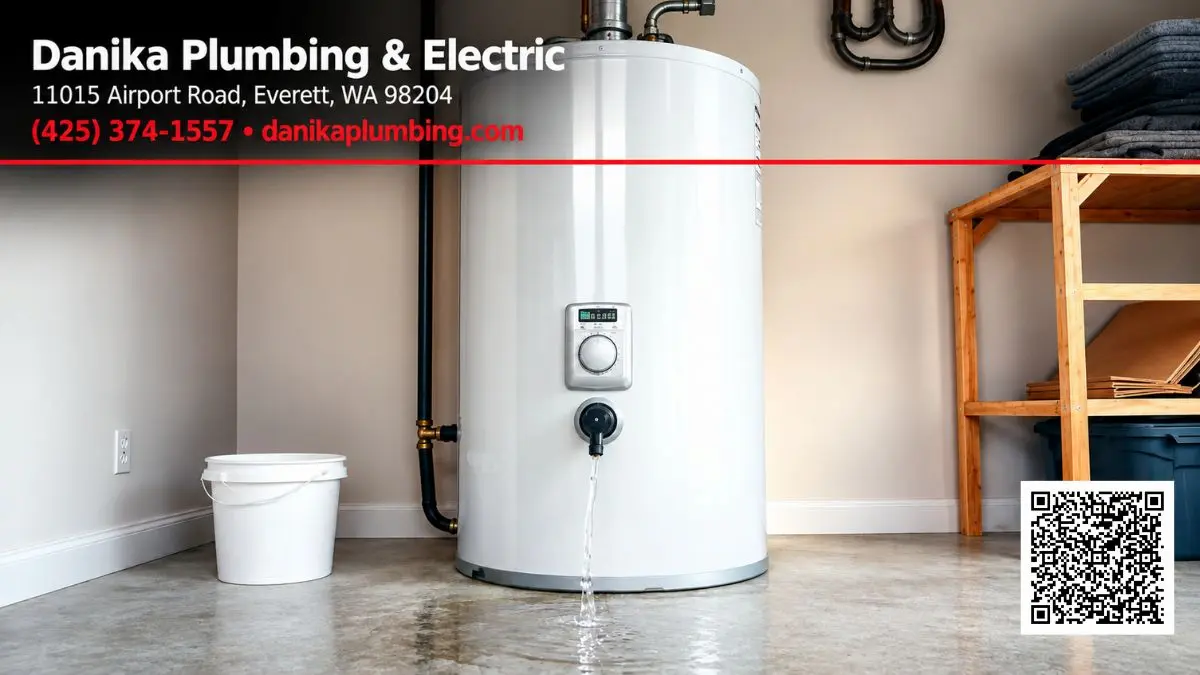
- Water at the base. Even a small puddle or a rust ring on the floor. Tanks rarely fail slowly. The early seep is the only warning you get before the slow leak becomes a fast one.
- Shrinking hot water supply. If a shower that used to last comfortably now runs cold halfway through, the dip tube has likely failed or sediment has taken up a serious share of the tank’s volume.
- Temperature swings mid-shower. Hot, then lukewarm, then hot again. On an electric unit that is usually a thermostat or element; on gas, often the gas valve. Repairable, but it tends to signal a unit in decline.
- Corrosion at the inlet and outlet fittings. Mineral crust or rust where the cold and hot lines meet the tank. Those are the most stressed connections, and if they look bad the rest of the tank usually matches.
Why water heaters age faster in Silver Lake and Eastmont homes
Two local factors move the timeline. The first is the water itself. Everett’s supply is on the softer side, but it still carries enough mineral to settle as sediment in a tank that is never flushed, and most of the tanks we open around Hauge Homestead Park have never been flushed. By year eight, that layer is thick enough to insulate the burner or lower element from the water it is supposed to heat.
The second is the plumbing feeding the heater. A good share of the housing between Silver Lake Rd and 112th St SE went up from the 1960s through the 1980s, and a lot of it still has original galvanized supply piping. Galvanized pipe sheds iron and scale into the water heater inlet, which eats the anode rod faster and accelerates internal corrosion. The same model of heater can last 15 years in a newer home on copper or PEX and 7 years in an older home still on galvanized. If you are seeing two or three of the signs above and the house has galvanized supply lines, you are closer to replacement than repair.
What to check before you call anyone
- Find the rating plate and write down the manufacture date. That single number decides most of what follows.
- Run the hot tap at a sink for a minute into a white cup. Then run the cold. Compare the color.
- Look at the floor around the base with a flashlight. Rust staining counts even if it is dry right now.
- Stand next to the unit while it heats and listen for rumbling or popping.
- Look at the fittings on top. Green or white crust, or rust streaks running down the tank, are worth a photo.
- Note whether the problem is one symptom or several. One symptom on a young unit is a repair. Three symptoms on an old unit is not.
Not sure which side of the repair-or-replace line you are on? Call Danika Plumbing & Electric at (425) 374-1557 or send us the details here and we will tell you straight what we would do with your unit.
When repair still makes sense, and when it does not
Water heater repair for Eastmont homes still makes sense in a specific situation: the unit is under 8 years old and the fault is one component. A thermocouple, a thermostat, an igniter, a gas valve, a single heating element. Those are routine part swaps that add years of useful life, and we would rather do that than sell you a tank you do not need.
Past 10 years, with any of the seven signs present, the math usually flips. You would be putting a new part into a tank whose lining is already going, and the leak that follows will not care how new the element is. That is the honest line we draw on water heater repair around Silver Lake and Eastmont: fix a part, replace a tank.
Two situations mean stop waiting. Visible water around the base, and hot water that is actively rust-colored. Both mean the tank itself has failed, and every day of continued use corrodes it further. A standard tank-for-tank replacement is usually a single visit, and Danika Plumbing & Electric handles the assessment and the install together. We handle water heater repair and replacement for homes around Thornton A. Sullivan Park every week, so none of this is new to us.
Signs you need a new water heater: FAQ
How long does a water heater last in a Silver Lake home?
A standard tank water heater typically lasts 8 to 12 years. A tankless unit that gets annual service can run 18 to 22 years. Check the manufacture date on the rating plate; a tank past 10 years or a tankless past 18 is on borrowed time regardless of how it seems to be running.
Is rusty hot water a sign I need a new water heater?
Usually, yes. If the cold water runs clear and only the hot side is rust-colored, the anode rod has been used up and the tank is corroding from the inside. That is not something a part swap fixes. Plan on replacement rather than repair, and do it before the tank starts leaking.
Can I keep using a water heater that has a small puddle under it?
Not for long. Tanks rarely fail gradually. A small puddle or rust stain under the unit is the early warning before a slow leak becomes a fast one. Shut off the water supply to the heater if the leak grows, and arrange replacement right away rather than waiting to see what happens.
Talk to us before the tank decides for you
Danika Plumbing & Electric, 11015 Airport Rd, Everett, WA 98204. We are a few minutes from Silver Lake and serve Silver Lake, Mill Creek and Casino Road homes from the Paine Field side of town, including everything between Green Lantern Park and the lake. Call (425) 374-1557 or request a visit online and we will tell you whether your heater needs a part or a replacement.