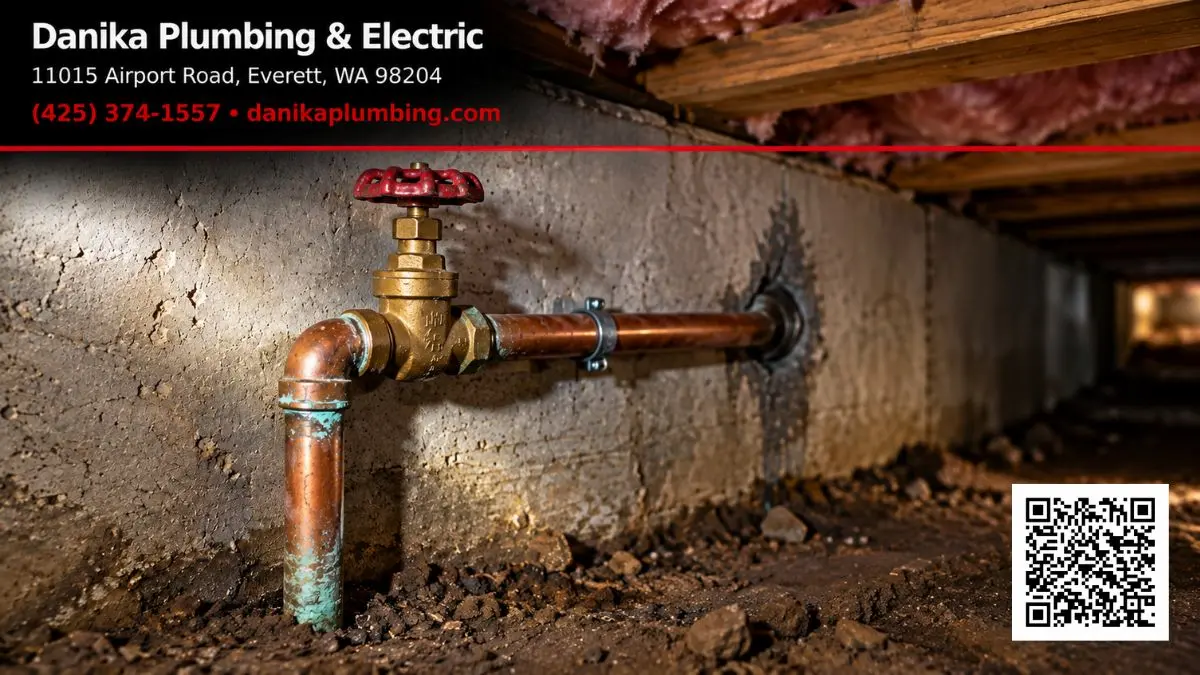
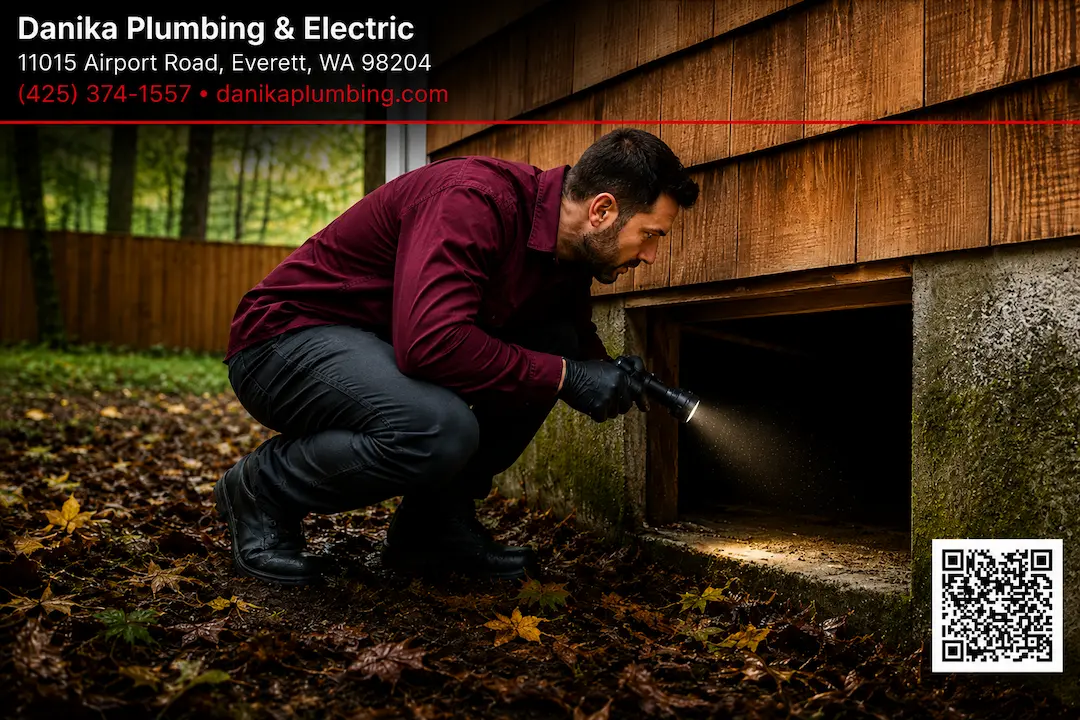
Somebody pulls the crawl space hatch off in November, shines a flashlight in, and finds water in the crawl space. That’s usually when we get the call. And the first question is almost always the same one: is that water in a crawl space normal, or is my house in trouble?
Fair question. In Snohomish County the honest answer is “it depends on what kind of water it is” — which sounds like a dodge until you understand that groundwater and a leaking supply line look identical from three feet away with a flashlight, and they cost wildly different amounts to deal with.
The short version
Damp soil and a little condensation under a Western Washington house in winter? Common. Puddles that show up after a storm and are gone in a few days? Worth watching, probably a drainage problem. Standing water that never really leaves, or water that’s there in July when it hasn’t rained in two weeks? That’s not groundwater doing its seasonal thing — that’s usually a plumbing leak, and the meter will tell you in about twenty minutes.
Either way, water sitting under a wood-framed floor is not something to leave alone for a season and see what happens.
Is it normal to get water in your crawl space?
“Normal” is doing a lot of work in that sentence. Most crawl spaces in Everett see some water in a crawl space during the wet months without it being a problem — the question is how much, and whether it’s standing or just soil that’s damp to the touch.
Damp is normal here. Most of the older homes we work in around Everett sit on glacial till — dense, compacted soil that doesn’t drain much. Snohomish County averages about 41 inches of rain a year, and most of it lands between October and May. Water hits the till, can’t go down, and moves sideways instead. Add a lot of lots that slope toward the house rather than away from it, and you get crawl spaces where the dirt is dark, cool, and slightly damp for months. Unpleasant to crawl through. Not, by itself, a structural emergency.
Standing water is a different animal. An inch of water pooled under your floor joists means something is delivering more water than the ground can take away, and it’s going to keep doing it. We’ve seen the same puddle in the same corner of the same house three winters running because nobody ever traced it back to the downspout dumping six inches from the foundation.
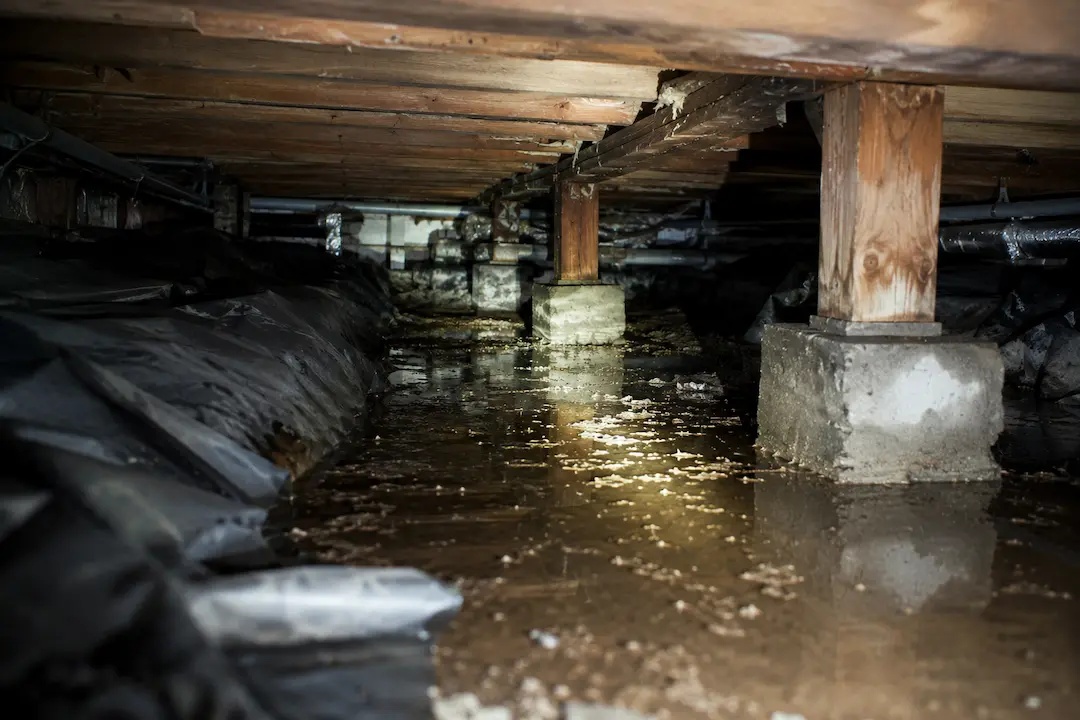
The rough test we use: if you can press a hand into the soil and it comes up muddy, that’s a moisture-control conversation. If you can see your flashlight reflect off a surface, that’s a water-intrusion conversation.
How do you tell groundwater from a plumbing leak?
This is the part most crawl space articles skip, and it’s the part that actually decides who you should be calling.
A few tells that point at plumbing rather than weather:
- The water shows up in dry weather. Groundwater is seasonal. A supply leak doesn’t care what month it is.
- It’s clear and it’s warm. Warm water under a house is a hot-side leak, full stop. Nothing about rain is warm.
- It’s concentrated under a bathroom, kitchen, or laundry. Groundwater tends to collect at the low point of the crawl space. A leak collects under the fixture that’s leaking.
- The water bill climbed and nobody changed their habits.
The confirming test is simple enough to do yourself. Shut off every fixture and appliance in the house, then go read the water meter — write down the numbers, wait an hour with nothing running, read it again. If it moved, water is going somewhere it shouldn’t. That test has saved a fair few homeowners in this town from paying a drainage contractor to solve a problem that was really a cracked poly line.
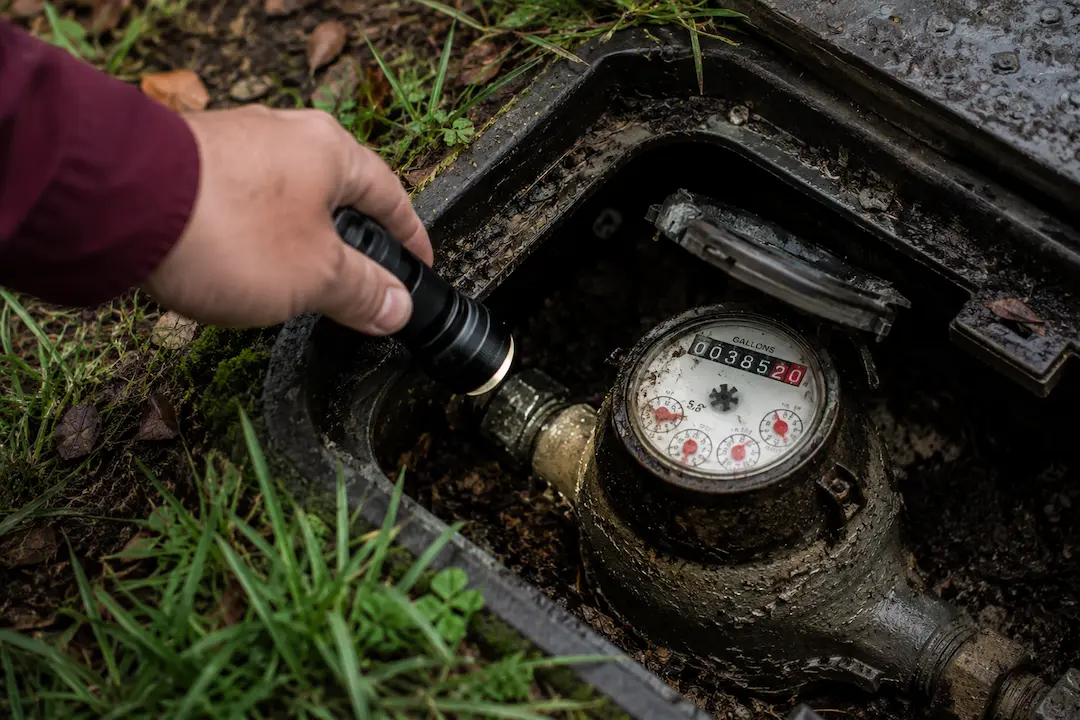
And if it didn’t move? Then you’ve got weather and dirt, and the fix lives outside the house — gutters, downspout extensions, grading, perimeter drainage.
How do you get rid of standing water in a crawl space?
Order matters here, and most people do it backwards.
Get the water out first — a wet/dry vac for a small amount, a utility or transfer pump for anything real. Then dry it: fans moving air across the soil, a dehumidifier if the space is closed enough to hold conditioned air. Wet insulation needs to come out rather than dry in place; fiberglass that’s been soaked stops insulating and starts holding moisture against the subfloor.
Then — and this is the step people skip — find the source. Pumping out a crawl space without fixing why it filled is a chore you’ve just signed up to repeat every winter. We’ve met homeowners who’d been vacuuming out the same space for six years.
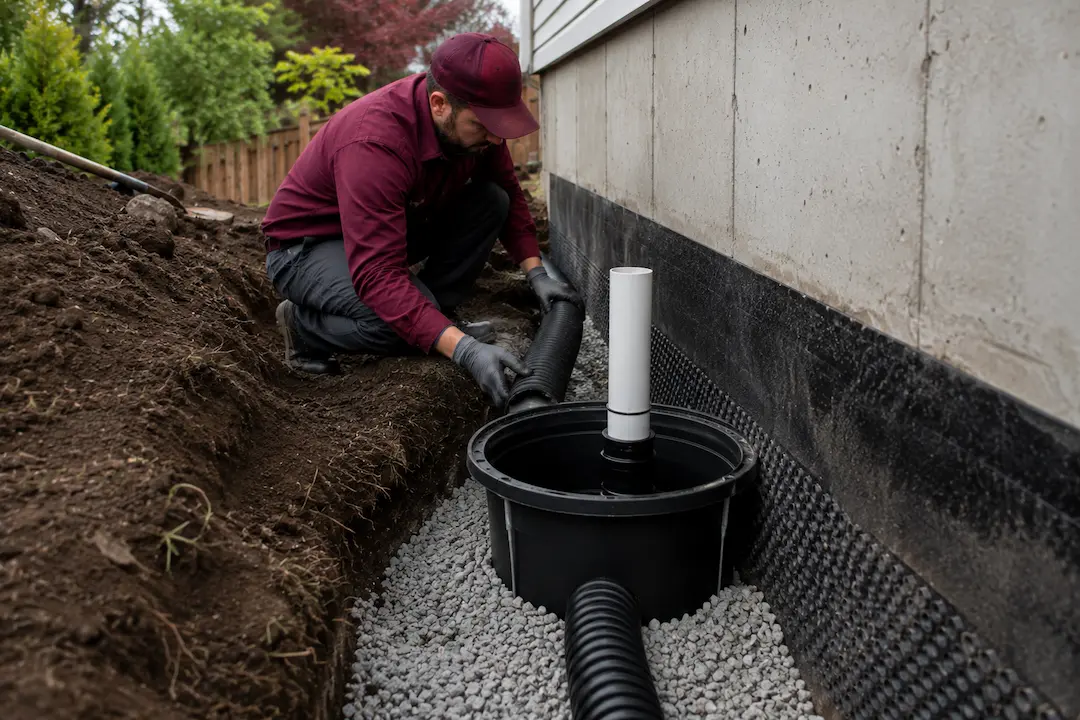
If the source is groundwater and grading alone won’t do it, the usual answer is a drainage system that gives the water somewhere to go: perimeter drain to daylight where the lot allows it, or an interior collection point and a pump where it doesn’t. Which one depends on your slope, and honestly you want somebody to look at it in person rather than guess from a photo.
What if there’s too much water in a crawl space?
Don’t go in.
Standing water in a crawl space frequently sits near electrical junctions, and there’s often ductwork and gas piping down there too. If there’s enough water in the crawl space that you’d call it flooded, kill the power to that part of the house at the panel if you can do it safely, leave the hatch open for air, and call somebody. Same goes if you smell sewage rather than just damp earth — that’s a drain or sewer failure, not a rain problem, and it’s a health issue, not just a dampness one.
If there’s an active leak you can identify, shut the main off. That one action stops a lot of damage while you’re waiting on anybody.
Will homeowners insurance cover it?
Generally speaking, policies in this region treat sudden and accidental water damage differently from gradual seepage. A pipe that burst last Tuesday tends to be a different conversation with an adjuster than a crawl space that’s been slowly taking on groundwater since 2019. Surface water and flooding are commonly excluded from standard policies altogether.
We’re plumbers, not adjusters, so read your own policy or call your agent before you assume either way — coverage varies more than people expect, and the difference usually comes down to how the loss is documented. Photograph everything before anybody starts pumping.
What does it cost to fix?
Wider range than any honest answer would like.
Extending a downspout and regrading a low spot is a weekend and a trip to the hardware store. Repairing an accessible supply-line leak is a service call. Installing a full perimeter drain with a pump under an existing house is a real project, priced by the linear foot and by how hard your crawl space is to move around in — and a 30-inch crawl space costs more to work in than a 4-foot one, because everything takes longer on your back.
Anyone who quotes you a firm number for crawl space water before looking at the crawl space is guessing. Get eyes on it.
Questions we get asked a lot
Will the water dry out on its own?
Some of it will evaporate. But it evaporates upward, into your floor joists and subfloor and eventually your living space, which is how a drainage problem turns into a musty-smell-in-the-hallway problem. Evaporation isn’t drainage.
How fast does mold or rot actually become a concern?
Mold can establish on damp organic material within a couple of days given the right temperature; wood rot is a slower, months-and-years process that needs sustained moisture. The short answer is that a wet weekend won’t rot your joists, and a wet decade absolutely will.
Isn’t the plastic sheeting supposed to stop water in a crawl space?
The ground cover is a vapor retarder — it slows moisture evaporating up out of the soil. It was never designed to hold back liquid water, and water running under it can actually be harder to spot because the plastic hides it. Worth noting that vapor retarder ground cover is a code requirement for crawl spaces in Washington, so if yours is missing or shredded, that’s worth raising with whoever inspects it.
Can you put a sump pump in a crawl space, or is that a basement thing?
You can, and around here it’s fairly routine. It needs a proper basin, a discharge route that doesn’t just recirculate the water back toward the house, and a float switch that someone actually checks once a year.
How often should I be looking down there?
Twice a year is a reasonable habit — once in late fall before the rain settles in, once in spring. Five minutes with a flashlight, looking for standing water, wet insulation, and anything dripping. Most of the bad crawl space situations we get called into were quietly developing for years.
Not sure which kind of water you’re looking at?
That’s a reasonable place to be. If there’s water in a crawl space and you can’t tell whether it’s rain or a leak, send us a photo, or better, let us come look — the meter test and a walk around the outside of the house usually sorts groundwater from plumbing in one visit, and knowing which one you’ve got tells you whether you need a plumber or a shovel.
Danika Plumbing & Electric
11015 Airport Road
Everett, WA 98204
(425) 374-1557
office@danikaplumbing.com
License # DANIKPL839PF
Related reading
- The crew that covers Everett
- Perimeter drainage, designed and installed
- Sump pump installation and repair
- Tracking down a leak you can’t see
- What a hard Northwest rain does to a drainage system
- Moving roof and yard runoff away from a foundation