Will frozen pipes thaw on their own? Sometimes, yes. A frozen pipe in a spot that’s about to warm up will often let go by itself once the temperature climbs. The catch is that “it thawed” and “it’s fine” are not the same sentence, and the gap between them is where most of the damage we see actually happens.
Will frozen pipes thaw on their own? Sometimes, and that’s the trap
Ice in a pipe is a blockage and a pressure problem at the same time. As water freezes it takes up more room, and the squeeze lands on whatever is weakest: a joint, a fitting, a thin spot in an old run of copper. A pipe can crack while it’s frozen and sit there perfectly dry, because the ice itself is plugging the hole.
Then the afternoon warms up, the plug melts, and the water that was politely holding still starts moving again. That’s usually when somebody hears a hiss inside a wall, or notices the ceiling in the room below has gone a shade darker.
We had a client last winter who figured they could wait it out instead of calling for help. Three days later they were dealing with burst pipes in their basement. A thaw can look like good news right up until it isn’t.
So, will frozen pipes thaw on their own? The honest answer is: let nature do the thawing only when you’re prepared to be standing nearby, with the main shut-off found and a way to use it, while it happens.
Is it actually frozen? Check before you do anything else
A faucet that won’t run isn’t automatically a frozen pipe. A few quick checks sort it out in about five minutes.
- Turn on a cold tap and a hot tap at the same sink. Only one dead? That points to a freeze on that side of the supply.
- Walk to a few other fixtures. If everything is dry or barely trickling, the problem may be near where the water enters the house. If it’s just one bathroom, you’re probably dealing with a run on an outside wall.
- Look at the pipe you can reach. Frost on the surface, weaker flow than usual, or a section that’s cold to the touch compared with its neighbors all tell you something.
- Listen. Banging, gurgling or whistling can mean water struggling past a frozen section. Water sounds or fresh stains where nothing is running mean stop reading and go find the main shut-off.
If you don’t know where yours is, we wrote a separate piece on that, linked below. It’s worth finding on a calm day, not this one.
Will frozen pipes thaw on their own? Where it goes wrong in an Everett house
Everett winters are milder than a lot of the country, which is exactly why our houses get caught out. Plenty of homes here weren’t built or insulated with a hard freeze in mind, so the first real cold snap finds every weak point at once. In our experience the usual spots look like this:
| Where | What we usually find |
|---|---|
| Crawl space | Exposed supply lines with little or no insulation |
| Garage | Exposed supply lines that never get warm air from the house |
| Exterior walls | Kitchen or bathroom runs along outside walls that never get warm air from the room |
| Outdoor spigots | A hose left attached, holding water in the last stretch of pipe inside the wall |
| Empty homes | Homes left empty with the heat turned down, nobody there to notice the first dry faucet |
Mill Creek, Lynnwood, and the hillier parts of Snohomish County vary a little, but the pattern is the same. Pipes in unheated, unlit corners go first.
Warming it up without making things worse
Will frozen pipes thaw on their own faster with a little help? Yes, but only if the help is gentle. If you’ve checked, the pipe is reachable, and you can’t see or hear any leak, a slow thaw is reasonable. Slow matters more than fast.
- Find your main water shut-off before you start and be ready to close it (clockwise until tight). If you see or hear water you can’t account for, close it right away.
- Open the faucet nearest the frozen section, hot and cold. That gives melting water and any trapped pressure somewhere to go.
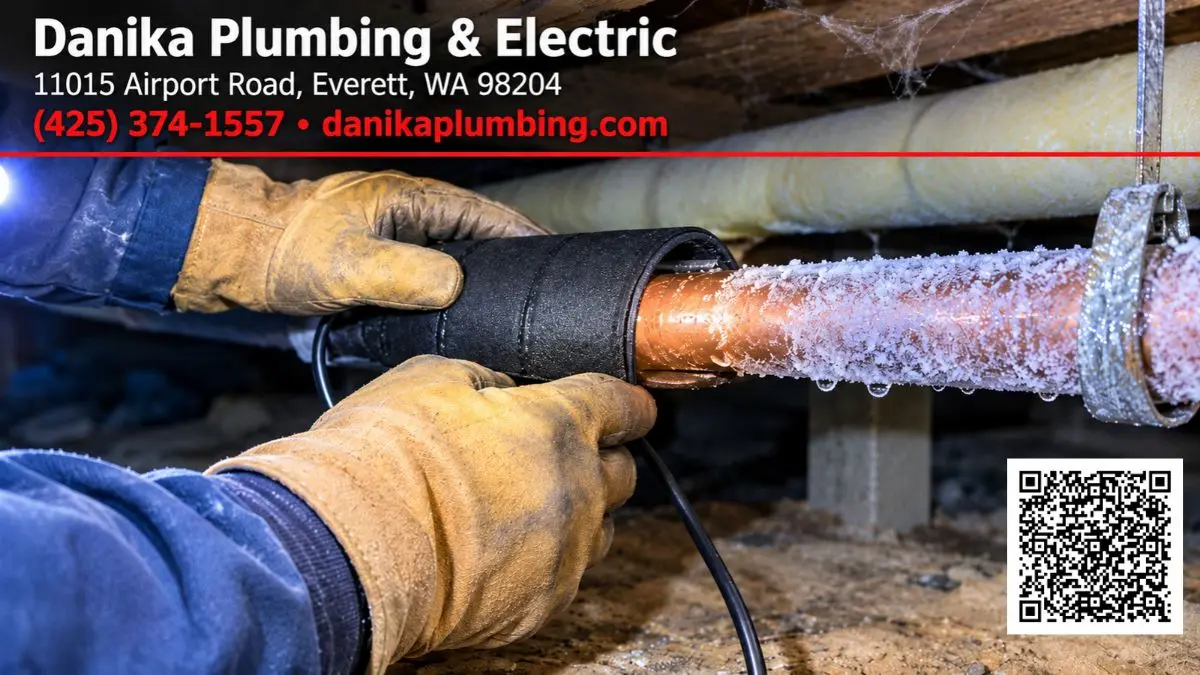
- Start warming the pipe at the end closest to the open faucet and work back toward the blockage. A hair dryer used gently or an electric heating pad wrapped around the pipe both do the job.
- Keep going patiently. It can take a while, and rushing is how people create new problems.
- Once water starts flowing, keep the tap open and watch the thawed section for drips or leaks.
What we’d keep out of your hands: open flames of any kind, blowtorches included, and any other high-heat source. Fixing a frozen pipe that way rarely ends well.
If it already split
You’ll usually find out in one of two ways: water coming from a wall or ceiling when the ice lets go, or a wet spot in the crawl space that wasn’t there yesterday. Either way, the sequence is short. Main off. Open your lowest faucets to relieve pressure and drain water out of the lines.
After that, call someone. A cracked line behind drywall isn’t a weekend project, and finding where the water actually went can take more than a flashlight. Damage in a wall cavity often outruns what’s visible on the surface.
Where to go next
If you’re reading this with a hair dryer in one hand, these pages are what we point people to afterward:
- For the day-to-day side of Everett plumbing, a plumber who knows Everett’s old crawl spaces is who answers the phone.
- If the thaw turned up water where it shouldn’t be, there’s help with locating the hidden damage after a thaw.
- For a line that did split, here’s what goes into repairing a split pipe.
- When this happens at 2 a.m., the after-hours plumbing help line doesn’t mind the clock.
- Not sure where to find the valve? We covered where the main shut-off hides in most houses.
- And for next winter, the full winterizing checklist covers prevention, which this piece deliberately doesn’t.
Cold-snap questions we keep getting
Will pipes freeze if the house is 70 degrees?
Pipes inside a heated, insulated part of the house generally won’t. But the thermostat reading in your living room says nothing about a crawl space, an exterior wall cavity, or the cabinet under a sink on the north side. We’ve seen warm houses with one frozen run, always in the one place the heat never reached.
How long can a pipe stay frozen before it bursts?
There’s no reliable number we’d give you, and anyone offering one is guessing. It depends on the pipe material, how long and how cold it’s been, and how weak the pipe was beforehand. The more useful rule: a frozen pipe has already used up some of its margin. Treat it as a repair waiting to be checked, not a problem that waits for you.
Hot tap or cold tap for the trickle?
Cold is enough when you’re trying to keep a vulnerable line moving through a freeze. Moving water is harder to freeze than still water, which is the whole idea behind the trickle. It’s a stopgap for one bad night, though, not a plan for the week.
Does pouring something down the drain thaw a frozen pipe?
Not really, and we’d skip it. Chemical drain cleaner won’t fix a frozen line, and it can damage PVC and corrode older pipe.
When the ice wins the first round
Will frozen pipes thaw on their own when the section is out of reach? Don’t count on it. If it’s still solid after you’ve worked at it, if the frozen section is somewhere you can’t reach, or if you’re hearing or seeing water you can’t account for, that’s the moment to stop and call. We thaw lines with professional pipe thawing equipment, and we’ll pressure-test the line afterward to find any split the ice left behind, which is the part a hair dryer can’t do.
Call us at (425) 374-1557 or email office@danikaplumbing.com, and have the location of your main shut-off ready. Tell us which sections are frozen and what you’re seeing. Any figures for time or cost are things we’d confirm after seeing the job, not guess at over the phone.
Danika Plumbing & Electric
11015 Airport Road, Everett, WA 98204
Phone: (425) 374-1557 |
office@danikaplumbing.com
License # DANIKPL839PF