The shower turns into a drizzle. The kitchen faucet takes forever to fill a pot. And it’s not one tap — it’s every tap, all at once, in a house that had perfectly fine pressure last week.
When the whole house drops together, that’s actually useful information. One weak faucet means a clogged aerator or a tired fixture. Every fixture weak at the same time means the problem sits somewhere upstream of all of them — and there are only a handful of places it can hide. We’ve chased this exact complaint through Everett homes from the Riverside blocks up to Silver Lake, and the diagnosis usually lands in the same short lineup.
Before you dig in — related reading
Worth a look alongside this article, depending on where your search leads:
- If the weak flow turns out to be a hidden leak, non-invasive leak detection finds it without tearing walls open.
- Only one fixture acting up? Start with our piece on low pressure at just the kitchen sink — different problem, different fix.
- A pressure drop paired with a bill spike is a classic combo — here’s what makes a water bill climb for no clear reason.
- Corroded or damaged supply lines call for pipe repair and replacement rather than another band-aid.
- For older homes where the pipes themselves are the bottleneck, a full repiping service is the permanent answer.
- Or skip the detective work and have our plumbers here in Everett put a gauge on it.
The 30-Second Answer
A sudden, whole-house pressure drop almost always traces to one of five things: a failing pressure-reducing valve (the number-one culprit in homes that have one), a main shut-off valve that isn’t fully open, a leak somewhere between the meter and the house, corroded old supply pipes finally choking down, or the city working on the lines in your neighborhood.
The fastest way to narrow it down costs nothing: ask a neighbor. If their pressure dropped too, it’s the utility — sit tight. If theirs is fine and yours isn’t, the problem is on your side of the meter, and the two valves (main shut-off and PRV) are the first suspects worth checking before anyone starts opening walls.
Why Would the Whole House Suddenly Lose Pressure?
Here’s the lineup, roughly in the order we find them on real calls:
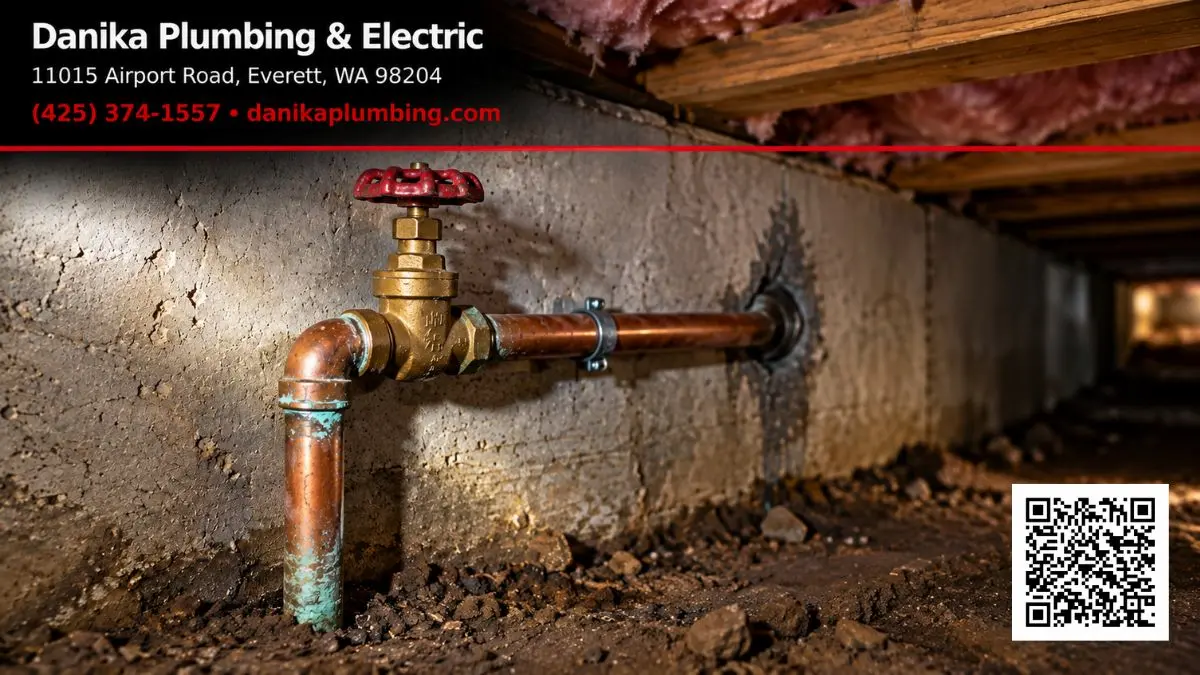
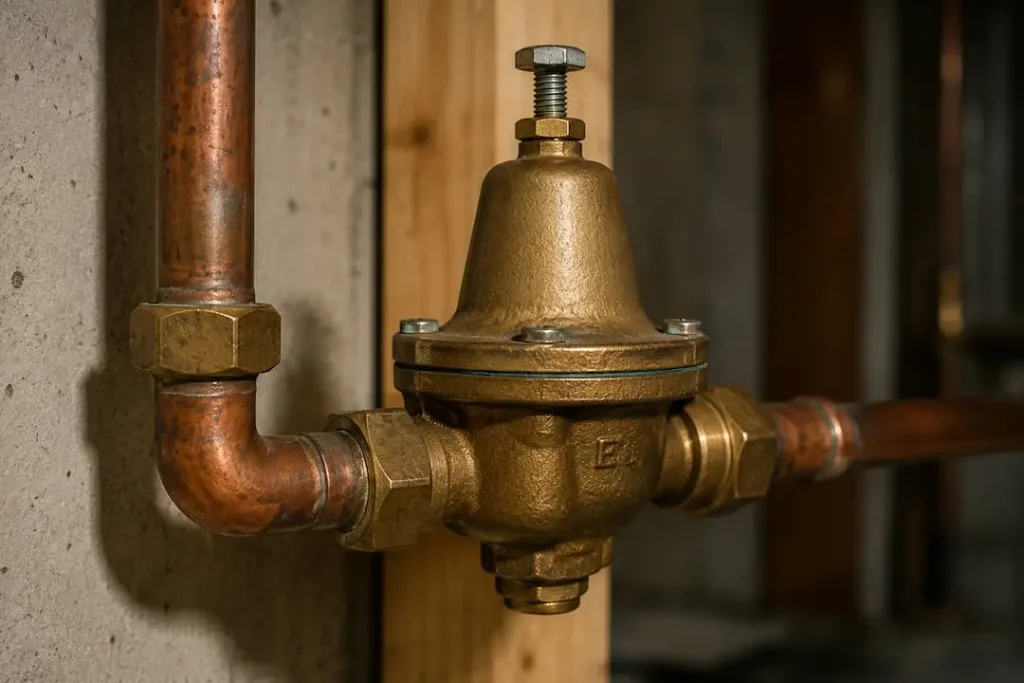
- A pressure-reducing valve on its way out. Most newer homes have a bell-shaped PRV near where the main line enters, taming street pressure down to something your fixtures can live with. They’re spring-and-diaphragm devices, and after ten to fifteen years the spring fatigues or the diaphragm fouls. When a PRV fails, it usually fails closed-ish — pressure everywhere sags at once.
- A main valve that got bumped. A shut-off that’s even a quarter turn shy of open throttles the entire house. It happens more than you’d think — after a water heater swap, a sprinkler winterization, a curious kid in the garage.
- A leak on your supply line. Water escaping underground between the meter and the foundation is water that never reaches your shower. A soggy patch of lawn that won’t dry out in July is a tell.
- Corroded galvanized pipe. Plenty of pre-1960s Everett houses — think the older blocks north of downtown — still carry water through original galvanized steel. It rusts from the inside, shrinking a ¾-inch pipe toward pencil-width over decades. That one usually feels gradual, but a flake of scale breaking loose can make it feel sudden.
- The city, not you. Hydrant flushing, a main repair down the street, or crews rerouting flow can all knock pressure down temporarily across a whole block.
We had a call last winter from a homeowner near Lowell convinced the city had cut his water down out of spite. Nope — his PRV had died at the ripe age of sixteen. One valve swap and his shower went back to behaving like a shower.
If It Is Only the Kitchen Sink
Check the aerator first. About 70% of the low-pressure kitchen calls we take end with a homeowner unscrewing the aerator, finding it half full of mineral deposits and grit, and the problem disappearing for free. Soak it in vinegar overnight, scrub it with an old toothbrush, screw it back on. Ten minutes, no parts.
We had a customer in Edmonds who was convinced she needed a new faucet installed. Her aerator was so packed with mineral deposits it looked like a science experiment. Five minutes of cleaning and her pressure was back, and she kept the few hundred dollars she was ready to spend.
If the aerator is clean and pressure is still low, the next step depends on whether the problem is the kitchen alone or showing up elsewhere too.
Kitchen only usually means the angle stop under the sink — the small valve where the supply line meets the wall — is partly closed or partly blocked. They corrode internally over time, particularly in older Everett homes still running their original 1960s–70s plumbing through Riverside and parts of Lowell.
House-wide points at something larger: a failing pressure-reducing valve at the main, a partly closed main shutoff, or the version we see most in 1950s–80s homes, galvanized supply lines that have narrowed internally by 30% or more.
One Everett note. Whole-house pressure that drops suddenly in winter is usually a partial freeze rather than a failure — but only if the temperature has been below 28°F in the last few days. Wrap exposed lines, open a faucet to a trickle, and check the crawlspace for visible ice. If the pressure was already low before the cold snap, that is a longer-term problem and not a freeze.
Is 40 PSI Too Low for a House?
Here’s the nuance worth getting right: 40 PSI isn’t actually a code number — it’s a comfort benchmark. Washington follows the Uniform Plumbing Code, and what the UPC actually requires is enough pressure to maintain at least 15 PSI of residual (flowing) pressure at your fixtures — a floor measured at the tap under load, not a static reading at the meter. In practice, though, 40 PSI is the level most plumbers treat as the low end of comfortable, and most homes feel best in the 45-to-60 PSI range. Dip toward or below 40 and you’ll notice it: showers lose their push, two fixtures running at once starve each other, and appliances like washers take longer to fill.
The other end is where code gets specific. Above 80 PSI of static pressure, the UPC requires a pressure-reducing valve, because sustained high pressure beats up fixtures, hammers pipes, and shortens water heater life. So the healthy target is a band — roughly 45 to 60, and never above 80.
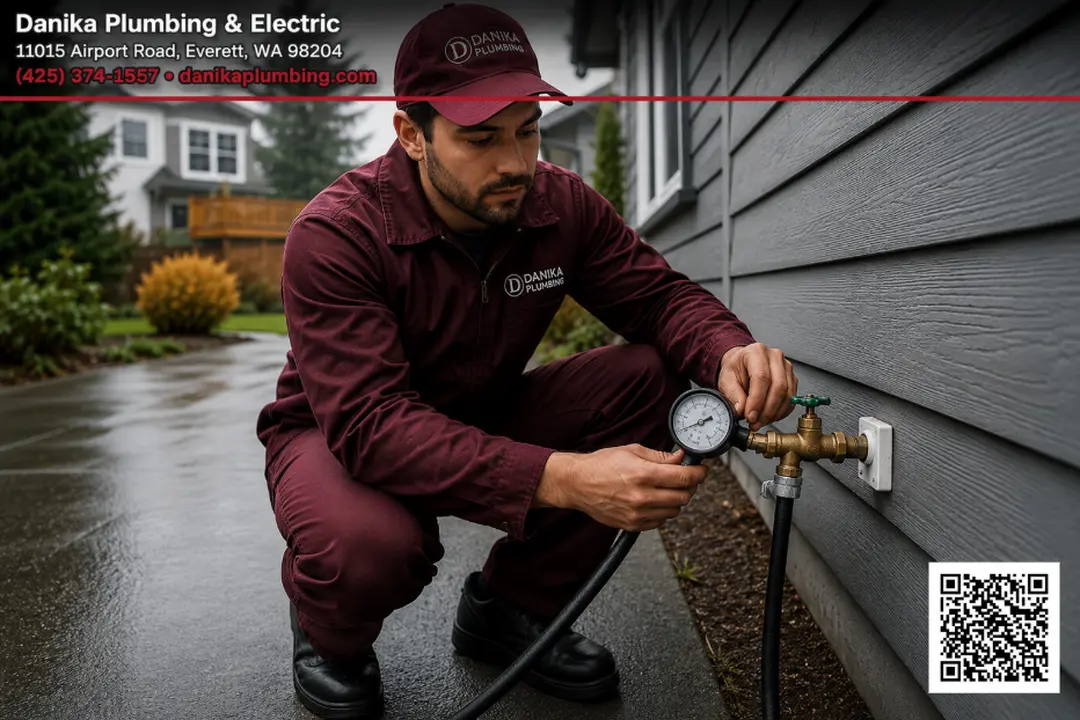
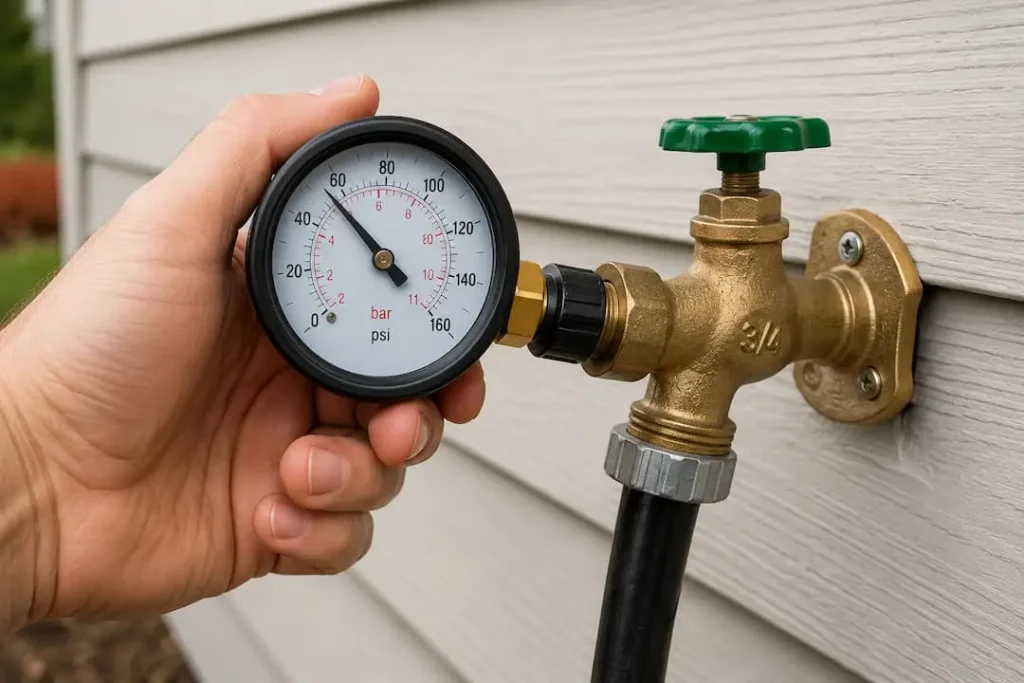
Want to know your actual number? A $15 gauge from any hardware store threads onto a hose bib. Screw it on, open the bib, read the dial. Do it once with everything off, then again with a shower running — a big drop between the two readings points at a restriction, like that corroded pipe we mentioned.
How Do Plumbers Actually Fix Low Water Pressure?
Not with guesswork, ideally. Here’s how the process runs when we take one of these calls:
- Gauge test first. Static pressure at a hose bib, then flowing pressure. Those two numbers split the problem in half — supply issue versus restriction — before anything gets touched.
- Check both valves. Main shut-off fully open? PRV holding its set pressure? A failing PRV shows itself on the gauge quickly.
- Rule out a leak. All water off, then watch the meter. A dial that keeps creeping means water is going somewhere it shouldn’t, and leak-detection gear takes it from there.
- Assess the pipes themselves. If the gauge says supply pressure is healthy but flow starves the moment a tap opens, the restriction is in the pipe — and in an older house, that’s very often internal corrosion.
The fix follows the finding: a PRV swap is a same-day job, a supply-line leak means excavating one spot, and corroded galvanized generally means repiping the affected runs. No single cure fits all of them, which is exactly why the gauge comes before the wrench.
Can You Boost Pressure to the Whole House?
Sometimes, yes — and sometimes you shouldn’t.
If you have a PRV, it’s adjustable. A turn of the bolt on top can bring a low-set valve up into that comfortable middle band. That’s the free option, and it’s the right one when the valve is healthy but set timidly.
If the street itself delivers modest pressure — which happens at higher elevations of a pressure zone — a booster pump is the real answer. It’s a small pump-and-tank package on the main line that lifts whatever the city gives you up to a steady target. Solid fix, but it’s the last resort, not the first: boosting pressure through corroded or leaking pipes just pushes harder on a problem.
One thing we’d steer you away from: cranking a PRV to its max to compensate for bad pipes. You end up with high pressure and low flow — the worst of both.
What Does Fixing It Usually Cost?
Depends entirely on which culprit you draw. Nationally, straightforward pressure repairs tend to land in the few-hundred-dollar range — a PRV replacement is one of the more affordable plumbing fixes there is — while booster pump installs commonly run into four figures, and repiping is its own larger conversation priced by the scope of the house. A buried supply-line leak sits somewhere in between depending on how deep and how far.
We’d rather not hang exact numbers on it here, because the honest answer starts with a gauge reading, not a price list. Any plumber quoting you a repipe before testing your pressure is skipping steps.
When It’s Everett’s System and Not Your House
Everett’s water comes off Spada Lake and moves through pressure zones on its way to your neighborhood — and pressure can dip legitimately when the city flushes hydrants or repairs a main nearby. Crews sometimes keep lines partially charged during repairs, which reads at your tap as weak flow rather than no flow.
The tells that it’s municipal: neighbors have the same problem, it started abruptly on an otherwise normal day, and it recovers on its own within hours or a day. If the drop lines up with visible utility work on your street, mystery solved. If it drags on past a day with no work in sight, a call to the city’s public works line settles it quickly — and if they say everything’s normal on their end, the ball is back on your side of the meter.
A Few More Questions We Hear
Why did my pressure drop overnight with no warning?
Overnight drops point at events, not slow decay: a PRV giving up, a new leak, or the city doing overnight line work (they often schedule it then). Slow fade over months points at corrosion or scale.
Is it low pressure or low flow? Does the difference matter?
It does. Pressure is the push; flow is the volume. A gauge showing healthy static pressure while your shower still dribbles means the pipes can’t deliver volume — a restriction. Weak gauge reading means weak supply. The fixes are completely different.
Could my water heater cause whole-house low pressure?
Only on the hot side. If cold taps run strong and hot taps run weak everywhere, the restriction lives at the water heater — often a sediment-clogged connection or a failing dip tube. Both sides weak means the problem is before the heater.
Does a whole-house filter or softener reduce pressure?
A clogged one sure does. If your home has a filtration unit and the pressure has faded since the last cartridge change, swap the cartridge before calling anyone. It’s the cheapest fix on this entire page.
Ready to Get Your Pressure Back?
A whole-house pressure drop is one of the more satisfying problems we solve, because it’s diagnosable — a gauge, a meter check, and a look at two valves usually name the culprit inside an hour. If your showers have gone limp, give us a ring and we’ll bring the gauge.
Danika Plumbing & Electric
11015 Airport Road, Everett, WA 98204
Phone: (425) 374-1557
Email: office@danikaplumbing.com
Washington License # DANIKPL839PF