The bill from the water district lands and it is a good chunk higher than the same month last year, with nothing in the house that would explain it. If you are off 164th St SE, in one of the subdivisions between Mill Creek Town Center and Highlands Park, the usual explanation is water leaving the house that you never saw. A water bill suddenly high with no change in how you live almost always means a leak or a fixture running on its own. This post covers the causes we find most often in Mill Creek, WA 98012 homes, a diagnostic you can run in half an hour, and the point where it makes sense to call a Mill Creek plumber instead of guessing.
Why this happens in Mill Creek Town Center homes
Most of the housing on either side of the Bothell-Everett Hwy and 164th St SE corridor went up between the late 1970s and the 2000s. That matters, because a house that age is old enough for its first round of rubber and plastic parts to be wearing out, but young enough that nobody has looked at them yet. These are the causes, in roughly the order they turn out to be the answer.
- A running toilet. The most common cause by a wide margin. A flapper that no longer seals lets water trickle from the tank into the bowl around the clock, and the fill valve keeps topping the tank up. It can be completely silent. A failing flapper can waste anywhere from a couple hundred to a few thousand gallons a day, which is enough to double a bill on its own.
- A leak on the service line. The pipe between the meter box at the street and the house runs under the lawn and the driveway. When it fails, the water soaks into the ground and the surface can stay dry for weeks. Lots near Highlands Park with deeper front setbacks have more buried pipe to worry about. This is the leak that water leak detection equipment exists to find, because nothing above ground gives it away until the bill does.
- Irrigation. Lawns and planting strips are the norm in this part of Mill Creek, and most of them run on automatic sprinklers. A zone valve that sticks partly open keeps running after the controller tells it to stop, and a cracked lateral under the turf leaks every time the system cycles.
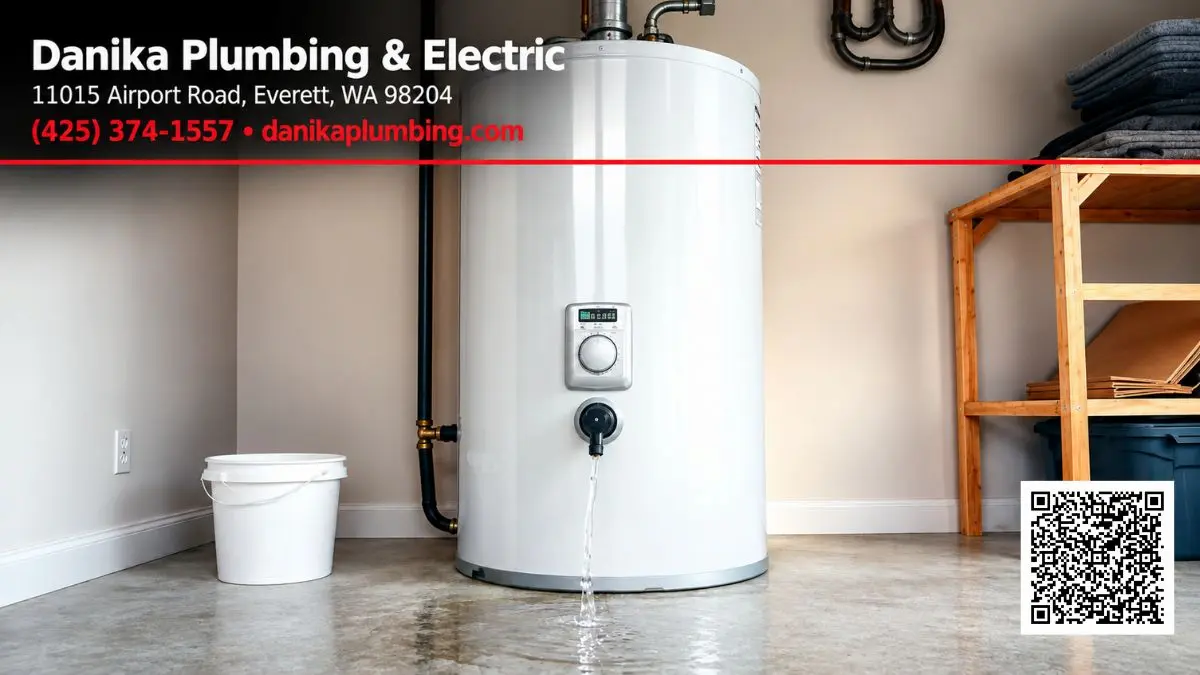
- A seeping water heater. A tank that has started to weep from the bottom usually drips into its pan, and the pan drains outside or to a floor drain, so you never see a puddle. The meter counts every gallon the tank replaces.
- More actual use. A new household member, a teenager who discovered long showers, a hose left on overnight. Rule it out before assuming a leak.
What to check first (before you call anyone)
Three steps, no tools beyond food coloring and a flashlight, about thirty minutes.
- Step one, the meter test. Turn off every fixture and appliance that uses water, including the irrigation controller and the ice maker. Find the meter box, usually in the planting strip or near the sidewalk at the front of the lot. Read the dial or watch the small leak indicator. Wait thirty minutes without running any water, then read it again. If it moved, water is leaving the supply side somewhere, and the faster it moved, the larger the leak. If it did not move, you are looking at a fixture that only runs sometimes, or at real use.
- Step two, the dye test. Put ten drops of food coloring in the tank of each toilet. Wait twenty minutes without flushing. If color shows up in the bowl, that flapper is leaking. Do this on every toilet in the house, not just the one you suspect. A running toilet you can hear is the easy kind; the quiet ones are the ones that show up on the bill.
- Step three, walk the irrigation. Run each zone manually from the controller and watch it. Look for a zone that will not shut off cleanly, heads that keep weeping after the zone ends, or patches of lawn that are greener and softer than the rest. Check the valve box and the backflow assembly for standing water.
If the meter kept turning and you have run out of places to look, call Danika Plumbing & Electric at (425) 374-1557 or book a leak diagnostic online. We are based at Paine Field, a short drive up the Bothell-Everett Hwy from Mill Creek.
When it is past DIY
The meter test tells you a leak exists. It does not tell you where. Once the toilets and sprinklers are cleared, what is left is pipe inside walls, under the slab, in the crawl space, or buried between the meter and the foundation. Finding it without opening anything up takes acoustic listening gear, thermal imaging and pressure isolation, which is work for a licensed plumber in Mill Creek, not a weekend project. Signs you are at that point:
- The meter moves with everything off and the toilets pass the dye test.
- A patch of lawn or the planting strip near the meter box stays soggy in dry weather.
- You hear water moving inside a wall when nothing is on.
- Warm spots on a slab floor, or a water heater pan that is never dry.
- Pressure at the fixtures has dropped at the same time the bill went up.
The buried service line deserves a separate mention. It is the leak homeowners wait longest on, because the yard looks fine and the house works normally. A plumber serving the 164th St SE corridor sees these on a regular basis, and the pattern is the same: two or three high bills, then a soft spot in the lawn, then a visible seep at the meter box. Catching it on the first bill means repairing a section of pipe. Catching it on the third can mean replacing the whole run. Many insurance policies also treat a sudden pipe failure differently from a slow leak that shows up over months of bills, which is one more reason to act early.
With detection equipment, a plumber for homes around Highlands Park can usually narrow the leak to a short stretch of pipe in one visit, so the repair opens one spot in the drywall or the yard instead of several.
Water bill suddenly high FAQ
How much higher does a water bill have to be before it means a leak?
There is no fixed number, because household use varies. Compare the bill to the same month last year, not last month, since irrigation season changes everything. If the bill is up by roughly a third or more and nothing about the household changed, run the thirty-minute meter test before you do anything else.
Can a running toilet really double a water bill?
Yes. A flapper that does not seal can waste hundreds to thousands of gallons a day, and it does it around the clock, including while you are at work and asleep. It is the single most common answer to a high bill in Mill Creek, and the dye test finds it in twenty minutes for the price of food coloring.
Does a high bill with a dry yard still mean a leak?
It can. A service line leak under the lawn or driveway can run for weeks before anything shows at the surface, because the soil absorbs the water. The same is true of a slab leak or a water heater pan that drains outside. If the meter moves with everything off, trust the meter over the dry ground.
Danika Plumbing & Electric, 11015 Airport Rd, Everett, WA 98204. We handle leak detection and repair across Mill Creek Town Center and the 164th St SE corridor, and out to Silver Firs and Martha Lake. Call (425) 374-1557 or send us the details through the contact page and we will get a plumber out to find where the water is going.