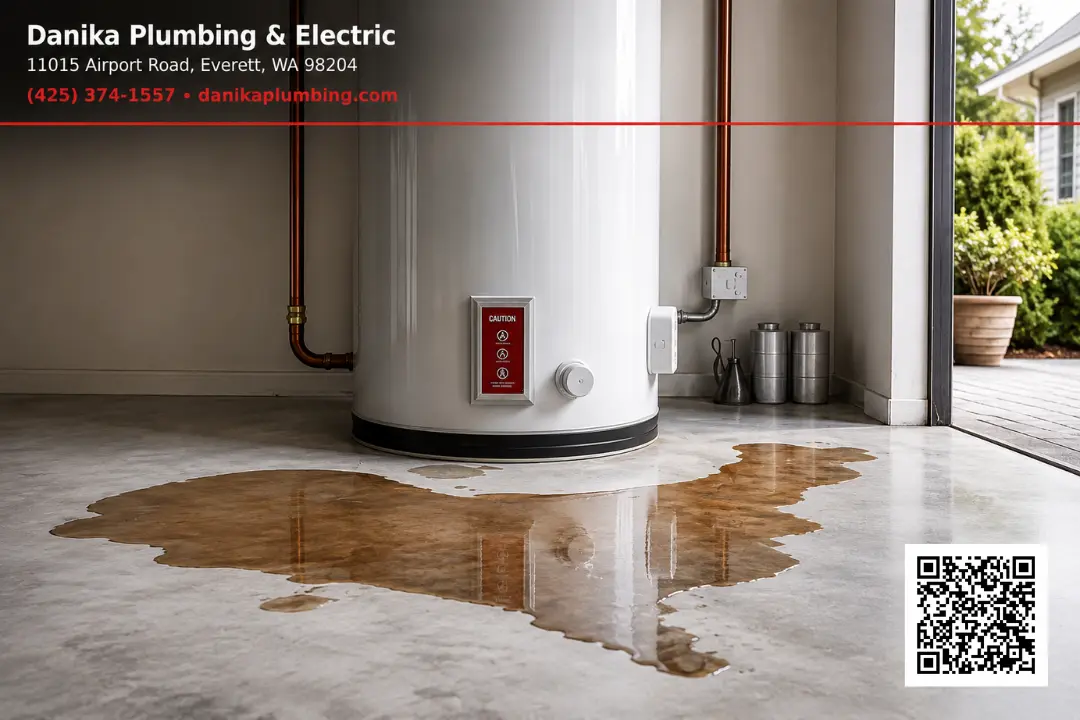
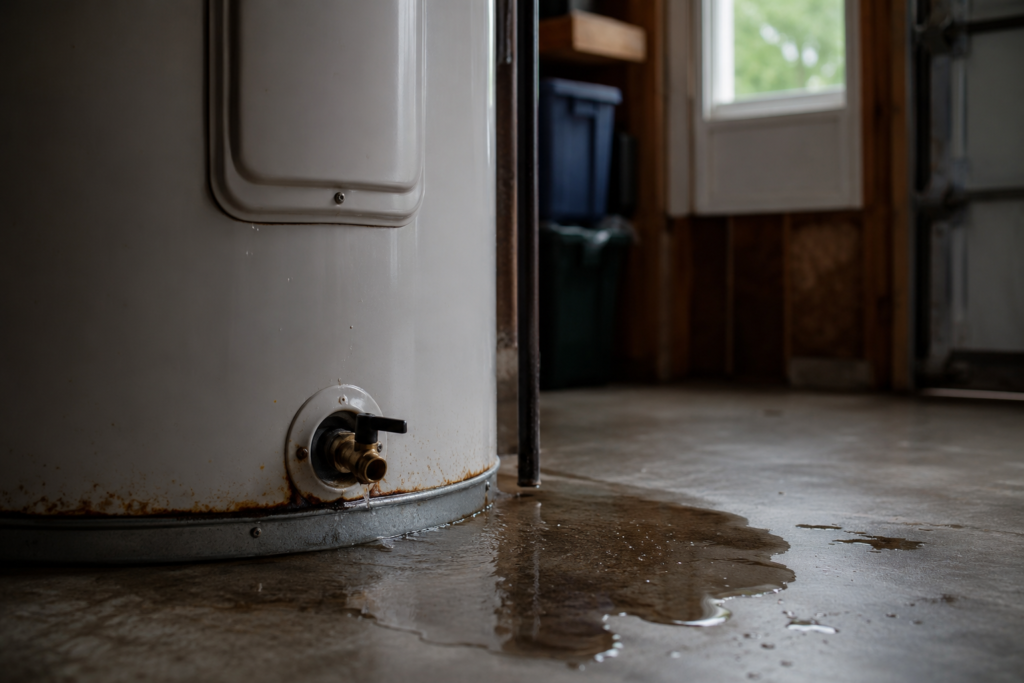
You go to grab something off the garage shelf, your sock lands in a puddle, and your stomach drops. The water heater. Sitting in a little pond it definitely wasn’t sitting in last week.
We get this call a lot from around Mukilteo — the older homes up in Old Town near the waterfront, the newer builds out toward Harbour Pointe and Picnic Point. A leaking tank feels like a five-alarm problem, and sometimes it is. But not always. So before you start pricing out a new unit at midnight, let’s sort out what’s actually going on and what you should do in the next ten minutes.
Before you dig in — related reading
- A full overview of how our water heater repair and replacement service works, for the diagnosis-to-fix process.
- How we handle plumbing throughout Mukilteo, including same-week and emergency response.
- The other warning signs that mean your tank is on its way out, beyond just a leak.
- For a fast-spreading leak that needs help now, around-the-clock plumbing help.
- Trying to decide if it’s worth fixing, our full repair-vs-replace cost breakdown.
- Closer to the Everett side of the county, our Everett water heater hub page.
The 30-Second Answer
Where the water comes from tells you almost everything. A drip from a fitting, a valve, or the pipes on top of the tank is often a tightening or a part swap — fixable. Water pooling at the bottom, seeping from the body of the tank itself, usually means the inner steel has rusted through. That’s not a repair. That’s a replacement, because once a tank starts leaking from corrosion, it only gets worse.
Either way: shut off the power or gas to the unit, close the cold-water valve on top, and don’t keep using it if the leak is steady. A slow drip can wait until morning. A spreading puddle, hot water hitting the floor, or anything near electrical should get a phone call now, not later.
Is a Leaking Water Heater an Emergency?
Depends on how fast it’s losing water and what’s around it.
A pinhole weep that leaves a quarter-sized damp spot is a “deal with it this week” problem. A tank dumping water across a finished floor, soaking drywall, or pooling near outlets and the gas burner is a “deal with it right now” problem. The water itself is one issue — the damage it does to flooring, framing, and anything stored nearby is often the bigger bill.
Can you still shower if your water heater is leaking? For a tiny, slow drip, usually yes for a short while — but you’re on borrowed time, and every gallon that runs through keeps feeding the leak. For anything more than a trickle, we’d say no. Shut it down. A cold rinse for a day beats a flooded garage and a ruined subfloor.
One Mukilteo wrinkle worth mentioning. A lot of tanks here live in garages and utility closets, and our Puget Sound humidity means condensation is real — we’ve shown up to “leaks” that turned out to be sweat dripping off cold supply lines. Before you panic, dry everything off and see where the wet returns. If it comes back at the base of the tank, that’s a leak, not condensation.
Is It Okay for a Water Heater to Leak a Little at the Bottom?
Short answer — no, but it depends on what at the bottom is leaking.
A few usual suspects live down there. The drain valve (the spigot near the floor) can drip if it’s loose or worn — often a cheap fix. The relief valve’s discharge tube runs down the side, and water from that means the tank may be running too hot or too pressurized. But if water is weeping from the seam of the tank with no fitting to blame, that’s the inner tank corroding through.
Here’s the honest part: a tank rusting from the inside can’t be patched. The steel is sealed inside insulation and an outer shell — there’s no getting to it. So a “little” leak from the body isn’t little. It’s the early stage of a failure that ends with the whole thing letting go, usually on the morning you have the least time for it.
How Long Will a Water Heater Last Once It Starts Leaking?
If the leak is a fitting or a valve, the tank can keep going for years after a proper fix. If the leak is the tank body itself, you’re usually looking at days to a few weeks — sometimes less. There’s no reliable countdown. Corrosion doesn’t fail politely.
Context helps. Most standard tank water heaters last 8 to 12 years, and that range is on the optimistic end if the unit’s never been flushed. Mukilteo and the surrounding area get water through the Mukilteo Water & Wastewater District, and while our regional supply runs reasonably soft, “soft” never means “no sediment.” Grit, scale, and rust flakes still settle over the years and grind away at the tank lining and the anode rod — the sacrificial part that’s supposed to corrode so the tank doesn’t. Once that rod is spent and the steel starts going, leaks follow.
So if your heater is creeping past the ten-year mark and now it’s leaking from the bottom, the math usually points one direction. Replace it on your schedule, not the tank’s.
What Are the First Signs a Water Heater Is Going Bad?
A leak is often the loud finale. The opening acts usually show up earlier:
- Rusty, cloudy, or metallic-smelling hot water — and it’s the hot side specifically that gives it away.
- Hot water that runs out faster than it used to, or never gets quite hot enough.
- Popping, rumbling, or banging from the tank as sediment shifts on the bottom.
- Moisture, rust streaks, or mineral crust around the base or the fittings.
- Age. A tank past 10 to 12 years that’s acting up isn’t being dramatic — it’s being honest.
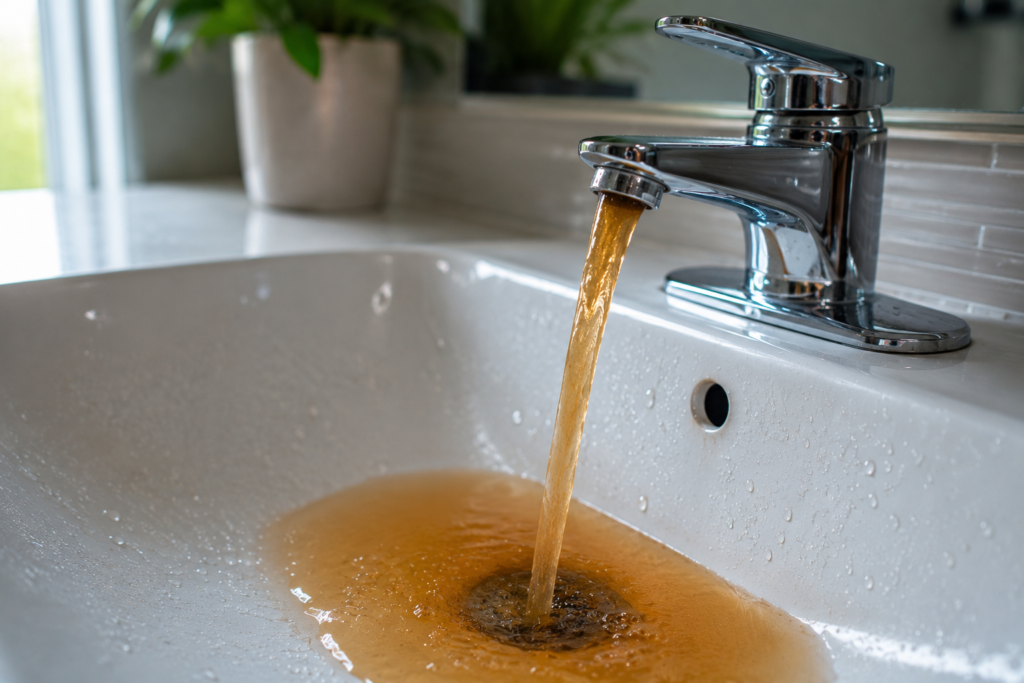
We had a customer near the Mukilteo Speedway who noticed a faint rusty tint in the bathtub for a couple of months and chalked it up to old pipes. It was the heater. Catching one of these early signs is the difference between a planned swap and a wet-vac-at-2 a.m. surprise.
Who Should I Call — and What Do I Do Right Now?
For a true emergency — water spreading fast, near electrical, or flooding a finished space — shut off the heater and call a licensed plumber. For anything calmer, here’s the order of operations before help arrives:
- Cut the power source. Electric unit? Flip its breaker. Gas unit? Turn the gas control dial to “Off” (or at least “Pilot”).
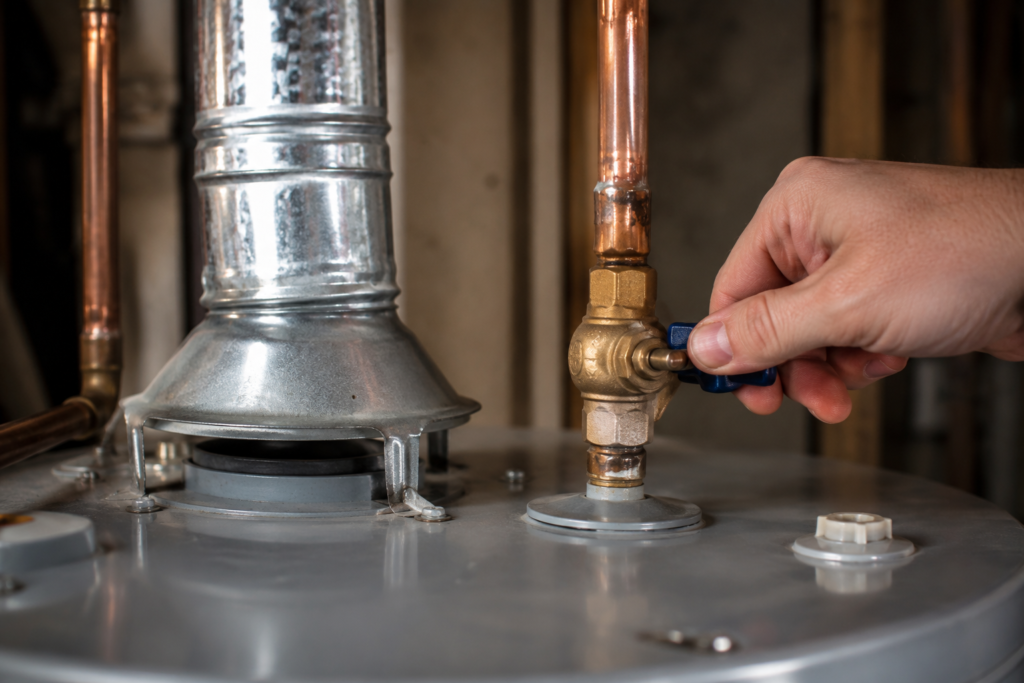
- Shut the cold-water supply. There’s a valve on the cold line at the top of the tank. Close it to stop more water feeding in. Can’t find it or it won’t turn? Use your home’s main shutoff.
- Move what you can. Boxes, tools, anything porous sitting near the tank. Water finds it fast.
- Snap a couple of photos. Where the water’s coming from and roughly how much. It helps us show up with the right parts — or the right tank.
Who to call is the easy part: a licensed plumber, not a handyman, because a water heater swap in Washington can involve gas, electrical, venting, and expansion-control requirements that have to be done to code. Mukilteo requires a plumbing permit for any water heater installation or replacement, and the work has to pass inspection — we pull the permit and schedule that inspection as part of the job, so you don’t have to chase it down yourself.
Is a Leaking Water Heater Covered by Homeowners Insurance?
This one trips people up, so let’s be clear — and add the usual “check your own policy, we’re plumbers not adjusters” caveat.
Most homeowners policies won’t pay to replace the water heater itself when it fails from age or wear — that’s considered maintenance. What many policies do cover is the sudden water damage the leak causes, like soaked flooring or drywall, as long as the failure was abrupt and accidental rather than a slow leak you let ride for months. Insurers tend to push back on damage from a leak that was clearly ignored — one more reason not to mop up a “small” tank leak week after week. If you do file, document the source, the damage, and the unit’s age, and check your deductible first.
Frequently Asked Questions
Can I still shower if my water heater is leaking?
For a very slow drip, briefly — but you’re feeding the leak every time hot water runs. For anything more than a trickle, shut the unit down and skip it. A short stretch of cold showers beats water damage.
Why is water pooling around the base of my water heater?
Either a fitting or valve above is dripping down and collecting at the bottom, or the tank itself has corroded through. Dry it, watch where the water returns — if it’s weeping from the body of the tank, it’s a replacement.
Should I turn off the water to a leaking water heater?
Yes. Close the cold-water valve on top of the tank to stop more water feeding the leak. If that valve is stuck, use your home’s main shutoff instead.
Is a small drip from the relief valve a problem?
It can be. The temperature-and-pressure (T&P) valve drips when the tank is too hot or too pressurized, which is a safety device doing its job — but it points to an underlying issue worth checking, not a part to cap off.
Standing in a Puddle? Let’s Sort It Out
If your tank’s gone from quietly heating water to slowly redecorating your garage floor, we’ll come figure out whether it’s a fitting, a valve, or the end of the line — and give you a straight answer instead of a hard sell. We’ve been doing this around Mukilteo and the rest of Snohomish County a long time.
Text us a photo of where the water’s coming from if you can. It genuinely helps us show up ready, with a wrench or a new unit, whichever you actually need.
Danika Plumbing & Electric
11015 Airport Road, Everett, WA 98204
Phone: (425) 374-1557
Email: office@danikaplumbing.com
Washington License # DANIKPL839PF