It usually starts with something small. A patch of paint that looks a little puffy. A faint musty smell in a room you keep clean. A water bill that crept up for no reason you can name. And the thought that won’t leave you alone: is something leaking back there, inside the wall, where you can’t see it?
We get this call all the time around Everett — especially in the older north-end bungalows and the mid-century homes out toward Silver Lake. Hidden leaks are sneaky by design. A pipe drips into a wall cavity for weeks, the framing soaks it up, and by the time the wall tells on itself, there’s already a mess back there. Here’s how to spot one early, before a quick repair turns into a framing-and-mold project.
Before you dig in — related reading
- Tracking down a leak you can’t see is its own skill set — that’s exactly what hidden leak detection is built for.
- Once the source is found, professional pipe repair handles the fix inside the wall.
- Local homeowners can reach a licensed Everett plumber for a same-week look.
- A hidden wall leak is a classic reason your water bill suddenly spikes with nothing else changing.
- If the leak turns out to be one of many in aging pipes, whole-house repiping may be the smarter long-term call.
- Not sure what that involves? Here’s our guide to repiping an older home.
The 30-Second Answer
You can usually catch a wall leak without cutting anything open. Look for the visible signs first — bubbling or peeling paint, a soft or stained drywall patch, a cool damp spot, or a musty odor that won’t air out. Then confirm with the meter test: write down your water meter reading, don’t run any water for two hours, and check again. If the numbers moved with everything off, water is going somewhere it shouldn’t. Professional leak detection can pinpoint the exact location without opening up the whole wall.
If you find a steady, active leak: shut off water at the main and cut power to any room where outlets or switches are wet. A slow mystery damp spot can wait a day for a proper diagnosis. Water actively running inside a wall — or anything wet near electrical — warrants a call now.
What are the signs of a water leak behind a wall?
Walls aren’t great at keeping secrets. Once water’s been hiding back there long enough, it starts pushing clues to the surface. The trick is catching them before the drywall gives up entirely.
Here’s what we tell Everett homeowners to watch for:
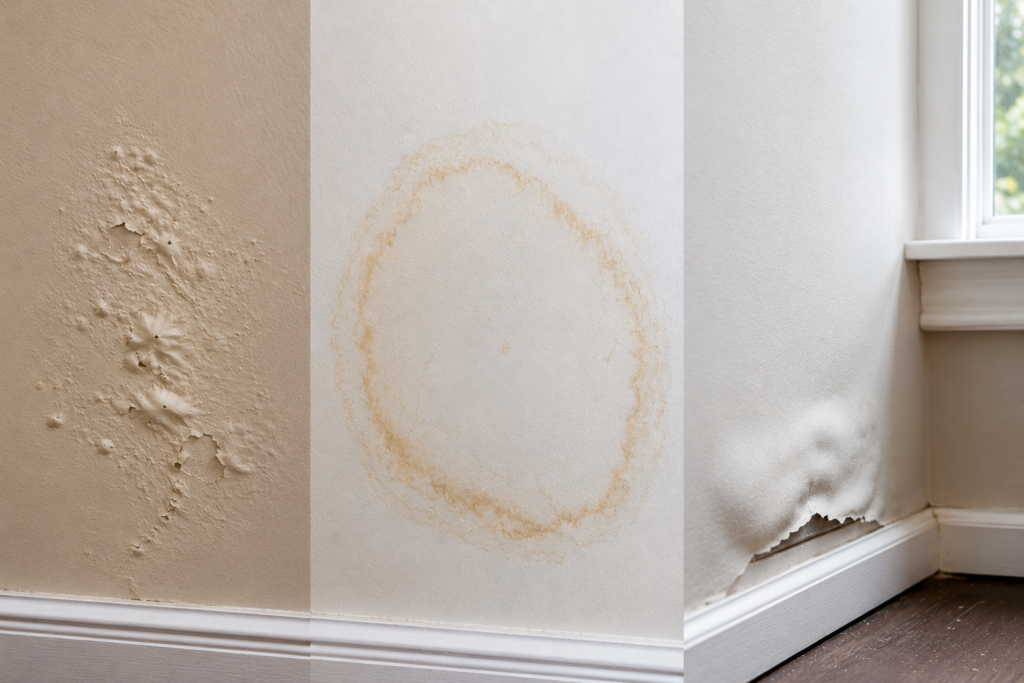
- Paint or wallpaper that’s bubbling, blistering, or peeling. Trapped moisture pushes the finish off the wall from behind.
- Stains. Yellowish or brownish blooms, often shaped like a ring or a streak running downward along the wall.
- A soft, spongy, or warped patch. Press gently — drywall that’s been wet loses its firmness and may feel cool to the touch.
- That musty, “old basement” smell. If a room smells damp no matter how often you clean it, something is feeding the moisture.
- Mold or mildew spots appearing along baseboards, in corners, or around outlet covers.
- A water bill that climbed with no change in how much water you’re actually using. (See why your water bill spiked unexpectedly — a wall leak is one of the most common culprits.)
- The sound of running or trickling water when every tap in the house is off.
One Everett homeowner near Legion Park called us about a “paint problem” — the wall kept blistering after they’d repainted it twice. It wasn’t the paint. A supply line behind that wall had a pinhole drip feeding moisture to that exact spot every day. Two coats of primer were never going to win that fight.
One thing worth knowing: the surface clue is almost always smaller than the wet zone behind it. Water travels along framing and down studs, so the stain you see may be a foot or more away from where the pipe is actually leaking.
How does a plumber find a hidden leak behind a wall?
The short answer: yes, plumbers find and fix leaks behind walls — and a good one does it with as little demolition as possible. Nobody wants their living room opened up on a guess.
The goal is to pinpoint the leak before any drywall comes out. A few tools and methods that do the heavy lifting:
- Moisture meters read dampness levels right through the wall surface, letting us map the wet area without touching it.
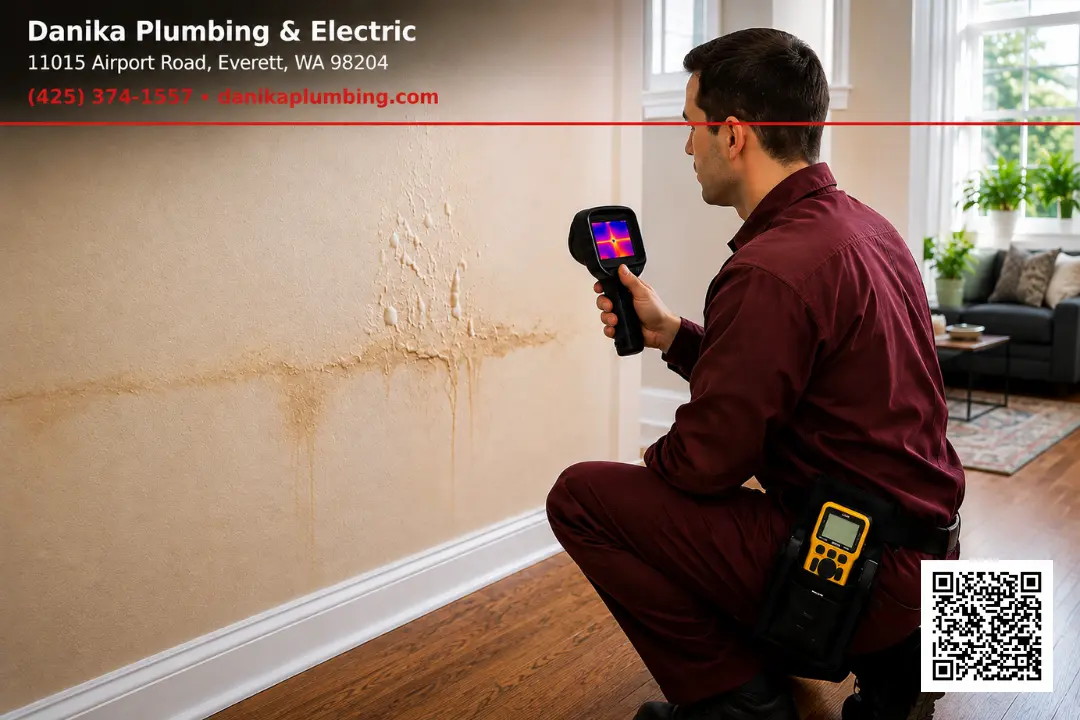
- Infrared (thermal) cameras show cool patches where water sits — a leak usually reads colder than the dry wall around it.
- Acoustic listening equipment amplifies the faint hiss or drip of pressurized water escaping a pipe inside the wall.
- The meter test — the same one you can run yourself — confirms whether the leak is on a pressurized supply line.
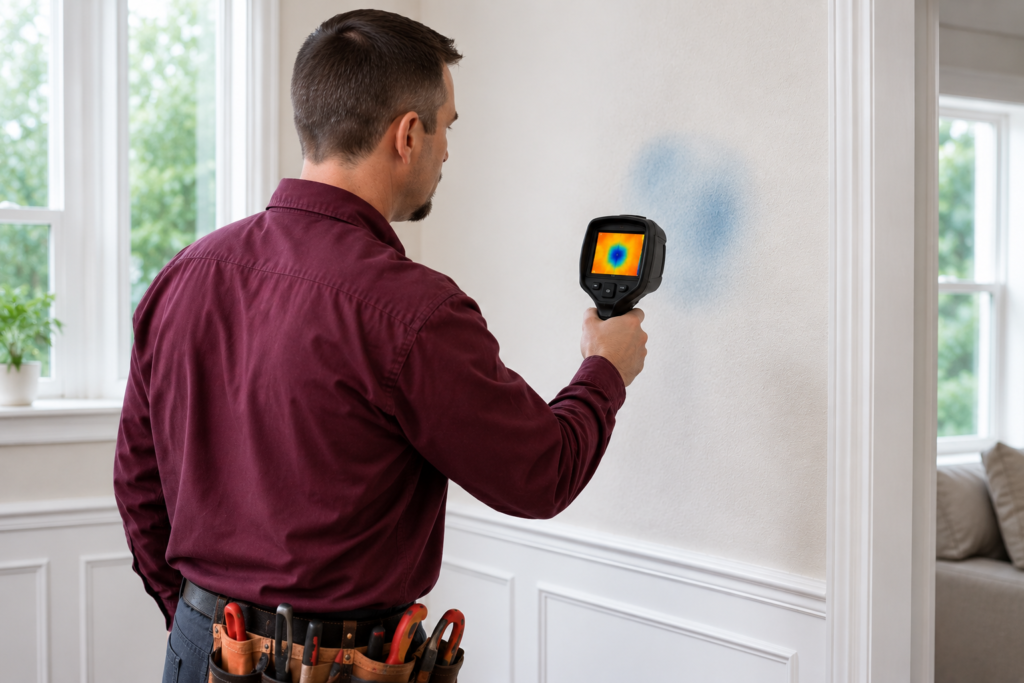
Once the location is pinned down, we open a small, deliberate access hole — not a wall’s worth of guessing — expose the pipe, and make the repair, whether that’s a new fitting, a section of copper, or a run of PEX. Then the wall cavity gets dried out before anything is closed back up. Sealing damp framing just schedules a mold call six months later.
Will a slow leak behind a wall cause mold?
It can — and around here it doesn’t take much. Mold needs moisture, something to feed on (drywall paper and wood framing are a buffet), and time. A wall cavity that stays damp checks every box.
The Puget Sound climate doesn’t help. Our humidity runs high a good chunk of the year, and a closed-up wall cavity dries slowly even when the outdoor air finally does. We’ve opened walls where a leak everyone assumed was “probably nothing” had been quietly growing mold across the back of the drywall. General guidance from restoration professionals is that mold can establish itself within a day or two of materials staying wet — which is exactly why we don’t recommend leaving a known leak to “see if it gets worse.” It will.
If you’re already seeing or smelling mold, take it seriously. Heavy growth inside a wall is often a job for a licensed remediation specialist, not a mop and some bleach. We’ll be straight with you about when the situation has crossed that line. For health concerns related to mold exposure, please consult a medical professional — our role is resolving the moisture source.
Is drywall ruined once it gets wet?
Not always — but it’s a closer call than most people hope. Drywall is gypsum sandwiched in paper, and once it’s thoroughly soaked it loses structural strength and starts to crumble, sag, or grow mold.
If the drywall got briefly splashed and dried quickly and completely, it may be fine. If it’s been wet for a while, feels soft or swollen, or shows obvious staining and mold, it’s usually past saving and needs to come out and be replaced. The rule of thumb we use: when in doubt, the cheap drywall comes out. A new section of board costs far less than letting a compromised, moldy panel stay in the wall and cause bigger problems later.
And here’s the part people often forget — fixing the drywall without fixing the leak is just redecorating the problem. The wall will blister again. Source first, surface second. Always.
Does homeowners insurance cover water leaks in walls?
This question comes up on nearly every wall-leak call, so here’s the general picture — with the important reminder that we’re plumbers, not insurance adjusters, and your specific policy is the final word.
Generally speaking, homeowners policies tend to cover water damage that’s sudden and accidental — a pipe that bursts or a fitting that lets go without warning, soaking the drywall and framing behind it. What they typically won’t cover is the worn-out pipe itself, or damage that resulted from a slow, ongoing leak that went unaddressed for months. Insurers draw a hard line between “sudden” and “gradual” damage, and a leak you knew about and ignored is exactly the kind of claim they’re likely to deny.
Coverage details vary significantly between policies and carriers. Confirm specifics — what’s covered, your deductible, and what your insurer considers “sudden” — directly with your provider before you assume anything. If you do file a claim, document the leak source, the damage, and all repair work, and take photos before anything gets opened up or torn out.
Note: The above reflects general patterns only and should not be read as a guarantee about your specific coverage. Confirm all details with your insurance provider before filing a claim.
What does it cost to fix a leaking pipe in a wall?
The honest answer is: it depends, and giving you a flat number sight unseen wouldn’t serve you well. The repair itself — a fitting or a short pipe section — is often the smaller part of the cost. What moves the total is everything around it: how accessible the leak is, how much wall needs to come out, and whether there’s water damage or mold to address on top of the plumbing fix.
A single accessible pinhole caught early is a modest repair. A leak buried behind tile, feeding mold into soaked insulation? That’s a bigger day for everyone involved. The least expensive version of this problem is almost always the one you catch early — which brings us back to paying attention to those first small signs before they grow. Call an Everett plumber for a straight, upfront estimate once we can see what’s actually there. No surprises.
Frequently Asked Questions
Can a water leak behind a wall dry out on its own?
Not if the pipe is still leaking — you’d just be drying a spot that gets re-soaked every day. Even after a leak is fixed, a closed wall cavity dries slowly in the Pacific Northwest’s damp climate, which is why we dry the cavity out deliberately before sealing it back up rather than trapping residual moisture inside.
How can I tell if it’s a plumbing leak or a roof leak?
Roof leaks typically show up after rain and start high — near the ceiling or at the top of a wall. A plumbing leak tends to be steady and ongoing regardless of weather, and usually appears near where pipes run, such as behind a kitchen or bathroom wall. The meter test helps clarify: if the meter moves with all water shut off, the source is plumbing, not your roof. If you’re also seeing wet spots in the yard or near the foundation, our guide to the signs of an underground water leak can help you rule that out.
Should I turn off my water if I think a pipe is leaking in the wall?
If the leak is active and spreading, yes — shut off the main and cut power to the room if outlets or switches are wet. For a faint, uncertain damp spot that isn’t growing, you can leave the water on until a plumber can diagnose it properly.
How long can a leak go undetected behind a wall?
Weeks or even months for a slow drip, since the wall hides the damage until it surfaces visibly. Early warning signs — a bump in the water bill, a persistent musty smell, or a soft drywall patch — are worth acting on quickly. For perspective on how quietly these situations develop, our page on main water line leaking covers similar slow-build scenarios where damage accumulated for months before the homeowner noticed.
Get Danika Plumbing & Electric on the Job
Think something’s leaking behind a wall in your Everett home? We’ll bring the moisture meters and the thermal camera, track the leak down with the smallest opening we can get away with, and give you a straight answer about what it’ll take to fix it — no guesswork, no unnecessary demolition.
Text us a photo of the spot if you can. A picture of the stain, the soft patch, or the bubbling paint helps us show up ready for what’s behind the wall.
Danika Plumbing & Electric
11015 Airport Road, Everett, WA 98204
Phone: (425) 374-1557 |
office@danikaplumbing.com
Washington License # DANIKPL839PF