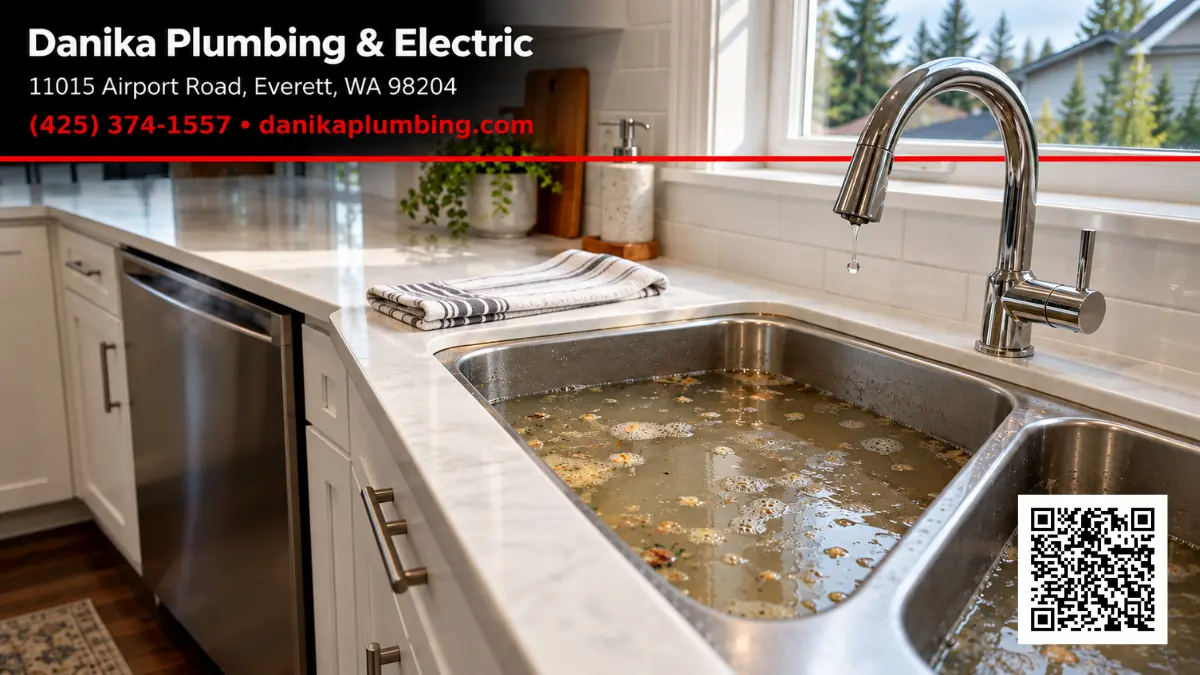
You flip the switch under the sink and get nothing — or worse, a low, angry hum, like the unit is considering its options and has decided against cooperating. Either way, you’ve got a sink full of last night’s dinner and a disposal that’s refusing to do its one job. We’ve taken these calls all across Everett, from Riverside to Silver Lake, and a surprising number end with us pointing at a red reset button rather than pulling out a wrench. If you already know how our Everett plumbing team handles kitchen calls in general, this post gets into the disposal specifics.
What we can do is walk through the real reasons a disposal stops working, what the symptoms actually mean, and when a fix turns into a replacement. That is the conversation we have with homeowners all the time — so here it is in plain terms.
Before you dig in — related reading
If you want more context on drain problems or why chemical fixes tend to backfire, these pages cover everything connected to what’s below:
- Our garbage disposal repair and replacement service, for when the steps below don’t solve it.
- Expert drain clearing — for the clog hiding past the disposal, not in it.
- Our Everett drain cleaning crew — local, licensed, and quick to the door.
- The warning signs of a clogged drain — when it’s the pipe, not the appliance.
- Why chemical drain cleaners can backfire — please don’t pour Drano in the disposal.
- Clearing a slow drain with baking soda and vinegar — gentler DIY for sluggish sinks.
The 30-Second Answer
If your garbage disposal is completely dead — no sound at all — press the reset button on the bottom of the unit and check the breaker. That fixes it more often than not. If it’s humming but not spinning, it’s jammed: kill the power, free the flywheel with the hex wrench from underneath, fish out whatever’s stuck, then hit reset. If it’s leaking, smoking, or smells burnt, stop here — that unit is done. Most disposals last 8 to 12 years, so if yours is past a decade, replacement is usually the smarter investment.
Why Is My Garbage Disposal All of a Sudden Not Working?
Disposals fail in a few predictable ways, and the symptom almost always points to the cause.
Dead silent — no hum, no nothing. That’s an electrical issue: a tripped reset button, a flipped breaker, or a wall switch that’s given up. Start with the reset button (more on that below). Nine times out of ten with a completely silent unit, that’s your culprit.
Humming but stuck. The motor is getting power, but something is wedging the grinding plate so it can’t turn. It might be a fruit pit, a chicken bone, a stray bottle cap, or the little plastic produce sticker that rode in on an apple. The hum is the motor straining against the jam. If you leave it running, you’ll cook the motor. Switch it off immediately.
Spinning but not draining. The disposal itself is fine — the pipe past it is clogged. That is a completely different problem, and one worth understanding before you dig further. Our drain cleaning service page covers how that gets cleared, and the warning signs of a clogged drain are useful to know either way. We see this regularly in older Everett homes with original drain lines.
A homeowner near Legion Park called us one winter, convinced their disposal had died mid-Thanksgiving prep. It hadn’t. A tightly packed wad of celery strings and potato peels had bound the blades into a solid green mass. Two minutes with the hex wrench and it was back in service. We did suggest the compost bin for fibrous vegetables going forward.
Do Garbage Disposals Have a Reset Button?
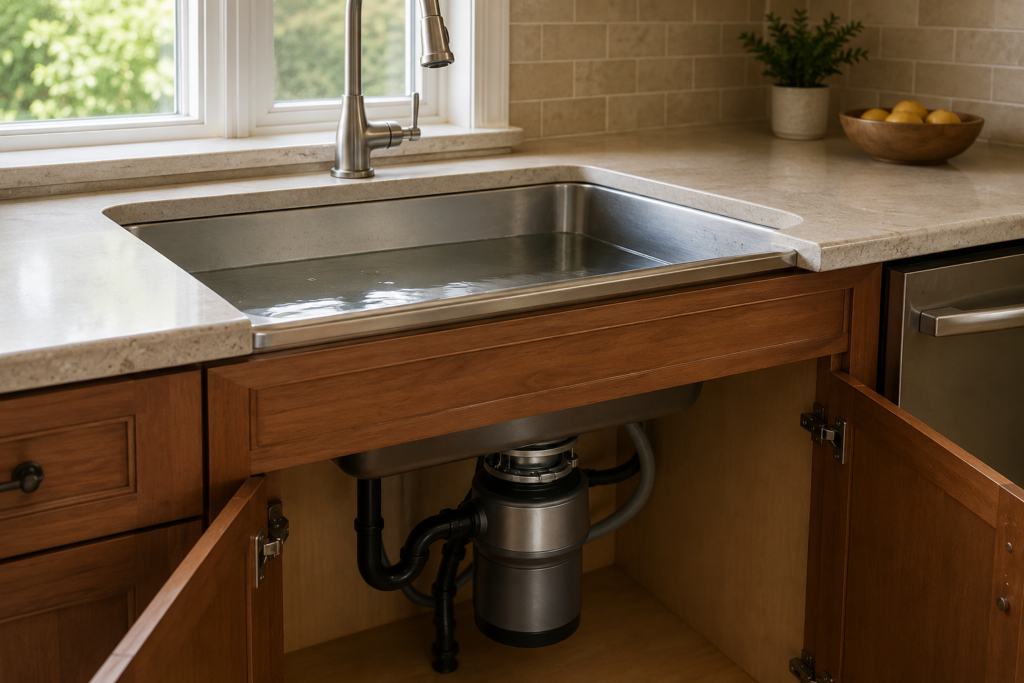
They do — and most homeowners have no idea it exists. Grab a flashlight and look at the very bottom of the disposal unit, underneath the sink. You’re looking for a small button, usually red and occasionally black, sitting dead center on the bottom of the housing. That’s the overload protector. When the motor draws too much current — from a jam, an overfilled chamber, or simply age — it trips to prevent the motor from burning out.
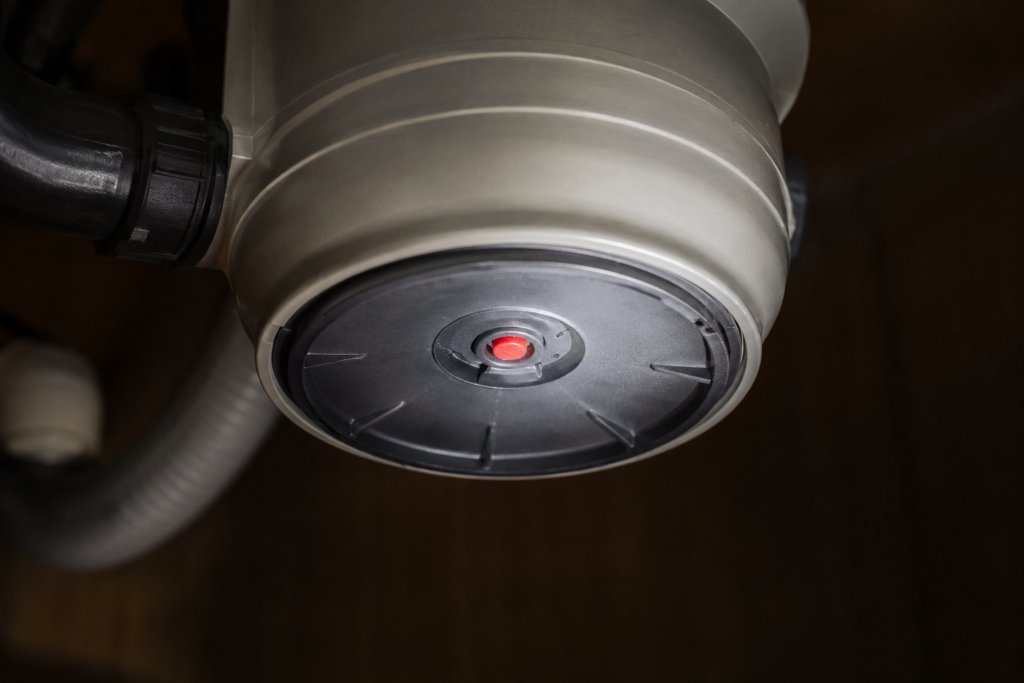
When it’s tripped, the button sticks out roughly a quarter inch. Push it back in until it clicks and stays. If it won’t stay seated, the motor is still too hot — give it ten to fifteen minutes to cool down, then try again. A disposal that trips its reset button every few weeks isn’t asking for patience; it’s telling you the motor or a bearing is on its way out.
How Do You Reset a Garbage Disposal Safely?
Here’s the sequence we follow on every jam call. The order matters — it keeps your fingers safe.
- Turn it off. Wall switch off. For a humming, jammed unit, flip the breaker too — you do not want the disposal waking up while your hand is anywhere near the opening.
- Free the flywheel. Find the hex (Allen) wrench slot on the bottom center of the unit. Insert the wrench and crank it back and forth until it moves freely — that’s you manually breaking the jam loose.
- Clear the chamber. With the power still off, use tongs or needle-nose pliers — never your bare hand — to pull out whatever caused the jam.
- Press the reset button on the bottom of the unit until it clicks and seats.
- Restore power and test. Run cold water, flip the switch, and listen. A healthy disposal spins up smoothly and steadily without hesitation.
If it hums again the moment you switch it on, something is still stuck or the motor itself is failing. Don’t keep cycling it — that’s how a fixable jam turns into a full replacement.
What’s the Average Life Expectancy of a Garbage Disposal?
Most units run 8 to 12 years. Cheaper builder-grade models sometimes tap out around year seven or eight; a solid ¾ or 1 horsepower unit that’s been treated well can push past twelve. What shortens that window is mostly what goes down it — coffee grounds, eggshells, grease, fibrous vegetables, and bones all wear the grinding components faster than the marketing suggests. How often you run it matters too: a busy family kitchen running the disposal three times a day ages it faster than a household that uses it twice a week.
One local note worth flagging: some homes in the Everett area — particularly in the unincorporated pockets of Snohomish County outside the city sewer system — run on septic. If that’s your situation, what you grind matters more, because everything the disposal processes ends up in the tank. Some septic systems handle a disposal reasonably well with an appropriately sized tank and regular pumping; others don’t. We’d check with your septic service provider before leaning on one heavily — that’s a practical recommendation, not a code requirement.
How Do You Tell If Your Garbage Disposal Needs to Be Replaced?
Some signs say “fix me.” Others say “it’s over.” Here’s how we tell them apart.
Water pooling underneath the unit. A leak from the body of the disposal — not from a connection or fitting — usually means the internal seals or shell have corroded through. That’s a replacement, not a repair.
It trips the reset button repeatedly. If you’re pressing that red button every few weeks, the motor is worn out.
It’s slower and louder than it used to be. Dull rattling, taking forever to clear a normal load — the grinding plate is worn down.
A smell that won’t quit. If a thorough cleaning with ice cubes, dish soap, and citrus peels doesn’t resolve the odor, food may be trapped somewhere you can’t reach, or the splash guard has deteriorated.
It’s past 10 years old. At that point, replacement parts often cost more than the unit itself is worth.
A jam, a tripped reset, a loose mounting ring, a leaky drain connection — those are repairs. A cracked housing, a dead motor, or a unit older than your last car — that’s a swap.
What Does It Cost to Fix or Replace a Garbage Disposal?
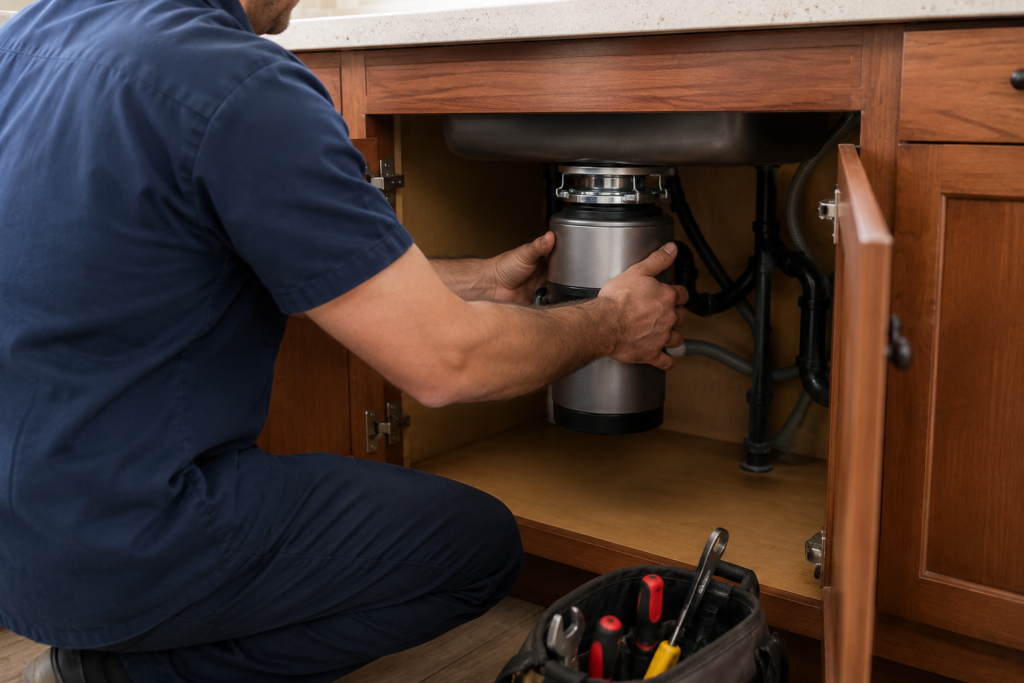
Ballpark numbers only — every kitchen is a little different. Clearing a simple jam is the cheapest outcome by far, and often something you can handle yourself with the steps above. A service call to unjam, troubleshoot, or diagnose typically runs in the low-to-mid hundreds, depending on what we find once we’re under the sink. Full unit replacement — new disposal plus installation — generally lands in the $250 to $600 range for a standard residential swap, driven mostly by the horsepower and quality of the unit you choose.
If your old disposal died unexpectedly, it’s worth finding out why before swapping in a new one. A bad wall switch or a wiring problem will happily kill the replacement too. These are general estimates for the Everett area and are not a quote.
Frequently Asked Questions
Can I pour drain cleaner down my garbage disposal?
Please don’t. Chemical drain cleaners corrode the disposal’s internal components and rubber gasket. If the sink is already backed up, you’ve got caustic liquid sitting against your hardware — and waiting to splash back at you. For a clog past the disposal, a plunger, a hand-cranked drain snake, or a call to us is far safer and more effective.
Why does my garbage disposal smell so bad?
Food residue accumulates on the grinding chamber walls and the underside of the splash guard. Try grinding a tray of ice cubes with a handful of citrus peels and a squirt of dish soap, running cold water the whole time. If the smell survives that treatment, food may be lodged deeper inside the unit — or sewer gas is escaping through the P-trap, which is a separate fix entirely.
Should I use hot or cold water with my disposal?
Always cold, while it’s running. Cold water keeps fats and grease in solid form so they get ground up and flushed through the drain. Hot water melts grease, which coats the inside of the pipe and re-hardens into a clog further downstream. Hot water is fine for rinsing once the grinding is done.
What should never go in a garbage disposal?
Grease and cooking oil, coffee grounds, eggshells, bones, fruit pits, and fibrous vegetables — celery, corn husks, potato peels, artichoke leaves. These either build up on the grinding plate, accelerate wear on the bearings, or wrap around the blades and stop them cold. The disposal is not a substitute for the compost bin.
Talk to Danika Plumbing & Electric About Your Disposal in Everett
If you’ve hit the reset, freed the jam, checked the breaker, and it still won’t cooperate — or it’s leaking, smells scorched, or is simply past its prime — we’re glad to take a look. We’ll tell you straight whether it’s a ten-minute fix or a new unit, and we won’t push you toward something your kitchen doesn’t need. Our garbage disposal repair and replacement service covers Everett and all of Snohomish County.
Danika Plumbing & Electric
11015 Airport Road, Everett, WA 98204
Phone: (425) 374-1557
Email: office@danikaplumbing.com
License # DANIKPL839PF