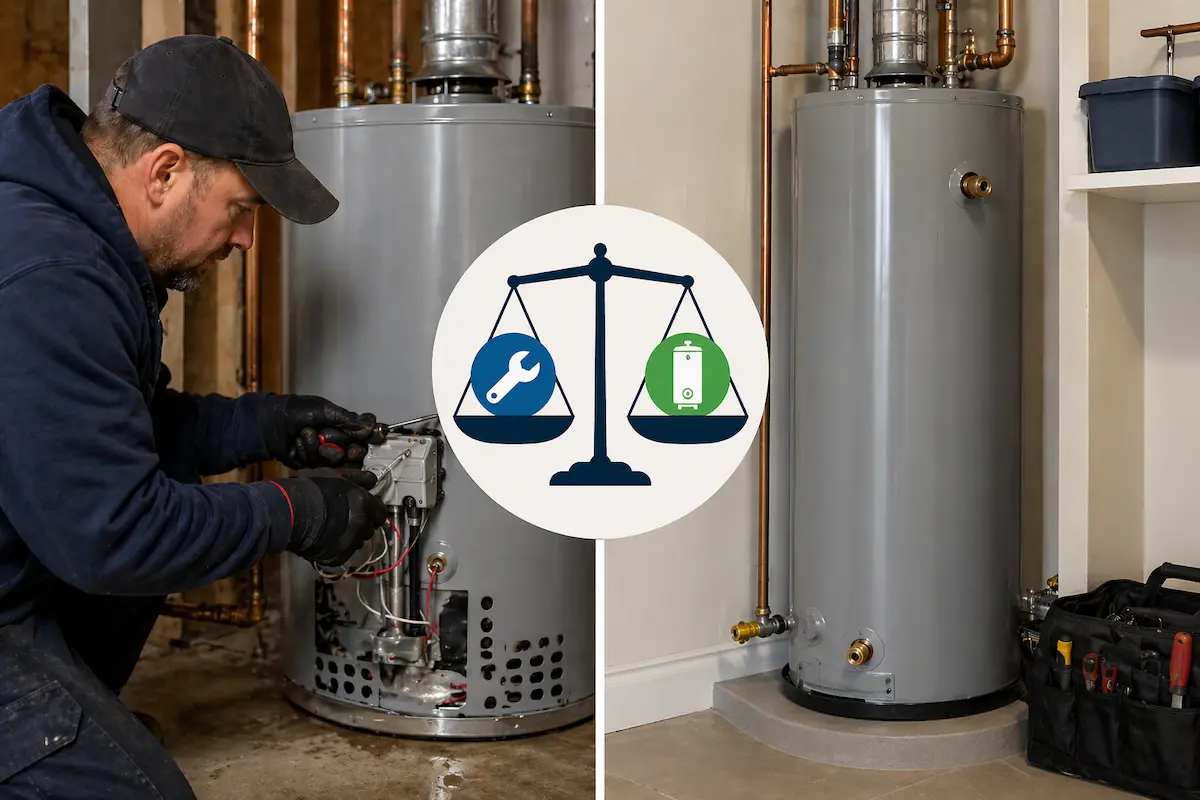
Short answer? It depends. On the age of the unit, what’s actually broken, and how much the repair will run you compared to a new install. That’s the honest version.
We get this question probably three or four times a week from Everett homeowners, and the answer isn’t the same for everyone. A five-year-old gas tank with a bad thermostat is a very different situation than a twelve-year-old electric unit that’s leaking at the seams. One’s a cheap fix. The other is throwing good money after bad.
Everett’s a specific place to own a water heater, too. Our groundwater comes in cold — like, genuinely cold — which means your unit is working harder than one sitting in a garage in Phoenix. Add in higher-than-average utility rates and the fact that a lot of the homes around here (especially in north Everett, Silver Lake, and out toward Mill Creek) still have original builder-grade tanks from the early 2000s, and you’ve got a lot of systems running on borrowed time.
This guide walks through the actual math — repair costs, replacement costs, and the point where it stops making sense to keep patching things up.
Average Cost to Repair a Water Heater in Everett
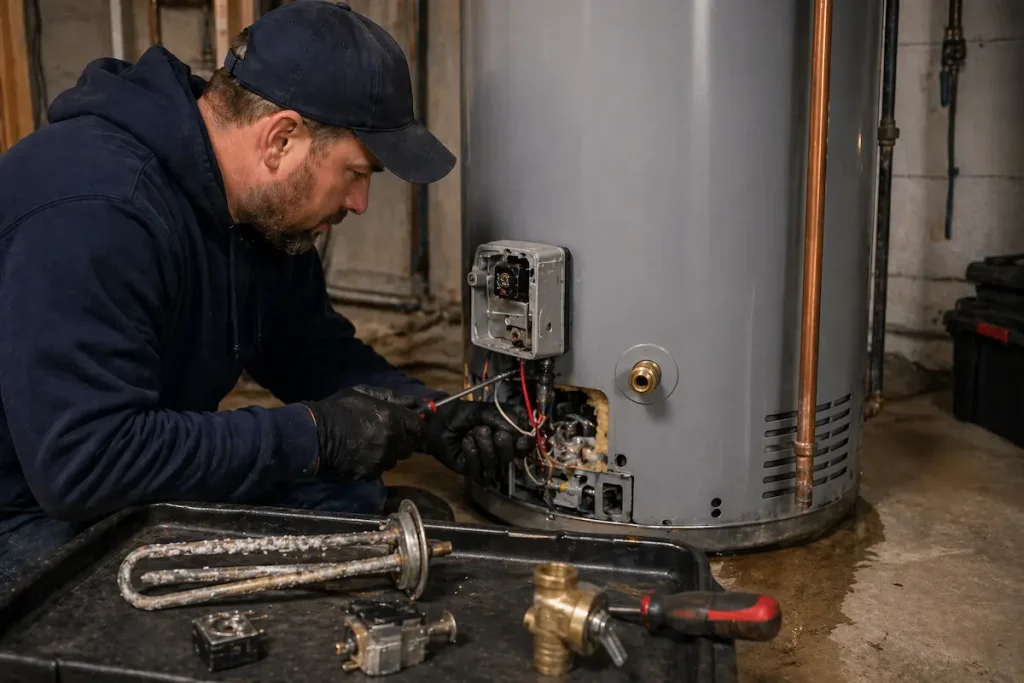
Most water heater repairs in the Everett area land somewhere between $150 and $800, depending on what’s wrong. If it’s a thermostat or a heating element on an electric unit, you’re usually on the lower end — parts aren’t expensive and the labor is pretty quick. Pilot light or ignition issues on a gas unit? Also generally cheap, assuming the gas valve itself isn’t the problem.
Pressure relief valve replacement is another common one. That’s the little valve on the side that prevents your tank from turning into a missile (we’re only half-joking — they actually can rupture if the T&P valve fails). Usually a one-hour job.
A repair is “low-cost” when the part is under $150 and the labor is under two hours. That’s the sweet spot where fixing it just makes sense. Anything past that, the math gets complicated.
Average Cost to Replace a Water Heater in Everett
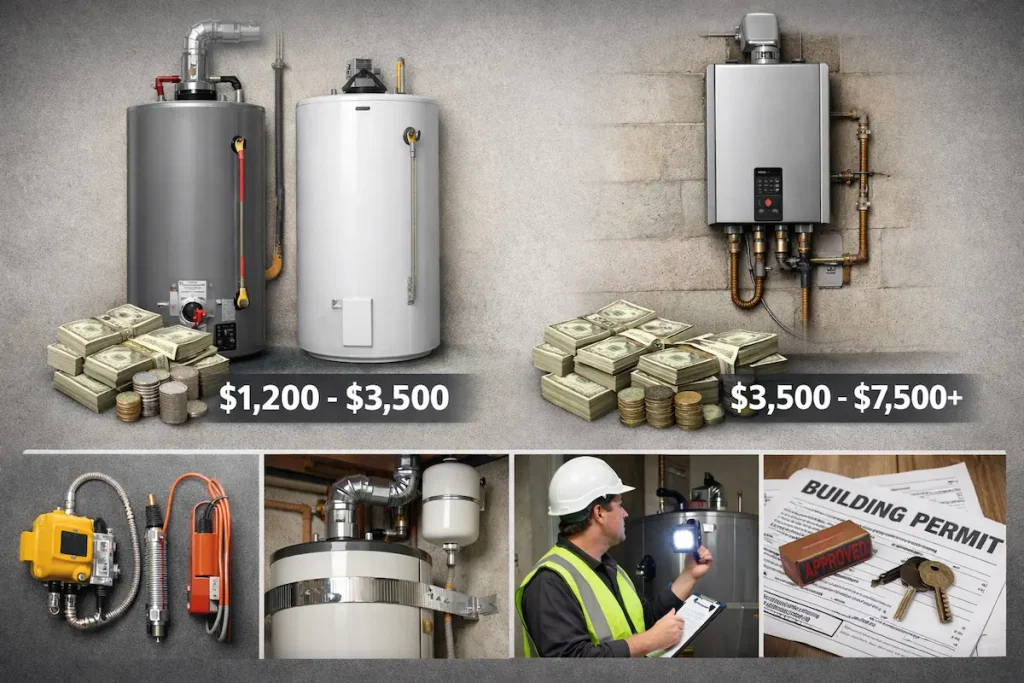
Replacement is where the numbers jump. A standard tank water heater — 40 or 50 gallon, gas or electric — runs about $1,200 to $3,500 installed around Everett. Tankless is a bigger investment: $3,500 to $7,500 and up, depending on the model and whether your home is ready for one.
A few things that push the price around:
- Gas vs electric — gas units cost more upfront but usually heat faster and run cheaper monthly
- Venting and code upgrades — older homes sometimes need new venting, seismic straps, expansion tanks, or a drain pan. We’ve seen code catch-up work add $400–$800 on older Everett homes, especially anything built before the mid-90s
- Permits and inspections — Snohomish County requires permits for water heater replacements, and yes, the inspector does show up
The cheap bids you see online usually don’t include any of that. Worth asking.
The 50% Rule (Quick Decision Framework)
Here’s the rule of thumb we use on jobs, and it’s a pretty reliable one:
If the repair is going to cost more than 50% of a full replacement, replace it.
That’s it. Simple math. If your repair quote is $900 and a new unit installed is $1,800 — you’re already halfway to a new tank. Spend the other half and get a fresh warranty, a more efficient system, and ten more years before you have to think about this again.
There are two other triggers that override the 50% rule. First, if the unit is already near the end of its expected lifespan (10–12 years for a standard tank), replacement almost always wins long-term. Second, if it’s a minor fix on a newer unit — say, a five-year-old tank with a bad element — just repair it. No brainer.
How Age Impacts the Decision
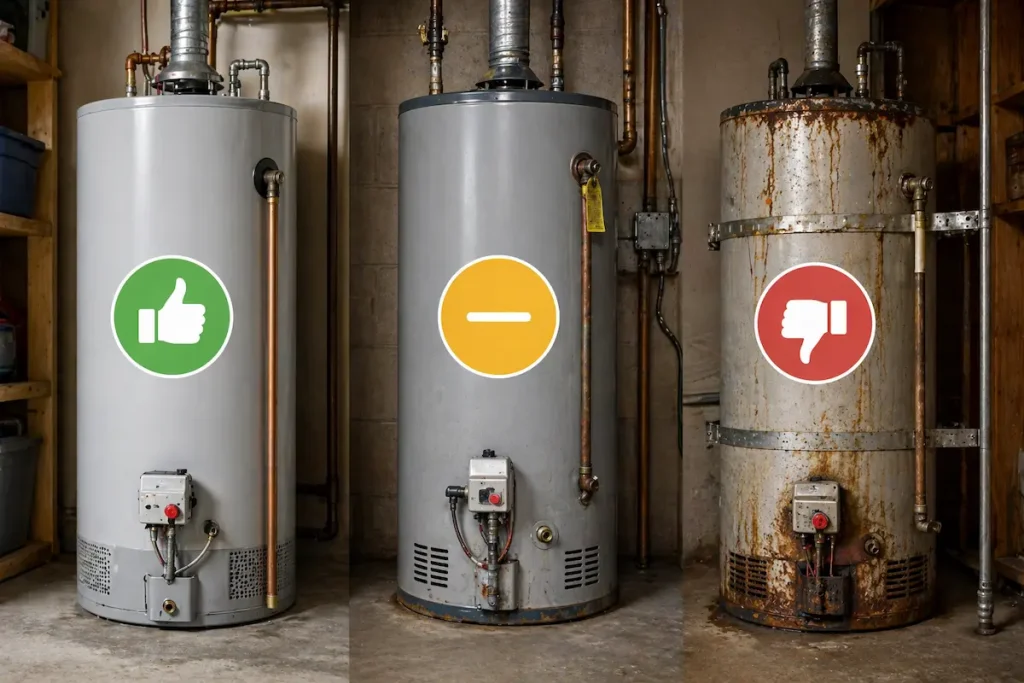
Age is honestly the biggest factor, and it’s the one people try hardest to ignore.
Under 5 years old? Repair, almost every time. These units still have warranty on parts in most cases, and the tank itself is nowhere near done. Even a bigger-ticket repair is worth it.
Between 6 and 10 years, it really depends on what’s wrong. A thermostat? Fix it. A failing gas valve plus signs of sediment buildup? Start getting replacement quotes.
Over 10 years — and this is where a lot of Everett homeowners find themselves — replacement is usually the cheaper option when you zoom out. You’re sinking money into a system that’s going to fail on you within a year or two anyway.
Worth noting: tankless units last around 20 years, while standard tanks average 8–12. So lifespan math looks different depending on what you’ve got.
Signs You Should Repair Your Water Heater
Some problems are genuinely just problems — not death sentences for your tank. Here’s when repair makes sense:
- You’ve got no hot water but the unit is under 8 years old and otherwise clean
- A single component has failed (element, thermostat, igniter, T&P valve)
- No leaks, no rust at the base, no weird smells
- It’s the first real issue you’ve had with the unit
- The tank itself looks structurally fine — no bulging, no corrosion around the fittings
If most of those boxes check, a repair is going to be the cheaper move. We’ll usually tell you straight up if we show up and find a simple fix on a healthy tank. No point selling you a new unit you don’t need.
One thing to watch for though — if it’s an older unit and the repair is “minor,” get a full inspection before you commit. Sometimes there’s more going on than the symptom shows.
Signs You Should Replace Your Water Heater
Some signs are the kind you don’t want to wait on. If you’re seeing any of these, it’s probably time:
- Rusty or discolored hot water — usually means the tank is corroding from the inside
- Visible leaks or cracks on the tank — not fixable. Once a tank starts leaking, it’s done
- Constant breakdowns — if we’ve been out twice in a year, that’s a signal
- Energy bills creeping up for no reason — sediment buildup forces the unit to work longer to heat the same amount of water
- Running out of hot water faster than it used to — classic sign of internal deterioration
We had a customer in Edmonds last spring who’d repaired his tank three times in eighteen months before calling us for a replacement. The total repair costs were within $200 of what a new install would’ve been. Painful to watch.
If you’re checking more than one or two of those boxes, it’s replacement time.
Energy Efficiency Considerations
This part matters more than people realize. An older tank — especially one with heavy sediment buildup — can burn through 20–30% more energy than a new one just to do the same job. On a gas unit in Everett, that’s real money over the course of a year.
New standard tanks are more efficient than they used to be, thanks to updated DOE standards. Heat pump water heaters (which we’re seeing more and more in Snohomish County thanks to local utility rebates) can cut electric water heating costs dramatically — though “dramatically” depends on your household size and hot water usage.
Tankless systems are the long-game play. Higher upfront cost, but they only heat water when you need it. If your household burns through hot water (big family, multiple bathrooms running at once), you’ll probably see the difference on your PUD bill within a year or two.
Still — efficiency savings only matter if your existing unit is actually inefficient. A healthy 4-year-old tank doesn’t need to be swapped out just to chase a few dollars a month.
Everett-Specific Factors That Affect Cost
A few things about our corner of the world push water heater costs in ways people don’t expect.
Cold groundwater. Water coming into Everett homes in winter runs around 45–50°F. Compare that to southern states where it’s 65°F+. Your tank is working harder, longer, to bring that water up to 120°F. More cycles, more wear, shorter lifespan.
Permits. Everett and most of Snohomish County require a permit for water heater replacement. Some homeowners try to skip this. We don’t recommend it — it comes back to bite you at resale, and your insurance may not cover damage from an unpermitted install.
Labor rates. Puget Sound plumbing rates run higher than national averages. That’s just the reality. A licensed, bonded plumber (like the folks at Danika) is worth it — we’ve cleaned up after a lot of DIY water heater jobs that flooded basements in Mukilteo and Lynnwood.
Utility incentives. Snohomish PUD periodically offers rebates on heat pump water heaters. Worth checking before you replace.
Repair vs Replacement — Side-by-Side
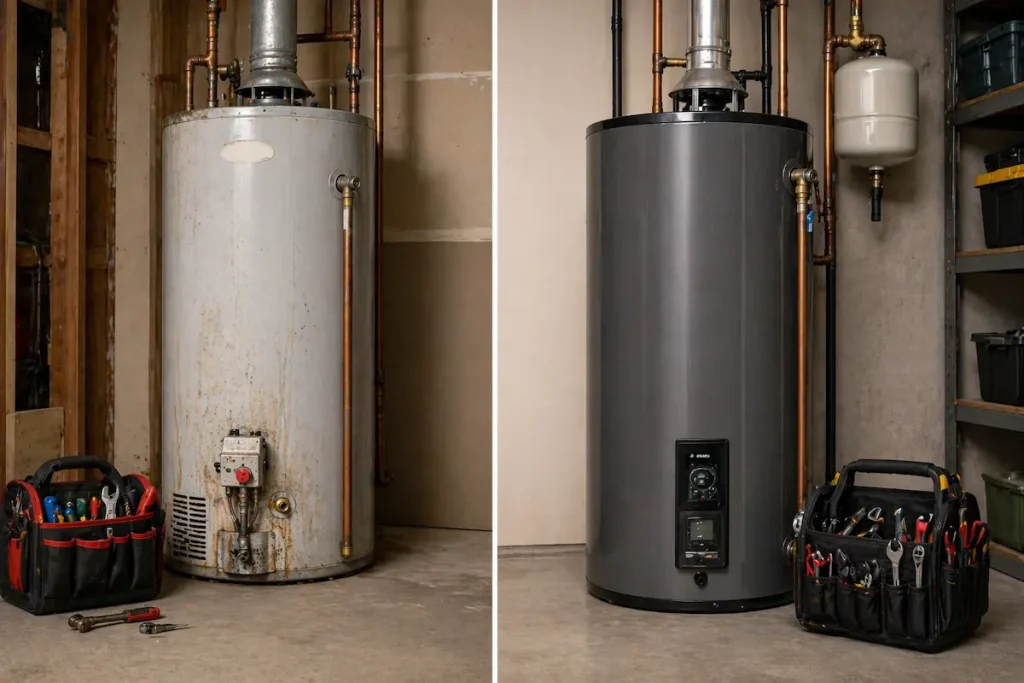
Quick comparison for the folks who just want the bullet points:
Repair:
- Lower upfront cost (usually $150–$800)
- Fast — often same day
- Short-term fix, especially on older units
- No change to your efficiency or hot water capacity
Replacement:
- Higher upfront cost ($1,200–$7,500+ depending on type)
- Longer install time (3–6 hours for a standard swap)
- Long-term savings from better efficiency
- Fresh warranty (usually 6–12 years on the tank)
- Better reliability — no more surprise cold showers
The cleanest way to think about it: repair buys you time, replacement buys you peace of mind. Which one makes sense depends on how much time your current unit actually has left.
When Homeowners Regret Repairing
We see the pattern pretty often. Someone has an older unit — 10, 11, 12 years old — something breaks, we give them the option, and they go with the cheaper repair. Totally understandable choice.
Then a few months later, something else fails. Then the tank starts leaking. Then they’re looking at three repair bills plus a replacement anyway.
The other version of this regret — hidden internal tank damage. A plumber can fix the obvious problem (say, a heating element), but sediment buildup and internal corrosion are already eating the tank from the inside. The fix works for a minute, and then the tank itself gives out.
We try to be upfront when we see this. If a tank looks rough internally or the unit’s past 10 years, we’ll say so. You can still choose to repair — that’s your call. Just go in with eyes open.
When Replacement Is the Smarter Financial Move
Sometimes the math is just clear. Replacement wins when:
- Multiple components have failed — thermostat and element, or gas valve and igniter. Once you’re stacking repairs, you’re past the 50% rule
- The unit is at or past its expected lifespan — 10+ years for a standard tank
- You’re running out of hot water faster than you used to — that’s either sediment or a dying dip tube, and both point toward replacement on an older unit
- You want better efficiency or higher capacity — if the household has grown, a 40-gallon tank might not be cutting it anymore
- You’re planning to sell within 2–3 years — a new water heater is a real selling point in Everett’s market, and an old one is a red flag on inspection reports
A family in Mill Creek called us last year with a 14-year-old tank that “just needed a quick fix.” We ended up installing a new unit, and they told us a month later their monthly gas bill had dropped by about $18. Not life-changing, but it adds up.
Professional Inspection: What a Plumber Looks For
When we come out to assess a unit, we’re not just eyeballing the obvious. A proper inspection looks at:
- Tank integrity — any rust at the base, bulging, or moisture where it shouldn’t be
- Sediment buildup — we can usually tell by the sound of the unit and by draining a small sample
- Burner or element condition — visual inspection of the combustion chamber on gas units, resistance testing on electric
- Anode rod condition — this is the sacrificial rod inside the tank. If it’s gone, the tank itself is next
- Venting and gas connections (for gas units) — looking for corrosion, proper draft, any signs of backdrafting
- T&P valve function — does it actually release pressure when it should?
- Code compliance — expansion tank, seismic strapping, drain pan. A lot of older Everett installs are missing at least one
This inspection is what lets us tell you honestly whether a repair will actually stick or whether you’re just buying another few months. We’d rather tell you the truth upfront than come back in six weeks.
Final Answer: What’s Cheaper in Most Cases?
Here’s the honest breakdown:
Short-term, repair is almost always cheaper. You’re looking at a few hundred bucks versus a few thousand. For a newer unit with a minor issue, that’s the obvious call.
Long-term, replacement usually wins for older units. Once you’re past that 10-year mark and the unit is showing real signs of age, repeated repairs add up fast, and the efficiency gap between old and new keeps widening.
The rule we give Everett homeowners, simplified:
- Newer unit + minor issue → repair
- Older unit + major issue → replace
- Anywhere in between → get the 50% math checked
If you’re not sure which category you’re in, that’s a reasonable reason to get a second opinion. A 15-minute inspection usually settles it. And we’d rather have that conversation with you upfront than get a call from you next winter when the tank fails on Christmas Eve (yes, that’s a real call we’ve gotten — more than once).
Get a Quote for Water Heater Repair or Replacement in Everett
If you’re stuck between repair and replacement, we’ll come take a look and give you the honest answer — not the one that makes us the most money. That’s just how we’ve always run things.
Danika Plumbing has been servicing water heaters across Everett, Lynnwood, Edmonds, Mill Creek, Seattle, and the rest of Snohomish and King County for years. Tank, tankless, gas, electric, heat pump — we’ve worked on all of it.
Call (425) 374-1557 or book an appointment online. Same-day service usually available.
Get a quote on your plumbing services in Everett today!