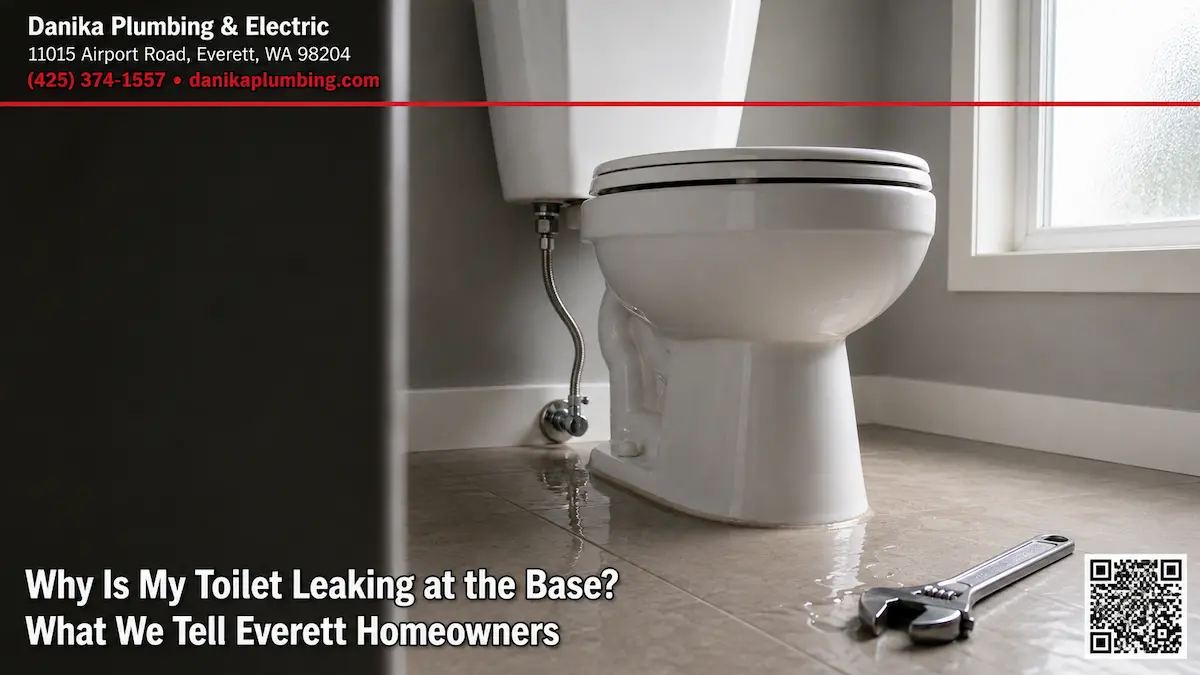
Why is your toilet leaking at the base? For most Everett homes it comes down to one of four things: a wax ring that’s worn or never seated right, closet bolts that backed off and let the toilet rock, a flange that’s cracked or sitting too low, or condensation faking the whole thing. Clear water that shows up slowly is usually the harmless one. Cloudy water that appears right after a flush is the one that eats subfloors. Here’s how to tell them apart, and when a wet floor is telling you something bigger.
We get asked this a lot, usually right after someone has mopped the same square of floor three mornings running. So let’s break down what’s actually failing under there and what you can handle yourself.
There’s no single cause, and here’s why
Water at the bottom of a toilet is never nothing. It might be a small nothing-much problem, a sweating tank or a loose bolt, but it’s never zero. A toilet leaking at the base means the seal between the porcelain and the drain below it has stopped doing the one job it has, and two toilets in the same house can fail for completely different reasons.
Before anything else, look at (and yes, smell) the puddle. Clear, odorless water that shows up gradually is often condensation, or tank sweat, or a drip from the supply line or tank bolts finding its way down the porcelain. Annoying, but not urgent. Water that appears right after a flush, especially if it’s cloudy or smells like, well, a bathroom, is coming from the drain connection under the toilet. That’s the one that damages floors, because every flush pushes a little more of it under the base where you can’t mop it up.
The timing matters as much as the smell. A flush sends a couple gallons past the seal in a few seconds, so if the wax ring has a gap, that surge is what forces water out at the base. Between flushes there’s nothing pressing against the failed seal, the floor stays dry, and you start doubting yourself. One customer near Forest Park mopped around her toilet every morning for a month thinking the kids were splashing. The kids were innocent. The wax ring was not.
So why is your toilet leaking at the base?
Your toilet sits on a ring of wax (some newer versions are rubber) that squashes between the porcelain and a fitting in the floor called a closet flange. Squashed wax makes a watertight, gas-tight seal. Here’s what breaks it:
- The wax gave up. Wax rings don’t have an expiration date, but they don’t love movement. A toilet that’s been rocked, re-shimmed, or reset without a new ring will eventually weep at the base.
- The bolts backed off. Two closet bolts hold the toilet down. When they loosen, the toilet shifts a little with every use, grinding the wax seal open. This is the cheapest fix on this list if you catch it before the leak starts.
- The flange is cracked or sitting too low. If the flange broke, or a bathroom remodel raised the floor around it (new tile does this all the time), the wax can’t compress enough to seal. We see this a lot after DIY flooring projects.
- The porcelain itself is cracked. Rare, but a hairline crack in the base leaks in a way no wax ring can solve. That’s a new toilet.
- It’s not a leak at all. Cold water in the tank plus a warm, steamy bathroom equals condensation running down the outside. Our winter water here comes in properly cold, so we get these calls from about November through spring.
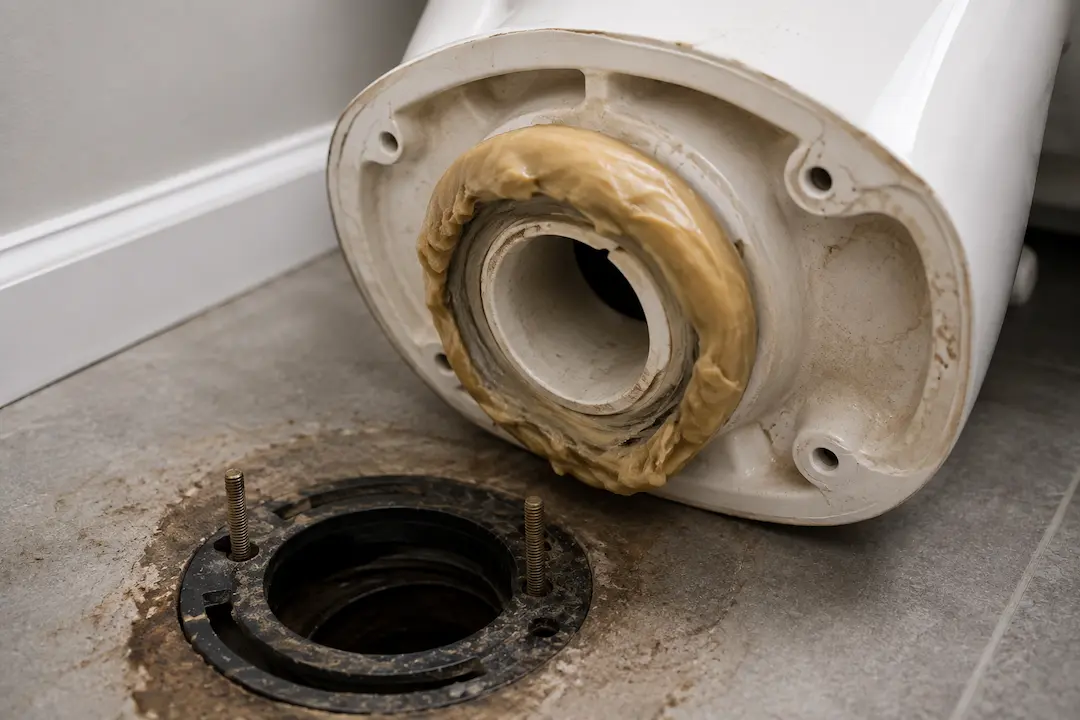
Most of the time it’s the first two, and the fix is pulling the toilet and setting a fresh ring. A cracked flange or cracked porcelain is less common and more involved. Condensation and supply-line drips fake the same symptom without any of the drama, which is why you check the easy stuff first.
Checks you can do yourself this afternoon
Start with the paper-towel test, because it costs nothing and settles the biggest question. Dry the whole toilet with a towel, tank and bowl and floor, then lay paper towels all the way around the base and leave them alone for a few hours. If the towels wet only after a flush, you’re looking at the wax ring or flange. If they dampen on their own with nobody flushing, look up rather than down: tank sweat, a weeping supply valve, and a tired tank-to-bowl gasket all deliver water to the same spot on the floor. While you’re down there, put a hand on each side of the bowl and rock it gently. Movement means the closet bolts need attention.
When to book a professional toilet repair
Push toward calling someone if the water is cloudy, if the floor around the base has gone soft or springy, if the toilet has been rocking for months, or if the leak came back after a previous reset. The difference isn’t just muscle: a snug bolt stops the movement, while a proper reset takes the seal back to a full compression that stops the same leak reforming a few weeks later. Our toilet repair specialists handle resets, wax rings, flange repairs, and full replacements. And if sewage is actively reaching the floor rather than seeping, that’s an emergency plumber call rather than a Saturday one.
How we fix toilets that keep leaking
Booking a repair doesn’t mean one fixed procedure. For a toilet that’s simply rocking, snugging the closet bolts evenly is sometimes the whole job, assuming the seal hasn’t already been worked open. For a failed wax ring, we pull the toilet, scrape both surfaces clean, and set a new ring. And for a flange that’s cracked, corroded, or sitting below the finished floor, the flange itself gets repaired or built up first, because a new ring on a bad flange is a leak with a delay timer on it.
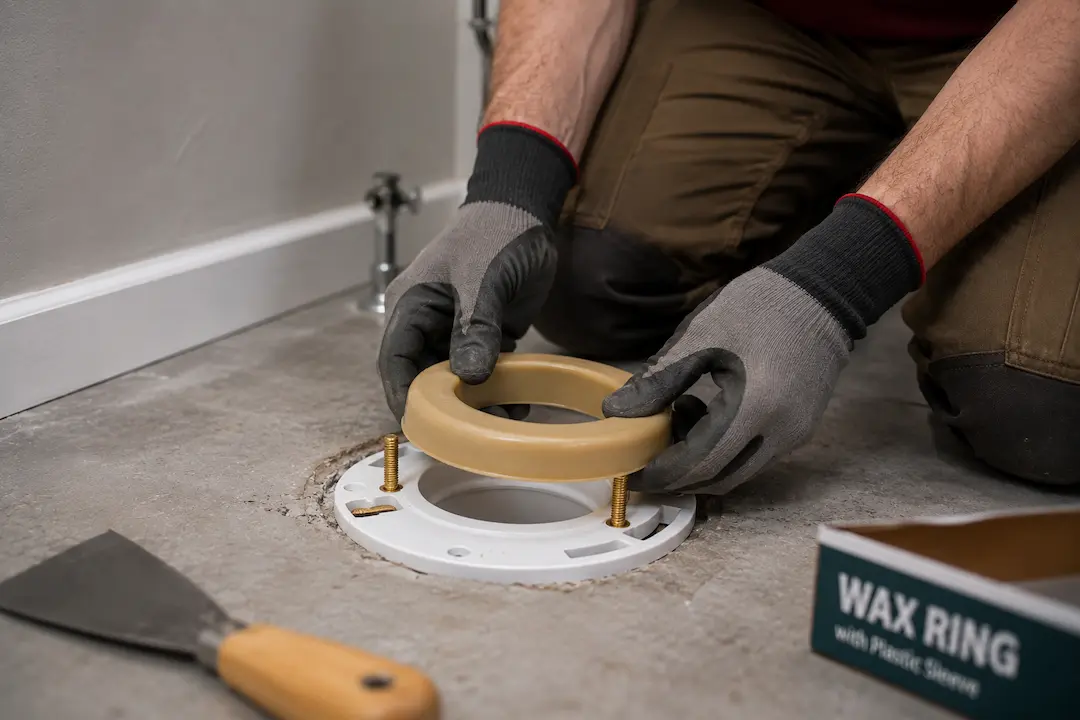
That last distinction is the one worth holding onto. A reset is maintenance; a flange repair or a replacement is what you do when the hardware itself has failed. A good plumbing company will tell you which one you’re looking at instead of selling you a wax ring on a toilet with a cracked base. If we lift a toilet and find a rotted subfloor or a hairline crack in the porcelain, we’ll say so, because the reset would only be a temporary fix and you’d be calling us back about the same toilet next season.
The wax ring, the flange, and the porcelain don’t age at the same rate
It helps to stop thinking of “the toilet” as one thing. The wax ring is the consumable: it’s designed to be replaced any time the toilet comes up, and it’s the part we swap most often. The closet bolts and the working parts inside the tank, flappers, fill valves, and seals, wear out on a cycle of years rather than decades.
The porcelain is a different animal. It can genuinely outlast the house, and there are toilets in older Everett homes flushing away decades after installation. But an older low-flow model from the first wave of mid-’90s designs may clog and leak often enough that replacement beats another repair, and the EPA’s residential toilet guidance is a reasonable starting point if you’re weighing a swap. If your base leak comes with constant running, weak flushes, or visible crazing in the porcelain, it’s fair to ask whether the toilet has earned retirement. And if the floor is wet but every part of the toilet checks out clean, that’s when expert leak finding earns its keep, because the water may be arriving from somewhere else entirely.
Signs your toilet is asking for help
You don’t have to guess at any of this if the toilet is already telling you. Any of these is a sign of a toilet leaking at the base that’s worth acting on:
- Water at the base that appears only after a flush.
- Cloudy water, or any smell to the puddle at all.
- A toilet that rocks or shifts when you sit down or lean on it.
- Flooring around the base that’s lifting, staining, curling, or feels soft underfoot.
- A faint sewer smell in the bathroom with no visible water anywhere.
- A leak that came back within weeks of a previous reset.
The first two point squarely at the wax ring or flange. The fourth and fifth are the ones we’d want to see sooner rather than later, because both suggest the problem has been running longer than the puddle lets on.
What happens if you just… don’t?
Ignoring a toilet leaking at the base doesn’t cause a dramatic problem overnight. It’s slow. Every flush pushes a little more water under the base where you can’t reach it, and the subfloor takes it on a few ounces at a time until one day the flooring lifts or the toilet starts to feel loose in a way tightening won’t fix.
Left long enough, wood that stays damp grows mold and loses strength, and a repair that would have been a wax ring becomes a subfloor job with a toilet sitting in the hallway. The repair cost barely changes if you act early. The floor repair cost changes a lot. Not a reason to panic over every drop of condensation, just why the leaks we get to early are always the easy ones.
What we do with our own toilets
People expect a plumbing company to recommend some secret product. We mostly don’t. Replacing a wax ring is within reach for a reasonably handy person, and the method is boring on purpose. Shut off the supply, flush and sponge out the water, unbolt the base, lift the toilet straight up (lift with your legs, porcelain is heavier than it looks), scrape every bit of old wax off both surfaces, set the new ring, and lower the toilet back onto the bolts in one careful motion. Snug the nuts down evenly, and don’t crank them. Overtightening cracks the base, which converts a cheap repair into a new toilet.
The caveats. If the flange underneath turns out to be cracked, corroded, or below floor level, the job stops being a Saturday project. Same if the toilet was rocking because the subfloor around it has gone soft, because wax seals won’t fix structural mush. And if you lift the toilet and can’t quite read what you’re looking at, don’t guess and re-set it anyway. A second-guess wax job that fails quietly under new flooring is one of the more expensive ways to save money. Which brings us to the shortcut we probably get asked about most.
Is it bad to just caulk around the base?
As a finishing touch around a toilet that’s already sealed properly? That’s exactly what caulk is for, and many installers deliberately leave a gap at the back as a tell-tale so a future leak has somewhere to show itself. As a fix for a leak you can already see? We’d steer you off it hard. Caulk doesn’t stop a failed wax ring, it just moves the evidence. The water still gets under the base; it simply has nowhere to escape to, so it soaks into the subfloor instead of pooling where you’d notice.
That’s the trade nobody explains at the hardware store. You give up a puddle you can mop and buy yourself a spongy floor you can’t see. If your first sign of trouble stops being water on the tile and starts being a soft spot underfoot, the repair has already grown. One reasonable attempt at snugging the bolts is fair game. Sealing the symptom shut is how a cheap reset becomes a floor job.
A few things about Everett homes that change the math
North of downtown, in Riverside, Delta, and the bungalows around Legion Park, we regularly find original cast-iron flanges that have rusted thin, and toilets set on layer upon layer of old flooring. Every added layer of vinyl or tile drops the flange lower relative to the toilet, stretching the wax seal thinner. If your bathroom floor has been redone and the toilet started weeping afterward, that’s not a coincidence; it’s geometry.
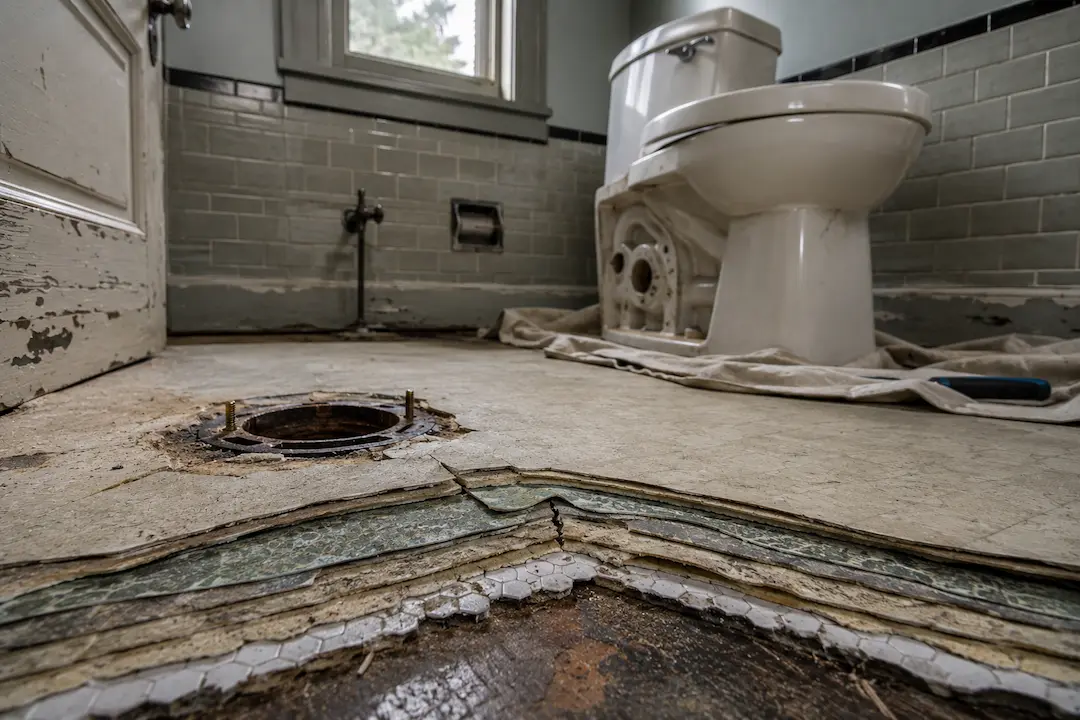
Our winter water comes in genuinely cold, too, which is why condensation calls cluster from about November through spring in bathrooms that get steamy and don’t vent well. And one more thing worth knowing: that wax ring isn’t only a water seal, it’s a gas seal. A bathroom that smells faintly wrong is sometimes the first symptom of a failing base seal, arriving before any visible water does. If your bathroom has developed an odor you can’t place, don’t caulk over it and hope, and it’s the kind of thing we’d want to look at as your plumber serving Everett and Snohomish County before it turns into a subfloor repair.
Odds and ends people ask us about toilet leaks
How fast does a toilet base leak become a serious problem?
Depends what’s leaking. Condensation is a nuisance and nothing more. A flush-driven wax ring leak wets the subfloor every time you flush, and wood that stays damp grows mold and loses strength, so think weeks to months, not years. The repair cost barely changes if you act early. The floor repair cost changes a lot.
Why does my toilet leak at the base even when nobody has flushed?
Look up before you look down. Tank sweat, a weeping supply valve, and a tired tank-to-bowl gasket all deliver water to the same spot on the floor. Dry the whole toilet with a towel, lay paper towels around the base, and check back in a few hours. The pattern of wet spots usually points at the source.
Will caulking around the base of a toilet stop a leak?
No, and it can make things worse by trapping the water where you can’t see it, so the first sign of trouble becomes a spongy floor instead of a puddle. Caulk is fine as a finishing touch around a properly sealed toilet, and many installers leave a gap at the back on purpose as a tell-tale. It is not a repair.
Does a rocking toilet always mean the wax ring has failed?
Not always. Sometimes the bolts just need a careful snugging, or the base needs shims on an uneven floor. But a toilet that’s been rocking for months has probably worked the seal open already. Fix the rock, then watch the base closely for a while.
Can a toilet leaking at the base raise my water bill?
Probably not this specific leak, because base leaks waste flush water, not supply water. A creeping bill usually means a running toilet or a hidden supply-side leak somewhere else in the house. Different problem, also worth chasing down.
Ready for a dry bathroom floor again?
DIY upkeep goes a long way, but a toilet leaking at the base reaches a point where guessing costs more than booking a repair, usually when the water is cloudy or the floor has started to feel soft. That’s the moment to let us look. We’ll figure out which of these it is, show you what we found, and fix the one that’s actually broken, not the whole list. Text us a photo of the puddle and half the time we can tell you over the phone whether it can wait for a regular appointment.
Danika Plumbing & Electric
11015 Airport Road, Everett, WA 98204
Phone: (425) 374-1557 |
office@danikaplumbing.com
Licensed in Washington (DANIKPL839PF)