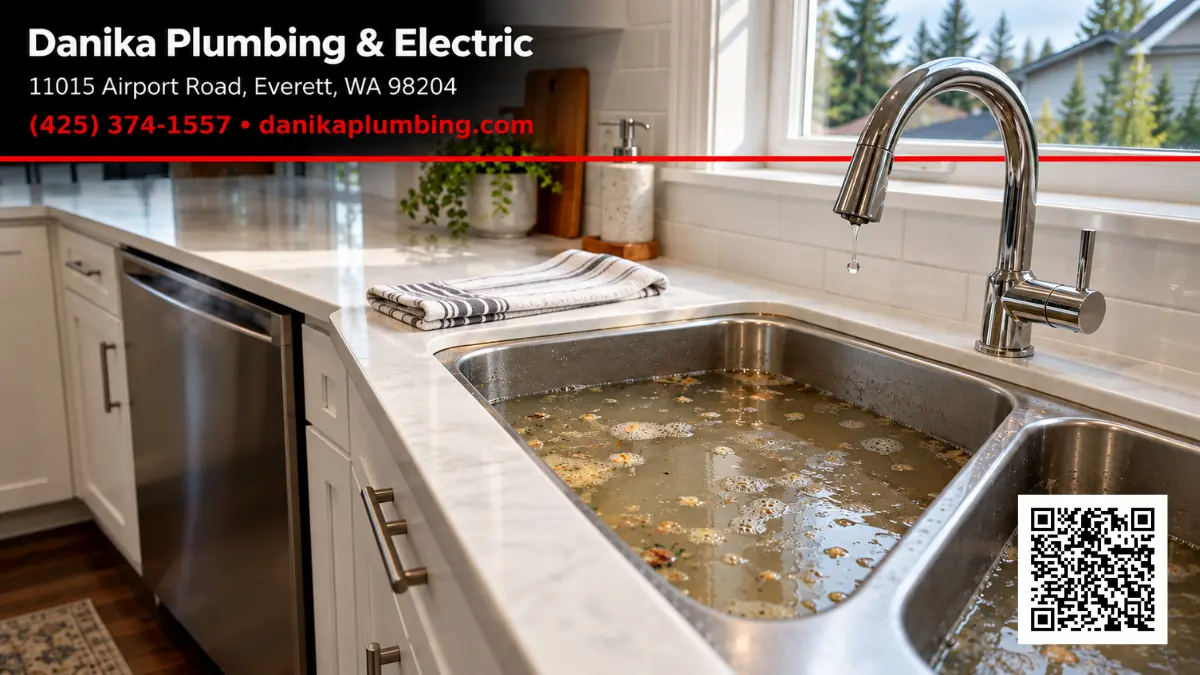
The dishwasher hits its drain cycle and dirty, greasy water rises into the kitchen sink from across the room. Nobody ran the tap. If you live in one of the subdivisions off 164th St SE, between Mill Creek Town Center and Highlands Park, this is one of the more common kitchen calls a plumbing company serving Mill Creek takes, and the fix depends on understanding one thing first: your dishwasher was never given a drain of its own. It shares the kitchen sink’s line. This post covers why that produces a dishwasher backing up into the sink, what you can check yourself in a Mill Creek, WA 98012 kitchen, and when the clog has moved past anything you should attempt.
Why this happens in Mill Creek Town Center homes
Under most kitchen sinks, a corrugated hose runs from the back of the dishwasher up in a high loop under the counter, then down into either the side inlet on the garbage disposal or a small branch fitting on the sink tailpiece. Some kitchens route it through an air gap, the chrome cap on the sink deck next to the faucet. Either way, that is the whole connection. There is no separate pipe to the main line and no dedicated vent. Plumbing-wise, the dishwasher and the sink are one fixture.
Anything that slows the sink drain slows the dishwasher drain. The dishwasher finds out first because its pump pushes a full tub of water out in one short burst under pressure, while the sink relies on gravity. A drain that handles a running tap without complaint can still send that burst backward, up through the disposal and into the bowl. Three things make this more likely in the housing along the Bothell-Everett Hwy corridor:
- Grease. It leaves the dishwasher as hot liquid, cools somewhere in the pipe, and coats the wall a little more every cycle. Food scraps, coffee grounds, rice and eggshells stick to that coating until the pipe has narrowed to a fraction of its size.
- Long, flat kitchen branch lines. Many of the 1980s and 1990s two-story homes between Highlands Park and Town Center have the kitchen on the far side of the house from the main stack, so the branch runs a long way under the floor with little fall. Slow water lets debris settle out.
- The disposal. A disposal does not clean the drain; it feeds it. The ground-up food travels down with the water and settles at the first rough joint or low spot. The drain can be partly clogged for months before anyone notices the sink draining slowly.
When years of buildup have narrowed the pipe, this is what professional drain cleaning is for. A cable punches a hole through grease; hydro jetting scours the pipe wall back to its full diameter. We have seen homeowners replace the dishwasher and have the new one back up within a week, because the machine was never the problem.
What to check first (before you call anyone)
Start by reading what the water is telling you. Dirty water in the sink only while the dishwasher drains, then slowly clearing on its own, means a partial clog in the shared line. Water that sits in the dishwasher tub and never pumps out points to the appliance: the drain pump, a clogged filter or a kinked hose. Water spitting from the air gap cap is the same shared-line clog showing up at a different exit. If the problem started right after a new disposal went in, read the FAQ below before anything else. Then work through these four checks, none of which needs tools you do not already own.
- Run the disposal empty for a few seconds with the cold water on. A soft plug of food at the disposal inlet sometimes clears. If nothing changes, stop; repeating it does not compound the effect.
- Look at the drain hose under the sink. It should climb high under the counter before dropping to the disposal inlet. A hose that has sagged over the years, or was re-routed low during a remodel, invites backflow.
- Fill the sink about halfway with the dishwasher off and watch it drain. Slow on its own means the restriction is further down the line, past where the two drains join. Drains fine means the clog is close to the connection.
- Pull the sink strainer, lift out any food or grease you can reach by hand, and run hot water for a minute.
If the sink still backs up after those four steps, call Danika Plumbing & Electric at (425) 374-1557 or request a drain visit online. We are at Paine Field, a short drive up the Bothell-Everett Hwy from 164th St SE.
When it is past DIY
This is where we would stop. Running a snake through the dishwasher’s own hose is a reliable way to puncture it, and a hand snake pushed blindly into a disposal can do real damage. On a grease coating, a small snake mostly punches a hole through the middle and leaves the buildup on the wall, so the sink backs up again in a few weeks. Pour-in remedies, from vinegar and baking soda to a kettle of boiling water, do not reach a clog sitting past the disposal in the branch line. Signs it is time for a plumber in Mill Creek:
- The sink drains slowly on its own, even with the dishwasher off.
- Standing water in the disposal chamber after a cycle ends.
- The backup repeats within days of clearing the strainer and running the disposal.
- Only one bowl of a double sink backs up every time, which puts the clog in that bowl’s branch.
- Other fixtures nearby, such as the laundry drain, have started acting up too.
A plumbing company that knows the homes around Highlands Blvd SE will tell you whether it is a disposal problem or a drain-line problem before quoting the work, and will run a camera down the kitchen line if it has come to that. Do not run another load in the meantime. A full tub of hot, greasy water into a line that is already struggling is how a slow drain turns into water on the kitchen floor. Hold off on the laundry too if it shares the same drain. For homeowners near Mill Creek Town Center, a plumbing company with a camera, a cable and a jetter can usually clear the line and tell you how long it had been building in a single visit.
Dishwasher backing up into sink FAQ
Is a dishwasher backing up into the sink ever normal?
No. A dishwasher draining through a proper high loop or air gap into a clear line should never push water into the sink. It is common, but there is always a findable cause: a clogged shared drain, a collapsed high loop, or a fitting that was never installed correctly.
We just installed a new disposal. Could a leftover plug be the cause?
Yes. New disposals ship with a knockout plug sealing the side inlet where the dishwasher hose connects. If the installer forgot to knock it out, the dishwasher has nowhere to drain but backward. Once knocked out, the plug drops inside and has to be fished out with the power off before the disposal runs.
Why does the water only come up on some loads?
Because the restriction is usually a narrowing, not a hard stop. A short cycle or light load squeezes through; a long wash with more debris and more water exceeds what the narrowed pipe can carry. An occasional backup is the early stage of the one you will eventually see every time.
Danika Plumbing & Electric, 11015 Airport Rd, Everett, WA 98204. We clear kitchen drain lines across Mill Creek Town Center and the 164th St SE corridor, and out to Silver Firs and Martha Lake. Call (425) 374-1557 or schedule through the contact page and we will get the sink and the dishwasher draining the way they should.