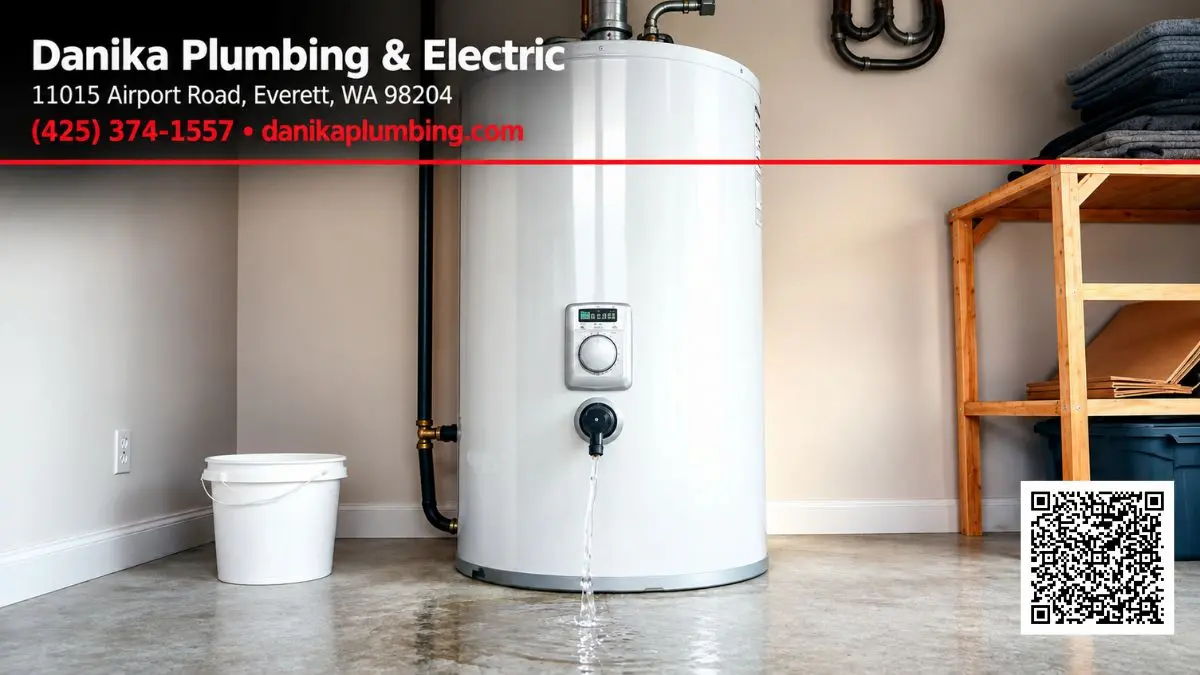

The washing machine is almost never the thing that is broken. We get called to laundry rooms across the Ash Way and 164th St SW area of Lynnwood 98087 with a wet floor, a soaked box of winter clothes, and a homeowner who has already priced a new washer. Most of the time a washing machine drain overflow has nothing to do with the machine. The pipe could not keep up, so the water came back out the top. A plumber working Ash Way homes sees this often enough to know where to look first, and this post walks through the same checks.
Why laundry drains overflow in Ash Way homes
Behind your washer there is an open vertical pipe called a standpipe. The grey hose hooks over the top and sits loose inside it. Under the floor that standpipe bends into a P-trap and joins the rest of the house drains. Your washer pushes water out with a pump and wants to be done in under a minute. The drain has no pump and moves water only as fast as gravity and pipe size allow. When the pump wins that race by enough, the standpipe fills and the top is the only place left to go. That is why nothing happens all wash, then the drain cycle starts and the floor is wet in seconds.
Three things narrow the pipe:
- Lint felt. Laundry water sheds lint, pet hair, sand and undissolved detergent, none of it heavy enough to drop out. It slows on the horizontal run past the trap and lies against the pipe as a soft grey felt, load after load. It narrows the pipe rather than blocking it, and a narrowed pipe passes a trickle but not a washer dump. This is the ordinary case, and the one a cable clears in an afternoon of drain cleaning.
- A shared line. In a lot of the 1990s and 2000s houses in the subdivisions off Ash Way, the laundry ties into the same branch as the kitchen sink before either reaches the main. Grease plus lint is a miserable combination. If the sink has been slow and the washer just started overflowing, those are not two problems.
- Venting. Drains need air behind the water, which is why every fixture is vented through the roof. Block that vent with a bird’s nest, fir needles or moss, and the drain still works, just slowly and noisily, gulping air back through the trap. The washer exposes it first because it asks for more drainage in one go than anything else in the house.
Where the machine sits matters too. In the older homes around Martha Lake Park and the lake streets off E Shore Dr, the laundry often lives in a garage corner on a drain routed decades ago for a machine that emptied slowly, and then a high-efficiency front-loader went into the same corner. The drain predates the machine. In newer two-storey homes the laundry is upstairs in a hallway closet, and the failure is worse: the overflow lands on subfloor instead of concrete, finds a seam, and shows up as a ceiling stain in another room. If your upstairs machine sits in a pan that has ever held water, treat it as the warning it is.
When a cable is not enough and the line needs scouring, that is hydro jet drain cleaning. If the trouble sits past the house, in roots, a sag or a broken lateral, that is sewer line repair. Everything else falls under Danika Plumbing & Electric general service.
What to check first, before you call anyone
- Run a load and watch the drain cycle. Does the water rise smoothly and go over the top, or surge, drop and surge again? A steady rise is volume the pipe cannot take. Surging means air is fighting its way in, which points at the vent.
- Look at the hose. It should hook over the rim and sit loose inside the standpipe. A hose that keeps jumping out is telling you the water hit a restriction and kicked back. Strapping it down just aims the overflow somewhere else.
- Undo anything sealing the hose into the pipe. Taping or caulking it in to stop a leak removes the drain’s air supply and turns a slow drain into a guaranteed one.
- Listen elsewhere in the house while the washer empties. If the laundry drain is the only unhappy fixture, the fault is local to that branch. If a floor drain weeps or the downstairs toilet burbles, stop. That is the main line talking.
- Check the detergent dose. High-efficiency machines are unforgiving about an overdose, and a standpipe brimming with foam is a different problem with the same puddle. Cut the dose for a few loads.
- Try hot water once. A kettle of boiling water down the standpipe will soften a fresh soap-and-lint film. If that does not shift it, the restriction is further along than anything poured will reach, and chemical drain cleaner will only stall in the horizontal run and be there when the line is opened.
Water on the laundry floor again and the kettle did not do it? Call (425) 374-1557 or request a visit online and we will find out whether it is the branch or the main before anything gets pulled apart.
When it is past DIY
Call a licensed plumber the moment any of these shows up:
- More than one fixture is misbehaving, or the lowest drain in the house is the one that overflows. The blockage is on the main.
- It has happened twice. A partial blockage can shift and run clean for a week or two, which reads as fixed. Nothing left the pipe.
- A snake goes straight down the standpipe and it still overflows. A thin cable passes through a lined pipe without clearing it.
- The overflow showed up the week the autumn rain came back. Once the ground starts taking water again, a sewer lateral that coped all summer with a bit of root in a joint starts coping less, and the washer reports it first because it dumps the biggest slug of water in the house.
- Water reached carpet, subfloor or drywall. Fixing the drain is one job. Drying the structure properly is a second one, and painting over damp material is how mold gets a foothold behind a wall that looks fine.
A plumber in Lynnwood from Danika comes down I-5 from Paine Field to exit 183, works out whether it is the branch or the main, and says so plainly if a cable would be a patch rather than a fix on your line. The same goes for a plumber serving Martha Lake homes: we would rather clear it once than come back for a third flood.
Washing machine drain overflow FAQ
Why does my floor drain overflow when the washing machine drains?
Because the water found the lowest opening it could reach. The blockage is downstream of both fixtures, on the shared branch or the main line. That version is not a DIY job, since water coming up a floor drain has been somewhere unpleasant first and the clearing point is rarely where the mess is.
My standpipe overflows but a snake goes straight down it. What is going on?
A hand auger passes through a partial blockage easily because the pipe only has to be slightly open. Lint and grease line the pipe rather than plug it, so you feel nothing and the drain has still lost most of its capacity. Or the pipe is clear and the fault is a vent or sag a snake cannot find.
Can a washing machine drain blockage clear itself?
Sometimes, briefly, and it is a trap. A partial blockage can shift enough to drain normally for a week or two, which reads as fixed. Nothing left the pipe. Lint builds in one direction only, so the next overflow comes sooner and messier. If the laundry drain has overflowed twice, treat the quiet stretch as borrowed time.
Danika Plumbing & Electric, 11015 Airport Rd, Everett, WA 98204. We clear laundry and branch drains in Martha Lake, Mill Creek and Meadowdale, and across the rest of Lynnwood and south Snohomish County. Call (425) 374-1557 or request service here and get the laundry room back in use.