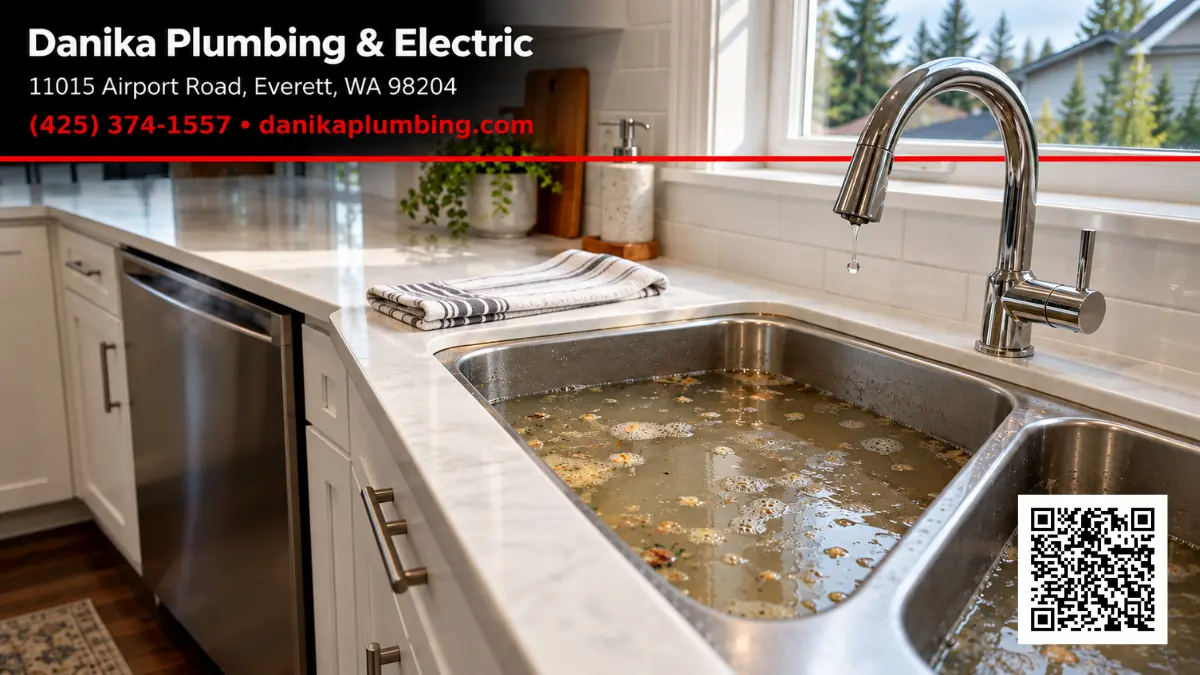
It usually starts around eleven at night. The house goes quiet, the fridge cycles off, and there it is: one drop hitting the bottom of a stainless sink every few seconds, keeping time like a metronome built by somebody who didn’t like you. That dripping faucet is the reason you’re up. So you get up, crank the handle another half turn, and go back to bed. Twenty minutes later it’s going again.
Most of the time it isn’t urgent. That half turn is worth talking about anyway, because it’s the first thing almost everyone does to a dripping faucet, and it’s also the thing most likely to turn a small repair into a bigger one. We’ll get to why, and we’ll cover what a faucet repair actually involves, what it should cost, and when a faucet drip in an Everett WA home is telling you about a problem well past the faucet itself. First, the part that matters if water is somewhere it shouldn’t be.
Read this part first if water’s pooling in the cabinet
A drip off the spout can wait. Water inside the cabinet can’t, because it isn’t going down a drain, it’s going into particleboard and then the subfloor underneath. If you open the door under the sink and find anything wet, stop reading and go find the shutoff.
If you want a crack at the faucet repair yourself: close both angle stops under the sink and open the faucet to confirm the water actually stopped. Plug the drain, because small parts are magnetically attracted to it. If a stop won’t turn, or turns and doesn’t stop the flow, shut off the water at the main and call a plumber for service rather than forcing it. A seized stop that gets forced can crack, and that turns a wet cabinet into a flooded one.
That’s the whole urgent answer. The rest of this is for the quieter version, the drip that’s just annoying rather than actively soaking anything.
A dripping faucet is almost always one small worn part
Here’s the reassuring bit. In the overwhelming majority of the faucet repair calls we get, nothing is broken in any dramatic sense. A faucet is a valve, and every valve on earth works by pressing something soft against something hard to hold back water. Rubber against brass, usually. Do that a few thousand times a year for a decade and the soft thing stops sealing, and the faucet starts to drip.
Which soft part depends on what’s inside your faucet:
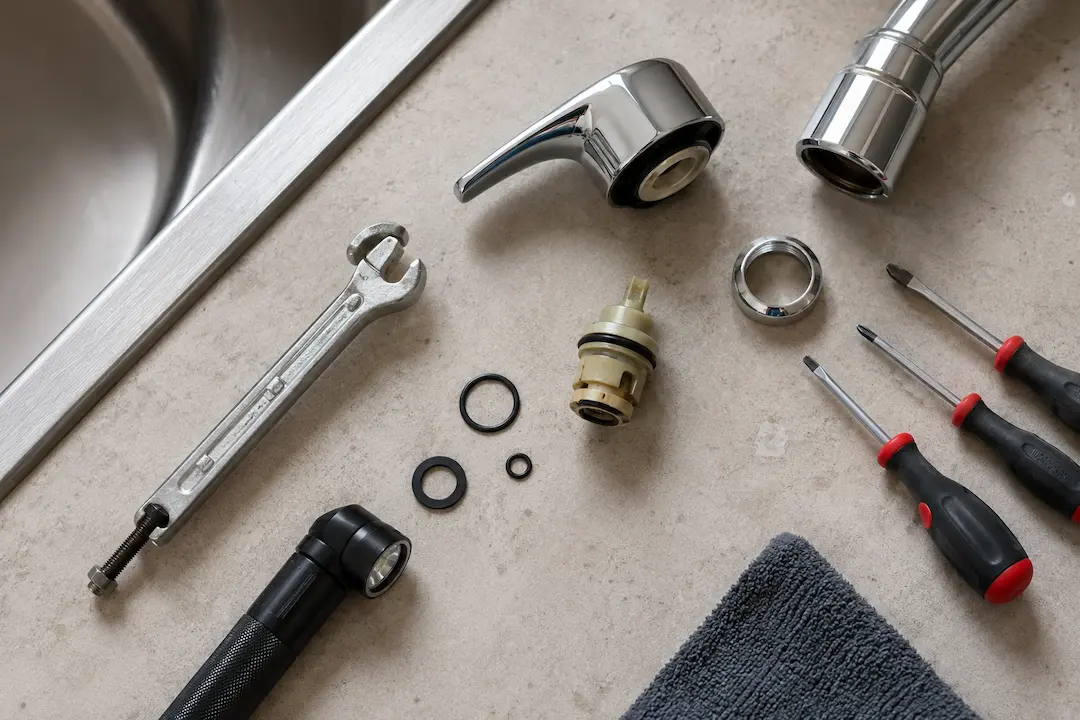
- A rubber washer, in older two-handle faucets. It flattens, hardens, sometimes tears, and water starts finding its way past it.
- An O-ring, which seals around the stem or the base of a swiveling spout. These dry out and go stiff, and water works through the gap they leave.
- A cartridge, in most single-handle faucets built in the last thirty years or so. It’s a sealed unit, and when it fails you replace the whole cartridge rather than rebuilding it.
- The valve seat, which is the hard half of that equation. Mineral buildup in the water pits it, and then even a brand new washer can’t sit flat on it.
None of those are expensive parts, and a faucet repair built around the right one is usually a modest job. Finding out which part it is, and whether the faucet is worth putting the part into, is the actual work of the service call.
Kitchen faucet, bathroom faucet: does the plumbing behind it matter?
It does, a little. A kitchen faucet gets worked harder than any other fixture in the house, cycling on and off dozens of times a day, so cartridges and O-rings in a kitchen faucet tend to wear out faster than the same parts in a bathroom faucet that only sees a few minutes of water a day. That’s part of why kitchen faucets are the single fixture we see most in faucet repair calls.
A bathroom faucet fails on a slower clock, but the plumbing behind it is often older, and the same wear shows up in a tub or shower faucet on the same wall for the same reasons. Bathrooms in Everett homes built before a remodel are more likely to still have the original two-handle compression faucet, with a washer and a seat rather than a cartridge, and those older bathroom fixtures respond well to a straightforward faucet repair rather than a full swap. Whichever fixture is dripping, the diagnosis is the same three questions: where does the water come from, what’s worn, and is the body of the faucet still worth repairing.
Where is the water actually coming out?
Before you touch anything, get a flashlight and watch the faucet for thirty seconds. Where water appears tells you more than anything else you can do without tools, and it’s the first question we ask over the phone before scheduling a service call.
- Out the tip of the spout, handle fully closed. Cartridge, stem washer, or a pitted valve seat.
- Around the base of the handle when the water runs. O-ring on the stem, or a loose packing nut.
- Where a swiveling spout meets the body. Spout O-rings, almost always.
- At the deck, under the escutcheon plate. A failed seal or gasket under the faucet body itself.
- Under the cabinet, at a braided line or nut. Not the faucet at all. That’s a supply-side plumbing repair, not a faucet repair, and it deserves more urgency than a spout drip, because supply lines carry water under pressure around the clock.
Faucet repair checks you can do yourself this afternoon
Then pull the handle, photograph everything as you go, and carry the old part into the supply house rather than trying to describe it over the counter.
When a faucet repair calls for a licensed plumber
Stop and call a plumber for service when you hit one of these:
- The angle stop won’t turn, or turns and doesn’t stop the water. Now you’re shutting off the whole house’s plumbing to fix a drip, and that valve is the real problem.
- There’s no shutoff under the sink at all, which happens in older homes more than you’d expect.
- You get the stem out and the seat is visibly pitted. A new washer on a bad seat drips again in a month, and you’ll be back to square one on the repair.
- The cartridge is discontinued, or you can’t identify the faucet at all.
- Anything is corroded enough that turning it feels like it might snap. Snapping a supply nut turns a quiet Saturday faucet repair into a wet one that needs emergency plumbing service.
We’d rather come out to a faucet you’ve already half diagnosed than one you’ve broken loose mid-repair, and honestly, we don’t mind either version. It’s what plumbing service is for.
Hiring the right plumbing service for faucet repair in Everett, WA
Not every plumbing service in Everett, WA treats a dripping faucet the same way, and it’s worth knowing what good service looks like before you’re standing in a wet kitchen at nine at night searching for an Everett WA plumber. A plumbing service that’s worth calling will ask where the water shows up before quoting anything, because a faucet repair quoted blind is a guess dressed up as a price. Ask any Everett plumber worth hiring how they price a faucet repair, and the honest answer is the same every time: they look at the faucet first, then they price it.
Licensing matters more than it sounds like it should. Washington requires plumbing contractors to carry a state license, and a plumbing service that skips that step on a faucet repair will skip it on a bigger repair too. When you’re comparing an Everett plumber against another, ask for the license number and check it, the same way you’d check a roofer or an electrician. A plumbing service with nothing to hide will hand it over without being asked twice, whether the plumbing job is a faucet repair or a full plumbing remodel.
Water actively pooling in the cabinet, or a shutoff that won’t cooperate: that’s the same-day version. We staff emergency plumbing service out of the same Everett, WA shop for exactly this, get the water off, confirm nothing’s tracked into the subfloor yet, and go from there.
Just a drip, no active leak: that’s a scheduled visit. A plumbing service that can tell you honestly which category your faucet falls into, rather than upselling emergency service on a problem that can wait, is the one worth keeping in your contacts. We identify the valve type, confirm what part’s worn, and bring the right cartridge or seat kit the first time instead of guessing off the faucet’s brand alone.
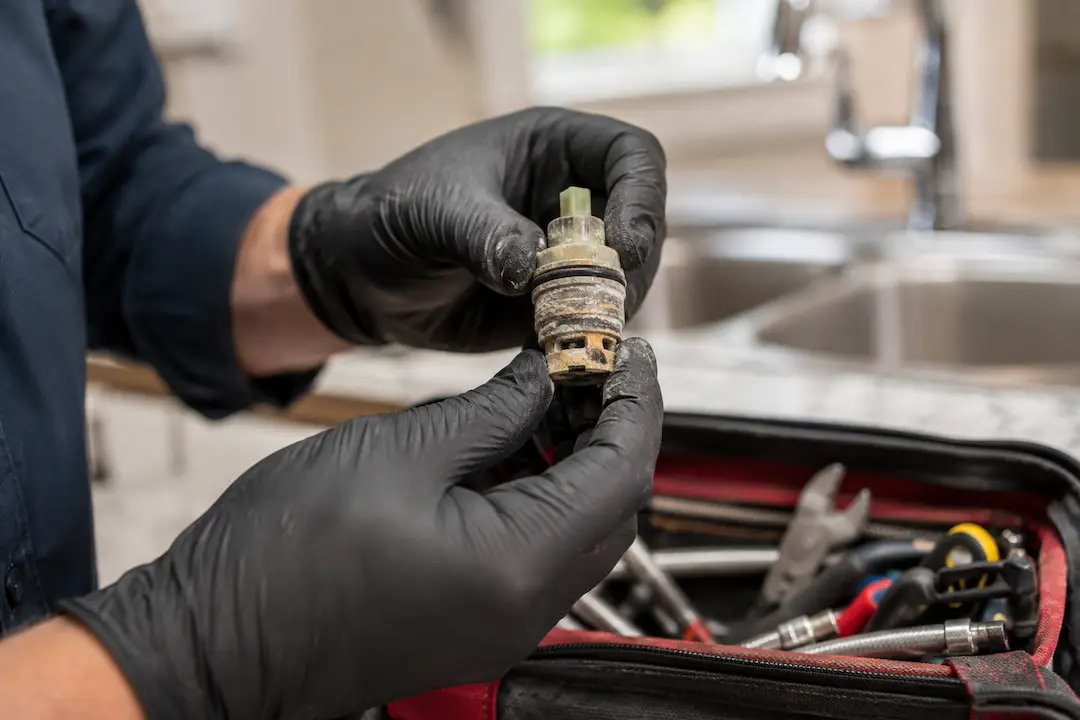
Cost is where most people start, and it’s a fair place to start. A faucet repair is one of the least expensive plumbing repairs a licensed plumber does, well below the cost of a full fixture replacement or a supply line repair, and a plumbing service that gives you a written cost before touching the faucet protects you from surprise pricing on a job that should be predictable. If a plumber won’t put a cost in writing for a faucet repair before starting, that’s worth treating as a warning sign about how they’ll price the bigger plumbing repairs later.
Everett, WA has plenty of plumbing service options, and most of them can handle a dripping faucet competently. What separates a good plumbing service from an average one is what happens when the faucet repair uncovers something else, a bathroom plumbing issue behind the wall, a drain that needs cleaning, or a supply line that’s past its service life. A plumber who flags that honestly, rather than quietly doing the minimum faucet repair and leaving the rest for next time, is doing the job the way it should be done, and it’s the standard we hold every plumber on our team to on every plumbing call.
Everett homes hand us the same two faucet and plumbing problems
Every Everett WA plumber on our crew will tell you the same thing: the housing stock around Everett, WA and the wider Everett area splits pretty neatly, and the water and plumbing behind the walls generally splits along the same lines. There are a lot of mid-century ramblers with original or near-original bathrooms, and those often still have two-handle compression faucets with real washers and real seats. Parts are cheap and the design is easy for an Everett plumber to work on, but the seats have had decades to corrode, and reseating one takes a tool most homeowners don’t own.
Then there’s everything built or remodeled from the nineties onward, where the kitchen almost certainly has a single-handle cartridge faucet. Those are simpler to fix in theory. The problem is identification. Kitchens get updated more often than any other room, so what’s on your counter often isn’t what the builder installed, and the brand stamped on the spout doesn’t always match the cartridge inside if a previous owner already had a faucet repair done with whatever the hardware store had in stock. We spend a surprising amount of time on our knees photographing the underside of a faucet body to figure out what we’re actually dealing with before quoting a repair.
One more local habit: rentals and duplexes around Everett cycle through builder-grade faucets fast, and replacing one outright often beats a parts hunt for a fixture that was never built to last in the first place. Property managers across Everett, WA tend to know this already and skip straight to replacement rather than paying for a repair on a fixture headed for the landfill anyway, which is a fair trade when the water savings alone pay the difference within a year or two.
Signs of faucet and plumbing problems you shouldn’t ignore
- A handle that has to sit at one exact angle or it starts weeping. That’s a seat problem, not a technique problem, and no amount of finding the sweet spot fixes it. It’s a faucet repair waiting to happen either way.
- A drip that comes back within days of cranking the handle harder. Cranking a faucet handle harder does sometimes buy you an evening, and it does it by crushing what’s left of the washer against a seat that’s already rough, so it’s a temporary fix at best.
- The hot side dripping specifically. You paid to heat that water and it’s leaving the faucet one drop at a time, which is a small but real cost on top of the eventual repair.
- A drop in water pressure at that one fixture while the rest of the house runs normally, which usually points at the same worn cartridge or valve seat rather than anything upstream.
None of those is proof by itself, but two together is usually enough to stop guessing and pull the handle off.
Off should mean off. So why isn’t it?
Because “off” is not a mechanical state, it’s just enough pressure to close a gap. When the seal or the seat has worn, the gap in the faucet never fully closes, and household water pressure is more than happy to push a few drops of water through it every few seconds. On brass stems you can strip threads doing it. We’ve pulled apart faucets on service calls where the washer had been mashed into something with the texture of a pencil eraser left in a hot car. Still dripped, still needed the same faucet repair it would have needed a month earlier.
What happens if a slow drip goes unnoticed
A slow drip off a spout tip is not an emergency by itself. It goes down the drain, it does no damage, and nobody’s floor is at risk. Wait for the weekend if you want, and treat it as a routine faucet repair rather than something that needs same-day service.
What matters more is anything wet inside the cabinet, because that water isn’t going down the drain, it’s going into particleboard and then the subfloor. Most homes we work in around here sit over crawl spaces rather than basements, so there’s no ceiling stain to warn you. It just quietly does its thing until the cabinet bottom swells or something starts to smell. Left long enough, that’s real water damage, not just an annoying sound.
And drips do not get better on their own. Every drop of water passing through that gap moves a tiny bit of mineral across the seat. A slow drip becomes a fast drip becomes a stream you can’t shut off, usually on a holiday, and usually right when you least want to be calling around for emergency plumbing services.
Could that dripping sound be something else?
Before you assume it’s the faucet, a few other sounds get mistaken for a drip. A running toilet a room away can sound like a faucet through a wall or floor. An ice maker line filling on a timer makes a similar rhythmic tick. Condensation dripping off a cold supply line onto a metal cabinet bottom can sound almost identical to a spout drip, especially in a humid crawl space below.
The useful distinction: a true faucet drip is steady and traceable to the spout or the handle base when you watch it. If you can’t find water actually appearing anywhere on the fixture itself, it’s worth checking the toilet and the ice line before assuming the faucet’s at fault.
When a dripping faucet points to a bigger plumbing repair issue
Most of the time a faucet drip is its own small, contained problem. Sometimes it isn’t, and it’s worth knowing the difference before you call for service. If the drip showed up alongside a drain that’s suddenly running slow, that’s usually two unrelated repairs rather than one, since a faucet’s internal wear has nothing to do with what’s building up inside a drain line. Drain cleaning and faucet repair get scheduled together often enough in older Everett homes that we treat them as a package on the first visit rather than two separate trips. A slow drain doesn’t need cleaning every time a faucet drips, but when both show up in the same week under the same sink, cleaning the branch line and repairing the faucet at once saves a second service call.
Drain cleaning itself comes in a couple of forms, and it’s worth knowing which one a plumbing service in Everett, WA is actually doing. Cabling a drain clears a soft clog and restores flow quickly, which is the right call for an isolated slow drain under a bathroom or kitchen sink. Jetting is a deeper drain cleaning, used when grease or scale has built a sleeve on the pipe wall over years rather than weeks, and it’s the drain cleaning method we reach for in older Everett homes where a cable alone keeps coming back dirty. Neither form of drain cleaning has anything to do with the faucet mechanism itself, which is exactly why we treat them as separate line items even on the same visit.
Corrosion is the other pattern worth watching for. If the supply lines feeding the faucet are old galvanized pipe rather than copper or PEX, a faucet that drips, a low-pressure tap two rooms over, and a supply line that’s started to weep at a fitting can all be symptoms of the same aging plumbing rather than three coincidences. That’s when a faucet repair on its own is a temporary fix, and the honest answer is a broader pipe repair or, in the worst cases, a full plumbing repair to the branch line feeding that fixture. We’ll always tell you plainly which situation you’re in before recommending anything past the faucet itself.
None of this means every dripping faucet is secretly a bigger plumbing repair. Most aren’t. But a plumber who only looks at the faucet, and never asks what’s happening in the drain, the supply line, or the rest of the plumbing behind the wall, can miss the pattern that actually matters. Good plumbing service means checking the water pressure at the fixture, checking the drain, and checking the supply line before calling a faucet repair finished, because water damage from an ignored pipe repair costs far more than the drain cleaning or pipe repair would have.
Repair or faucet replacement? What decides it
Most Everett WA faucet calls end in a repair, not a replacement, and for good reason: a cartridge or a washer costs far less than a whole new fixture and solves the same problem. But repair isn’t always the better call. If the body of the faucet itself is corroded, if you’re chasing the third leaking connection on the same fixture in two years, or if replacement parts for a discontinued model are impossible to find, replacement stops being a downgrade and starts being the practical choice.
It depends entirely on which part failed and whether the shutoffs under the sink need attention at the same time, so we won’t invent a number here that doesn’t hold up house to house. What we can tell you is that most faucet repairs are a modest, single-visit cost compared with a full fixture replacement, and you’ll see the written price for your specific repair before any work starts. A straightforward cartridge swap is quick, low-cost work. A full valve rebuild on an older two-handle set, or a faucet where parts have to be special-ordered, takes longer and runs higher. We’ll tell you which situation you’re in before we start, not after, so the repair-versus-replacement decision is yours to make with real information.
The same question comes up outside the kitchen too. Outdoor faucets, the hose bibs on the side of the house, are often past the point of a simple washer once a hard frost has cracked the body, and full replacement is usually cheaper than repeated repair calls on the same fitting. The same logic applies to an aging shower valve or a bathroom faucet that’s already been repaired more than once: at some point a repair on top of a repair stops making sense, and faucet replacement resets the clock instead of just extending it. Ask about our replacement services when a fixture’s reached that point, rather than sinking another repair into it.
Protecting the rest of your plumbing while you deal with one dripping faucet
A dripping faucet is a small amount of water. The habits that let it happen are worth a second look, because the same habits tend to sit behind bigger plumbing problems in an Everett, WA home. Water is patient, and a house full of plumbing gives water a lot of places to eventually find a weakness: a water heater fitting, a washing machine line, a water main connection under the yard, a bathroom supply valve nobody has touched in years. Water pressure that’s too high wears out a faucet cartridge faster than normal use ever would, and the same high water pressure is quietly stressing every other supply line, every water heater connection, and every washing machine hose in the house. If a plumbing service checks your faucet and finds the pressure running hot, that’s worth fixing at the source rather than just at the faucet, because it’s one repair instead of a slow parade of them.
Water damage rarely announces itself at the moment it starts. A dripping faucet you can hear is actually the easy case, because you know exactly where the water is going. Water that’s tracking behind a wall, under a slab, or beneath a cabinet floor from a failing supply line gives no such warning, which is why a plumbing service that only fixes the faucet you called about, without a quick look at the shutoffs, the supply lines, and the visible plumbing nearby, is leaving value on the table. We do that quick look on every faucet repair in Everett, WA as a matter of habit, not as an upsell.
None of this requires a full plumbing inspection every time a faucet drips. It requires a plumber who treats the faucet as one part of a connected water system rather than an isolated fixture, checks the water pressure while they’re under the sink anyway, and tells you plainly if anything else in your home’s plumbing looks like it’s heading toward the same kind of repair. That’s the standard we hold ourselves to on plumbing service calls across Everett, WA, whether the job is a five-minute cartridge swap or a longer plumbing repair. Water quality and water pressure both play a role too. Everett’s municipal water is relatively soft, which is kind to rubber washers and O-rings compared to the hard water plenty of other regions deal with, but soft water is not the same as zero wear. Every faucet in every Everett, WA home still ages, still needs plumbing service eventually, and still benefits from a plumber who checks water pressure and water quality together rather than treating a faucet repair as a part swap and nothing more. A whole-house water and plumbing checkup once every few years, covering water pressure, water heater connections, and the visible plumbing under every sink, catches most of this before it turns into an emergency plumbing call.
If you want a second opinion before committing either way, our reviews from other Everett homeowners are a fair place to see how that call has gone for people in a similar spot.
Faucet replacement services and other pages that go deeper
More information on each of these, if you want to go deeper on a specific service:
- Faucet repair and replacement
- Kitchen plumbing repairs
- Professional leak detection
- The local Everett plumbing service
A few more faucet repairs and care habits worth keeping
A faucet dripping Everett homeowners catch early is a five-minute fix, and good faucet care in an Everett home doesn’t take much beyond that: work the shutoffs under each sink open and closed once a year so they don’t seize in the position you least want them in, unscrew the aerator every few months and rinse the screen, and don’t ignore a drip just because it seems harmless. Catching a worn washer or cartridge early is a small job. Left alone, the same part turns into a stripped stem or a seat that needs regrinding.
Dry the deck around the base rather than leaving water standing, because that’s what creeps under the mount and swells a cabinet from the inside. Know where your shutoffs are before you need them, not while you’re standing over a puddle wondering. And if a handle starts feeling gritty or needs an extra half turn to stop, book the repair then. A cartridge pulled early comes out whole, while one left to grind for another season can weld itself into the body. Catching a small water problem early is exactly what keeps a five-minute repair from turning into a bigger one.
A quick faucet and plumbing repair checklist
- Confirm where the water actually appears before assuming which part is worn.
- Locate and test your angle stops before you need them in an emergency.
- Don’t crank the handle harder. It buys a night at most and wears the seat faster.
- Photograph the faucet as you take it apart, and bring the old part to the supply house.
- Treat any water inside the cabinet as urgent, even if the drip itself seems minor.
Faucet questions Everett homeowners ask us after service calls
What is the most common cause of a dripping faucet?
A worn part inside the valve, most often a rubber washer, an O-ring, or a cartridge, depending on what kind of faucet you have. The valve seat underneath a washer can also wear or pit, which keeps a drip going even after the washer’s replaced.
Is it bad if my faucet is dripping?
A slow drip off a spout tip isn’t an emergency. It goes down the drain and does no real damage on its own, though it won’t get better with time. Water showing up anywhere else, like inside the cabinet or at the base of the faucet, is worth taking more seriously since that water isn’t going down a drain at all.
Why does it drip every 30 seconds instead of steadily?
Because surface tension is holding the drop of water until it gets heavy enough to fall, and the rhythm you’re hearing is just how long that takes at your particular gap size and water pressure. A slower interval means a smaller gap, not a different problem. It’s the same worn part, earlier in its life, and the eventual faucet repair is the same either way.
Will a dripping faucet show up on my water bill?
Possibly, though a single slow drip is often small enough to disappear into normal month-to-month variation. If your water bill jumped noticeably, we’d look past the faucet you can hear and check for a running toilet or a leak you can’t see, because those move far more water than a spout drip does. Compare a few billing periods rather than reacting to one, and if the numbers stay high, that’s a leak repair question, not a faucet repair question.
Should I leave a faucet dripping when it gets cold?
That’s a different thing entirely, and worth separating out. Deliberately running a thin stream during a hard freeze is a real tactic for pipes at risk, done on purpose and then shut off afterward. A faucet that drips on its own in August is telling you a part has worn out. Don’t let the freeze advice talk you into living with a broken valve year round.
Do I need a plumber for a dripping faucet, or can I fix it myself?
Plenty of faucet repairs are genuinely DIY-friendly if the shutoffs work and the parts are still available. Where people get stuck, and where calling a plumber pays for itself, is a seized angle stop, a pitted valve seat, or a cartridge nobody sells anymore. If the first attempt doesn’t hold, that’s the point to call for plumbing service rather than working through a second or third repair on the same faucet. The same logic applies if you’re weighing a drain cleaning call against a DIY snake: a first try is reasonable, a second and third try on the same clog usually isn’t.
About that drip: we’ll turn up with the right cartridge
If you’ve stared at it long enough, or the parts hunt has gone nowhere, hand the faucet repair over to us. We work on faucets constantly across Everett, WA, we carry the common cartridges, and we’ll tell you straight when a fixture isn’t worth repairing instead of selling you a rebuild on something that’s due for replacement anyway. That’s the kind of plumbing service we’d want if it were our own sink, and it’s the same plumbing service we bring to drain cleaning, pipe repair, bathroom plumbing, and the rest of the plumbing repairs an Everett, WA home tends to need over the years. Water finds every weak point in a house eventually. A faucet repair now is usually the cheapest plumbing service you’ll buy all year.
Danika Plumbing & Electric
11015 Airport Road, Everett, WA 98204
Phone: (425) 374-1557 |
office@danikaplumbing.com
Licensed in Washington (DANIKPL839PF)