It starts small. A patch of paint that looks puffy. A faint musty smell in a room you keep clean. A water bill that climbed with nothing else changing. And the question that will not go away: is something leaking inside the wall where you cannot see it? In the two-storey homes around Exploration Park and the rest of Mill Creek, WA 98012, that question usually points at an upstairs bathroom sitting over the living room. This is how to confirm a hidden leak without cutting anything open, what to do in the first ten minutes if it turns out to be active, and when it is time to call an emergency plumber for Mill Creek homes instead of watching the spot.
Why wall leaks happen in Mill Creek north homes
Most houses north of 132nd St SE and up Seattle Hill Rd were built from the 1980s through the 2000s, and the plumbing inside the walls reflects that. A few patterns come up over and over:
- Copper supply lines from the 1980s and 1990s builds developing pinholes. Copper of that era can thin from the inside, and a pinhole on a pressurized line puts a steady mist into the wall cavity all day.
- Supply fittings at upstairs fixtures. A compression stop under a vanity or a toilet supply that was overtightened years ago lets go slowly, and the water runs down inside the wall rather than onto the floor where you would notice it.
- Shower valves and tub overflows. These are not pressurized leaks. They only run when someone is in the shower, which is why the stain downstairs comes and goes.
- Slow drying. A closed wall cavity in this climate stays damp long after a leak stops, so a small drip does more damage here than the same drip would in a dry region.
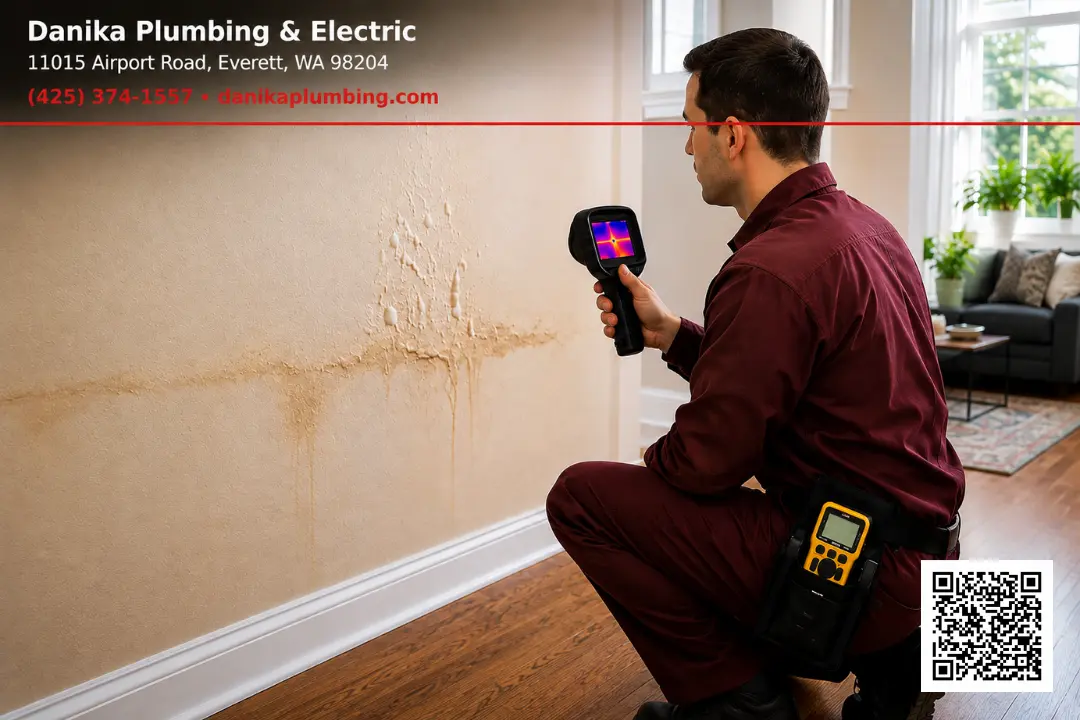
Finding which of these you have is a separate skill from fixing it. Water leak detection with moisture meters, a thermal camera and acoustic listening gear maps the wet area and locates the pipe before any drywall comes out. That is the difference between one deliberate access hole and a living room wall opened on a guess.
What to check first, before you call anyone
- Look for the surface clues. Bubbling, blistering or peeling paint. Yellow or brown stains, often a ring or a streak running downward. A patch of drywall that feels soft or cool when you press it. Mold spots along baseboards or around outlet covers. A musty smell that does not air out.
- Listen. With every tap in the house off, a faint trickle or hiss near the wall means a pressurized line.
- Run the meter test. Write down the water meter reading, run no water for two hours, and read it again. If the numbers moved, water is going somewhere it should not. Mill Creek homes have the meter in a box at the sidewalk.
- Separate it from a roof leak. Roof leaks show up after rain and start high, at the ceiling or the top of a wall. Plumbing leaks run steadily regardless of weather and show up where pipes run: kitchen and bath walls, and the ceiling under an upstairs bathroom.
- Note the timing. A stain that only appears after someone showers points at a valve or overflow, not a supply line.
One thing to know: the clue on the surface is almost always smaller than the wet zone behind it. Water travels along framing and down studs, so the stain you see can be a foot or more from the leak itself.
If the meter moved or the wall is wet to the touch, call (425) 374-1557 or request a visit and send a photo of the spot if you can. A picture of the stain or the blistered paint tells us what to bring.
When it is past DIY
A faint damp spot that is not growing can wait a day for a proper diagnosis. These cannot:
- Water actively running inside the wall. Shut the main off at the house, or at the meter box if the house valve will not turn.
- Anything wet near an outlet, a switch or the panel. Cut power to that room at the breaker before you touch the wall.
- Visible or smelled mold. Mold needs moisture, something to feed on and time, and drywall paper and framing in a damp cavity give it all three within days. Heavy growth is a remediation job, and our part is removing the moisture source.
- A meter that keeps moving after you have checked every fixture and the irrigation.
Those are the calls where you want a licensed plumber in Mill Creek on the way rather than a handyman with a drywall saw. Sending an emergency plumber to Seattle Hill means locating the leak, opening the smallest access hole that will do, exposing the pipe and making the repair, whether that is a new fitting, a section of copper or a run of PEX. Pipe repair inside a wall is finished only when the cavity has been dried out. Sealing damp framing books a mold call for six months from now.
If the leak turns out to be one pinhole among several in the same copper run, patching one at a time stops making sense. That is the point where repiping the affected lines is the honest recommendation, and we will say so before you pay for a third repair.
Two notes on the aftermath. Wet drywall that dried quickly can be fine; drywall that is soft, swollen or stained is past saving and should come out, because a new section of board costs far less than a moldy panel left in the wall. And on insurance, policies generally treat sudden and accidental damage differently from a slow leak that went unaddressed, so document the source and the damage with photos before anything is opened, and confirm the details with your own carrier.
Water leak behind wall: Mill Creek questions
Can a leak behind a wall dry out on its own?
Not while the pipe is still leaking; you would be drying a spot that gets re-soaked every day. Even after the repair, a closed wall cavity dries slowly in the Puget Sound climate, which is why the cavity gets dried deliberately before it is sealed.
How can I tell if it is a plumbing leak or a roof leak?
Roof leaks follow rain and start high on the wall or at the ceiling. A plumbing leak is steady regardless of weather and appears near where pipes run. The meter test settles it: if the meter moves with all water off, the source is plumbing.
Should I shut off the water if I think a pipe is leaking in the wall?
If the leak is active and spreading, yes. Shut the main and cut power to the room if outlets or switches are wet. For a faint damp spot that is not growing, you can leave the water on until a Mill Creek emergency plumber can diagnose it properly.
Danika Plumbing & Electric, 11015 Airport Rd, Everett, WA 98204. From the shop at Paine Field we cover Mill Creek north and Seattle Hill, plus Silver Firs and Silver Lake, for hidden leak calls. Call (425) 374-1557 or schedule a visit online and we will bring the moisture meters and the thermal camera.