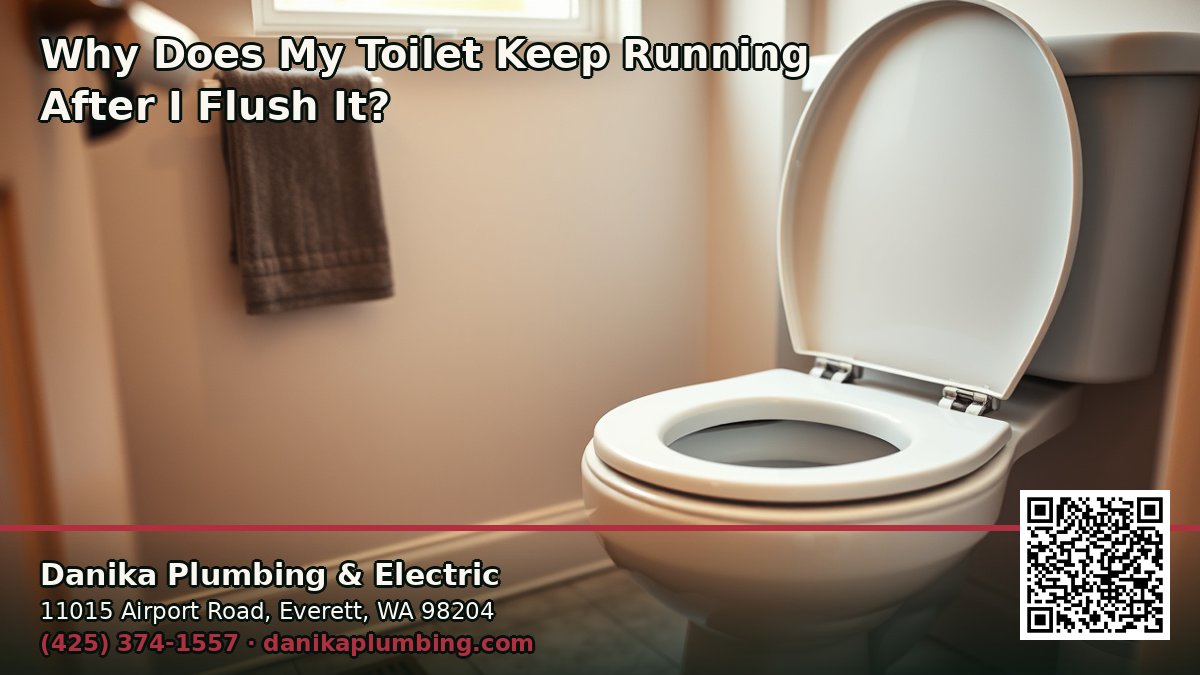
Why does my toilet keep running? Because a toilet that runs all night is a small, steady leak with a flush handle on it.
Most people tune it out. The hiss becomes part of the house, like the furnace kicking on or a neighbor’s dog, until the day somebody finally lifts the tank lid and wonders how long it’s been going on. We’ve had customers tell us it had been “doing that since the spring.” Nobody could say which spring. When people finally ask why does my toilet keep running, the answer is almost always sitting right under the tank lid.
Why does my toilet keep running? It is almost always one of a handful of worn or misadjusted parts inside the tank: the rubber flapper that seals the bottom, the fill valve that refills the tank, the float that tells the fill valve when to stop, or the chain connecting the handle to the flapper. You can usually tell which one by watching the water level and listening, and the common ones are cheap to fix.
Take the lid off first to see why your toilet keeps running
Before you grab a wrench or a replacement part from the hardware store, look. Slide the tank lid off (set it somewhere it can’t fall, porcelain doesn’t forgive) and watch the water level and the parts around it. Is the water creeping up toward the tall open tube in the middle? Is it already spilling over the top of that tube? Is there a steady trickle you can hear but not see, somewhere around the bottom?
Those three observations tell you most of what you need. Water pouring into the overflow tube means the fill side is overshooting. A hiss with a normal-looking level, and a bowl that keeps getting small top-ups on its own, usually means the seal at the bottom of the tank is letting water slide into the bowl. Same noise, different part, which is why guessing and swapping parts at random gets expensive in a hurry.
Flapper, Fill Valve, Float, Chain: Why a Toilet Keeps Running
Here’s the order we’d check them in, because it goes from least effort to most:
- The chain. It links the flush handle to the flapper, and it needs a little slack. Too tight and it props the flapper open a hair; too loose and it can slip under the flapper and keep it from seating. Fix the length and see if the running stops. This one costs nothing, which is why it goes first.
- The flapper. It’s the rubber seal at the bottom of the tank, and it is the part we replace more than any other on this complaint. Rubber ages. It warps, goes soft, picks up mineral film, and stops sealing flat. Press on it gently with the tank half-empty and see whether the running changes. A worn flapper is also the culprit when the bowl seems to refill itself every so often with nobody touching the handle.
- The float. It rides on the water and tells the fill valve when the tank is full. If it’s set too high, the water keeps rising until it spills down the overflow tube, and the toilet runs forever. Sometimes it’s just an adjustment screw or a clip. Sometimes the float is stuck against the side of the tank or sitting waterlogged and won’t rise properly at all.
- The fill valve. That’s the tall assembly on the left or right that brings water in and shuts it off when the float says so. Grit gets into the valve and keeps it from closing fully, or the internal seal wears out, and you get a long hiss that never really stops.
- The flush valve seat. If the flapper looks fine but the toilet still leaks into the bowl, the ring the flapper sits on can be pitted or crusty. At that point you’re past a quick part swap and into a decision about how much life is left in the toilet.
One thing that helps: put a few drops of food coloring in the tank, don’t flush, and come back a little later. If the color shows up in the bowl, the flapper or its seat is leaking. If the bowl stays clear but the tank keeps topping off and spilling into the overflow tube, it’s the float or the fill valve. It’s a low-tech test, and a lot of us in this trade have been making people do it for years because it works.
Is a running toilet really that big a deal?
It depends how long it’s been going, and honestly, you won’t know. That’s the trouble with a leak that happens inside the porcelain: there’s no stain on a ceiling, no puddle on the floor, nothing to tell you the clock is running. The water goes straight down the drain, and the first sign tends to be a utility bill that’s a bit higher than it used to be.
We aren’t going to put a number on it, because it varies a lot with how bad the leak is and what your water and sewer rates look like. But it’s real water, treated and delivered to your house, going down the drain for nothing. If you’ve seen the bill creep up and can’t explain it, why does my toilet keep running is a fair first question, and the tank is among the first places we look. And if the toilet checks out, that’s when it’s worth looking harder for something less obvious.
The other cost is noise, and sleep. We’ve seen more than one repair booked because somebody couldn’t stand the sound at 2 a.m. anymore. That’s a fine reason.
When a running toilet stops being a parts-swapping job
Replacing a flapper or a fill valve is the kind of repair a handy homeowner can do, and we’d never talk you out of it. Where it gets less sensible is when the shutoff valve under the tank won’t actually stop the water (you turn it and the flow doesn’t change), when the supply connection is corroded, when you’ve replaced two parts and it’s still running, or when the toilet is old enough that the tank hardware is all brittle together. In that situation we’d rather look at the whole toilet than watch you make a third trip to the store.
In Everett, with so many older homes, the shutoff valve under the tank often hasn’t been turned in years, and the nut, the rubber washer or the valve body can be worn or corroded by the time anyone needs it. That’s why a five-minute job sometimes turns into a bigger one. If you’ve already swapped a part and are still asking why does my toilet keep running, the shutoff or the valve seat is usually the real answer. If anything in there looks crusty or feels like it’ll snap, stop and call us. We’ll swap the part, test the shutoff, and leave the tank quiet.
Also worth reading if you’re already knee-deep in the toilet
- an Everett plumber who’ll come take a look: For when the shutoff won’t hold or the repair outgrows the Saturday.
- toilet repair and replacement in Everett: What we do when the toilet itself is the problem, not just a part inside it.
- someone to track down a silent leak: If the toilet is fine and the water bill still isn’t.
- the base-leak write-up: Water on the floor around the toilet is a different animal from water running inside it.
- a few other reasons the water bill jumps: Worth a skim before you assume the toilet is the only suspect.
The questions that usually come after the handle jiggle
How long should a toilet run after you flush it?
Just long enough to refill the tank, and then it should go quiet and stay quiet. A flush followed by a short burst of filling is normal. If you can still hear water moving a good while later, or the fill valve starts back up on its own with nobody near the bathroom, something in the tank is letting water slip away and the toilet is quietly topping itself off over and over.
Can I replace just the float, or does the whole fill valve go?
On a lot of modern toilets the float is built into the fill valve, so replacing one means replacing the other, and the whole assembly is usually inexpensive and made to come out as one piece. Older setups with a separate ball on an arm let you swap or adjust just the float. Either way, if the float was the only thing wrong, you’d see the water level riding too high or stopping too low, not a constant hiss with a normal level.
Do I need a plumber to replace a fill valve?
Not necessarily. It’s a tank-side job: shut off the supply, empty the tank, swap the part, reconnect the supply line. We’d call it a reasonable weekend project if the shutoff valve under the tank actually shuts off and the connections turn without a fight. Where we get called in is when the shutoff won’t hold, a connection is corroded or seized, or the toilet is old enough that you’d be fixing one part while three others are right behind it.
We diagnose before we replace anything, and we only recommend a new toilet when repairing it no longer makes sense. If it’s the flapper and a rinse of the fill valve, that’s what we’ll do.
Danika Plumbing & Electric
11015 Airport Road, Everett, WA 98204
Phone: (425) 374-1557 |
office@danikaplumbing.com
License # DANIKPL839PF