

If your water turned brown all of a sudden, it’s almost certainly rust: iron oxide and settled sediment shaken loose and carried to your tap instead of sitting quietly in the bottom of a pipe. In the short run, brown water in Everett homes is rarely harmful, and most of the time it clears on its own.
The useful question isn’t what it is. It’s whose it is. Rust that arrived in the water from the street is somebody else’s problem and generally sorts itself out. Rust that’s being manufactured inside your own walls, or in the bottom of your water heater, is yours, and it doesn’t clear up. It just pauses.
Telling those two apart takes no tools and not much time, which is the point of everything below.
Is that brown water from the city’s pipes or from yours?
Start with a pattern, not a cause. It’s the first thing we ask anyone calling about brown water in Everett to do. Run the cold tap nearest where water enters the house (a laundry sink, a hose bib, the kitchen). Then a bathroom upstairs. Then the hot water. You’re mapping where the brown water shows up and where it doesn’t, and that map does most of the diagnosing for you.
- Every tap, hot and cold, all at once. Something upstream stirred the water supply: hydrant work, a main break, a crew opening a valve a few streets over. This is the common one, and the one that fixes itself.
- Only the hot side. Your water heater. Sediment collects in the bottom of a tank over the years, and anything that stirs it, whether a heavy draw or a tank that’s simply getting on, sends it out as discolored hot water. Cold water runs clear because it never goes near the tank.
- One fixture, everything else fine. A branch line that hasn’t been used much, or an aerator that’s been quietly collecting flakes out of the water. Least dramatic version by a mile.
- Brown for a few seconds, then clear, every time. Corrosion sitting in the pipe between uses, getting flushed out by the first draw of water. That’s a pipe telling you what it’s made of.
- It keeps coming back with no work going on nearby. Now it’s yours. Something in the plumbing system is shedding, and it will keep shedding.
The map works because city water and your water reach the tap through different pipes. The public water mains end at the meter. Past the meter it’s your plumbing system: the service line, the pipes in the walls, the water heater and the faucets. Water discoloration at every tap at once usually starts in a water main out in the street. Discolored water at a few faucets but not others starts inside the house.
We had a call in the spring from a homeowner certain her water heater had failed. It hadn’t. Her cold water was brown too, and a crew two doors down had been on a hydrant all morning. She’d run the hot water first only because that’s the tap she was standing at. Order matters more than people expect.
What’s floating in your glass?
Discolored tap water can come out anywhere from pale yellow to brown water the color of strong tea. Whatever the shade, the discoloration is usually made of the same few things in different amounts: rust particles, iron, manganese and loose sediment.
Iron gives water the orange-brown tint most people picture. Manganese runs darker and can leave black marks on sinks and tubs. If you want a free test before calling anyone, fill a clear glass with tap water and leave it on the counter overnight. Rust and sediment settle into a layer at the bottom, and the water above it looks lighter by morning. Water that stays evenly cloudy all night is carrying finer silt, which is more common with well water after heavy rain. That’s the better outcome, because sediment that settles is sediment that flushing can move out of the system. What the glass can’t tell you is whether it came from the street’s pipes or yours. The tap map above does that.
Is brown water safe to use while you wait?
Short version: fine for the toilet, fine for washing your hands or a quick shower, not for drinking, and be careful with laundry.
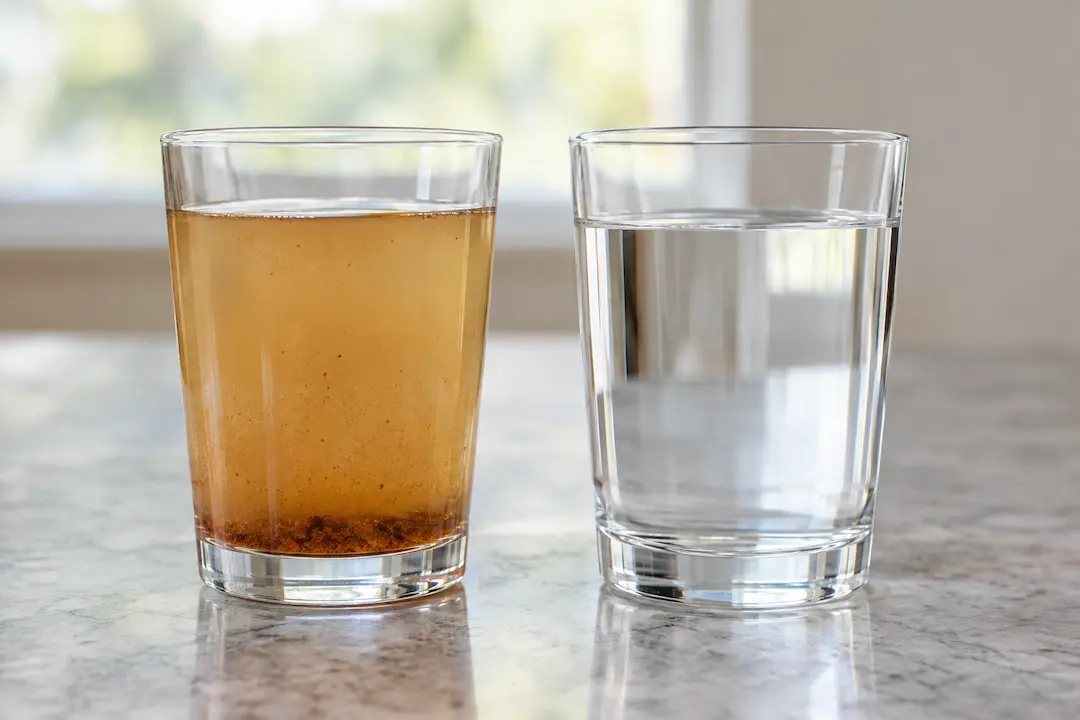
At the levels that tint tap water, iron and manganese are mostly a nuisance rather than a health threat. They look alarming, taste metallic and stain things, and for most people that’s the whole of it. The City of Everett’s own guidance after a main break is that brown or discolored water is safe, but that you should run the water until it’s clear before using it. So no, a brown glass of water isn’t an emergency. We’d still not drink the water, cook with it, or fill a pet bowl from it until it clears, because “usually just rust” is doing some work in that sentence.
Laundry is where people actually lose something. Rust-colored water sets a stain into light fabric, and the bleach reflex makes it worse: chlorine and iron together fix the color rather than lift it. Don’t start a load in that water, and if you’re mid-cycle, leave the clothes wet in the drum. Heat is what makes it permanent.
The color of the water on its own isn’t what to stay alert for. Water that’s temporarily discolored due to a hydrant crew or a main repair is a nuisance, and it passes.
The one thing that does move this from nuisance to phone call: if the discoloration arrives alongside a smell, a drop in pressure, or a boil-water notice, stop using the water altogether and call whoever bills you for it. Inside Everett city limits that’s City of Everett Public Works, whose 24/7 dispatch line is 425-257-8821 (press 1 for urgent water problems). Some homes with an Everett mailing address sit outside city limits and are billed by a local water district instead. If that’s you, call the number on your water bill.
When does brown water usually run clear again?
If the cause is outside your house, running a cold tap will usually pull clean water through behind the discolored water. A bathtub spout is ideal: widest path, no aerator to wreck, and it’s what the city itself recommends after a main break. Give the water a proper run, not a quick rinse. If the brown water is still there after half an hour, the City of Everett asks you to call its dispatch line rather than keep running water down the drain.
Once the water clears at the cold tap, run each hot tap for a minute too. Any line in your plumbing that was used while the water system was stirred up can be holding a little discolored water and sediment of its own, and flushing it now saves you finding it in tomorrow’s shower.
Flush with cold water only while the supply is still dirty. Running hot water at that stage pulls street sediment into the water heater, where it settles in the bottom of the tank and turns the city’s problem into yours.
Most municipal-side events are done well before that. You’re using clean water to drag the disturbed sediment past your fixtures and out, and it takes as long as the street takes to settle.
What should bother you is repetition. Once, after visible work in the neighborhood? Normal. Twice in two weeks with nothing going on outside? That’s a house problem wearing a city problem’s clothes, and no amount of flushing touches it, because you’re rinsing away the symptom while the source carries on corroding.
And if it never fully clears, if the water goes from tea to weak tea and stops there, don’t wait it out. That’s a water supply line that’s lost its lining, and the flakes coming through in the water are the small ones. The big ones are still attached.
How much of this is the city’s job?
Less than people assume. On the supply side, Everett conducts a comprehensive water quality testing program, to borrow the Public Works department’s own description. Every year Public Works tests the water for more than 100 possible contaminants and publishes the results in an annual Drinking Water Quality Report. Bacteria monitoring alone runs to roughly 125 water samples a month, taken from points around the distribution system.
The same water system supplies about three quarters of Snohomish County through a network of local water providers, so plenty of homes well outside town are drinking Everett water that arrives under another utility’s name.
Where the utility’s side of the system stops is your meter. Its own water quality report says as much: the utilities division is responsible for the water it delivers, but it can’t control the materials used in the plumbing inside your house. That’s why a clean water quality report and discolored water at your kitchen sink aren’t a contradiction. The water can leave the water main in good shape and pick up rust in the pipes between the meter and your faucet.
If you want to know the water quality at your own tap, and not the system average, a water test from a lab is the only real answer. For city customers with rust, that’s rarely necessary. For well owners, it’s the first step.
Why brown water turns up so often around Everett
Three things make brown water in Everett a more familiar call than it might be somewhere newer: galvanized pipe, hydrant work, and wells.
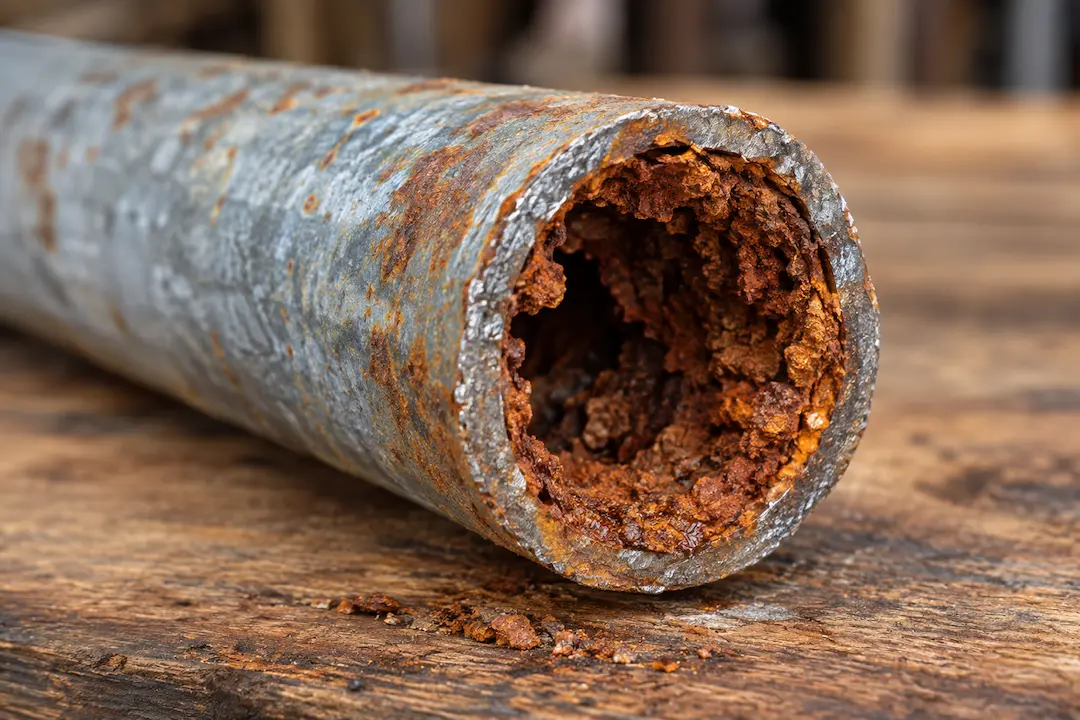
First, the housing stock. Plenty of the homes we work in around Everett went up when galvanized steel was the ordinary choice for water supply pipe, and galvanized pipes rust from the inside out. It doesn’t fail politely. It narrows first, so the household notices weak water pressure at one fixture and shrugs, and then one day the water is orange. And if somebody repiped the visible runs decades ago and left whatever was buried alone, you can have newer copper at the sink with old steel feeding it, a system that’s half new and half old.
Second, the mains. Water crews flush hydrants, fix breaks and swap valves on their own schedule, and nearby road or utility construction can jar an old line the same way, and the first anyone knows of it is a bathtub full of water the color of weak coffee. Worth a glance up the street before assuming the worst. A truck, cones and a puddle answers the question for free.
Third, and this one is seasonal: outside city limits, and especially in the rural parts of Snohomish County, plenty of properties are on private wells, and the water table doesn’t stay still. When the fall rain returns and the ground starts taking water again, a well that gave clean water all summer can pull in silt and tannins it wasn’t pulling in August. A first-ever brown-water week in the fall, on a well, is worth a look at the well and not just the plumbing.
On a well, the long-term answer to iron in the water is usually a filter or a whole-house filtration system, and which one depends on the water quality coming out of the ground. That’s why a water test comes before any equipment. On city water we’d skip the filter entirely. A pitcher filter can’t keep up with pipes shedding rust, and the discolored water from a main break is gone once you’ve flushed.
Pages worth opening in another tab
- If the hot water side is the culprit, the fix lives with the water heater specialists.
- If it’s the cold water and it keeps happening, you’re looking at supply pipe: either a section of it, through main water line service, or the lot, through whole-house repiping.
- Corrosion that’s far enough along to color the water is often far enough along to be weeping somewhere too, which is work for the leak detection specialists.
- And everything else sits with Everett’s local plumbing team.
What people want to know once the panic wears off
Why is ours brown when the neighbors’ water is fine?
Because the water system is only shared up to your property line. Past that it’s your service line, your pipes, your water heater. Whole street affected means the water main. Your house alone means the answer is inside your house, and the neighbors being fine is the most useful clue you’ll get all day.
Who should I call about brown water in Everett: the city or a plumber?
The utility, if cold water at every tap turned discolored at once for no visible reason. Inside Everett city limits, brown water from the main is a job for City of Everett Public Works, whose dispatch line is 425-257-8821; outside them, call the district on your water bill. They’ll know straight away whether they’ve got work going on in that part of the system, and that call is free. Call us when the brown water is hot-only, fixture-specific, or keeps returning after the street has gone quiet. Those sit on your side of the meter.
Can I run the dishwasher or a load of laundry in it?
Dishwasher, we’d skip. Not for safety, but because rust residue in the water dries onto glassware as a film you then have to rewash. Laundry, definitely not: it’s the one appliance where discolored water costs you something you can’t get back. Wait for clear water, then run an empty hot cycle before clothes go in.
It’s only brown for the first ten seconds. Is that still a problem?
It’s not urgent, but it isn’t nothing. A brief flush of discolored water on the first draw means corrosion is accumulating in the pipes between uses, and it’s most noticeable at a tap nobody touches much, like a guest bathroom. The water itself is fine once it runs clear. The pipe is telling you it’s shedding, which is a thing worth knowing before it’s a thing worth fixing.
Does brown water mean a pipe has burst somewhere?
Sometimes, which is why a sudden whole-house discoloration is worth a moment’s attention rather than a shrug. A break in a water main drops pressure across the system, and the drop pulls sediment and soil into the water line. Brown arriving alongside a noticeable loss of water pressure is worth reporting. Brown on its own, with normal water pressure, almost never means anything has burst.
Why is my well water brown when city water isn’t?
Because nobody flushes a hydrant on your behalf, so there’s no external event to blame and no crew coming to make it stop. Brown well water is usually iron, silt drawn in after heavy rain, or tannins from the ground. Sorting out which is a water-testing job, not a plumbing one. The Snohomish County Health Department no longer tests water itself, but it points well owners to the state Department of Ecology’s map of labs that do. We’ll rule out the plumbing side first, since that’s the cheaper half to answer.
Let us settle it: your pipes, or the city’s main
Most of the time, brown water in Everett is a bad morning and nothing more. But “most of the time” is a rotten thing to bet an old supply line on, and the version that matters looks exactly like the harmless one for the first day or two.
If the water’s cleared and come back, if it’s hot-only, or if it simply won’t go away, we can tell you which side of the meter it’s on and what it’ll take to stop it. Call Danika Plumbing & Electric at (425) 374-1557, or email office@danikaplumbing.com.
Danika Plumbing & Electric
11015 Airport Road, Everett, WA 98204
Phone: (425) 374-1557 |
office@danikaplumbing.com
Licensed in Washington (DANIKPL839PF)