
Leak Detection
A hidden leak never announces itself. It just runs up the bill, softens the framing, and surfaces somewhere it didn’t start.
Water is a poor witness to its own crime. It escapes a pressurized line, travels along the outside of the pipe, follows a joist or a bed of gravel, and surfaces two rooms away — or never surfaces at all and simply soaks into the ground beneath a poured floor. Which is why the most expensive way to find a leak is to start cutting where the stain is.
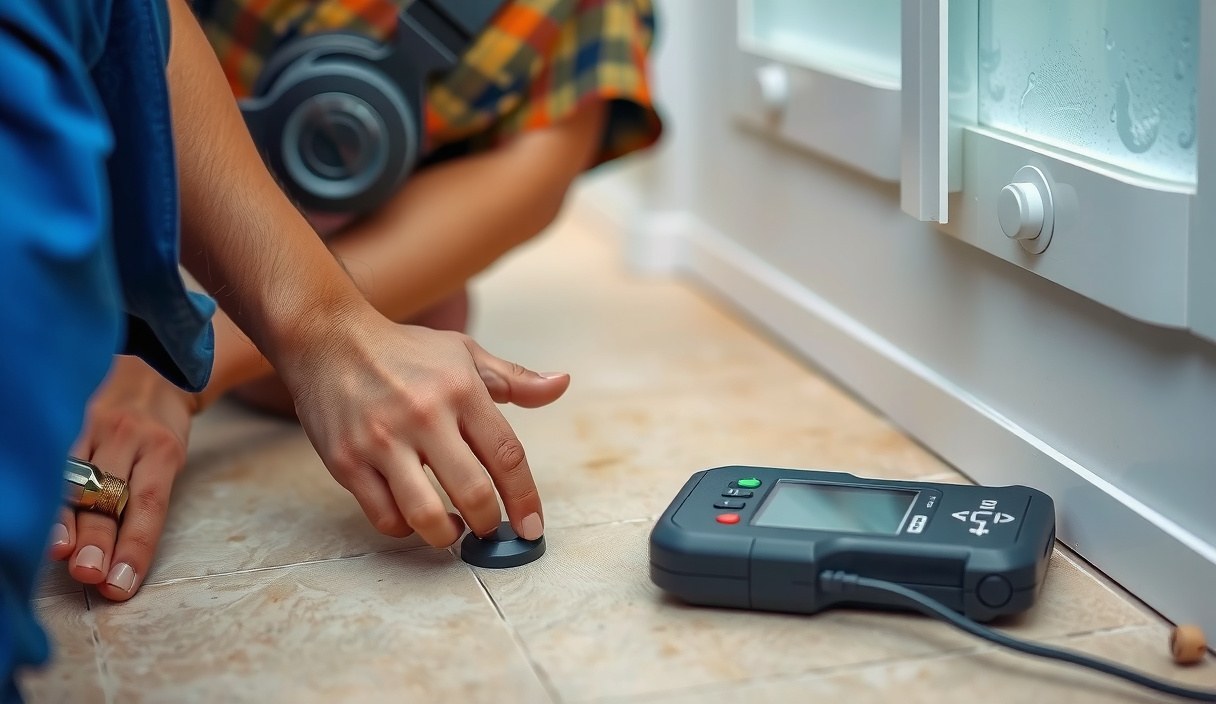
We begin with equipment instead of a saw. Acoustic gear listens for water escaping under pressure. A thermal camera reads the temperature ghost a hot line leaves on a floor. Pressure tests confirm a leak exists at all and narrow down where it lives. By the time anything gets opened up, we can usually put a mark on the floor and tell you what sits underneath it.
The methods behind our leak detection services
No single instrument finds every leak. A pinhole in a hot line under concrete behaves nothing like a weeping joint in a wall cavity or a cracked irrigation feed out in the yard, so most jobs use two or three of these together, each narrowing what the last one left open.
Acoustic listening
Water forced through a break makes noise — a hiss, a rush, a rhythmic tick against whatever it strikes. Ground microphones and contact probes amplify that sound and filter out the house around it, so we can walk a line and hear where the volume peaks. It reads through concrete, soil and drywall, and it is the workhorse on anything that holds pressure. Drains and waste lines are where the other tools earn their keep.
Thermal imaging
A thermal camera does not see water. It sees temperature. A leaking hot line under a floor warms the concrete above it into a bloom you can trace back toward its source; a cold-water leak often reads the opposite way, as a cool patch where evaporation pulls heat out of the surface. Quick, entirely non-invasive, and the usual way we confirm what acoustic detection suggested.
Pressure testing and isolation
Before where comes whether. We isolate a section, bring it up to pressure and watch the gauge. A gauge that holds clears that section; a gauge that falls proves a leak and tells us which side of the valve it sits on. Working valve to valve shrinks the search from the whole house to a single branch — the difference between opening one square of drywall and opening a wall.
The meter test
The simplest check in the kit, and the one homeowners can run themselves. With every fixture off, the low-flow indicator on the meter should sit perfectly still; if it creeps, water is going somewhere. We then isolate the house at the main shutoff and repeat the reading, which separates an interior hidden water leak from a break out in the yard — two very different repairs.
Tracer gas
When a line is drained, unpressurized, or the leak is too small to make a sound worth hearing, we introduce a safe inert tracer mixture into the pipe. The gas escapes through the breach, rises through soil, sand or concrete, and a surface probe picks it up directly above the failure. It finds what acoustic gear cannot hear, and it is usually what settles a stubborn leak under a driveway or a poured floor.
When the pipe runs under concrete
Plenty of houses in this county sit over a crawlspace, which makes a supply line comparatively easy to reach. Slab-on-grade is a different story — newer developments around south Everett, Marysville and Lake Stevens, plus garages, converted basements and additions poured straight over the plumbing.
A slab leak hides its symptoms well. The floor develops a warm patch you notice in bare feet. The water heater cycles more than it used to because it is quietly reheating water that is escaping underground. A hairline crack opens in tile or a section of laminate cups at the seams. Sometimes the only clue is the sound of running water in a house where nothing is running.
Finding one leans on the combination: acoustic first to find the loudest point, thermal to confirm the temperature signature, tracer gas when the first two disagree. We mark the spot, photograph it, and measure it off two fixed reference points so the location survives the conversation. What happens next is a real decision — open a small window in the slab and repair the line in place, or abandon that run and reroute it overhead through walls and attic space. Depth, flooring, the condition of the pipe and the state of the rest of the system all push that call one way or the other.
The things that send people looking
Almost nobody calls about a leak they can see. They call about something that stopped adding up:
- A water bill that climbed with no change in how the household uses water
- The sound of water moving through the walls late at night with every tap closed
- A warm or damp spot on a floor that has no business being either
- A musty smell in a closet, a cabinet or the crawlspace that keeps returning
- Paint bubbling, drywall staining, or a ceiling mark that returns after every repaint
- A strip of lawn that stays soggy or greener than everything around it through a dry stretch
- Pressure at the fixtures that drifted down slowly enough that nobody noticed
Living in the Puget Sound region works against early detection. Damp is the local default — a musty crawlspace in February gets shrugged off, and a wet patch in the side yard in November means nothing at all. Leaks here run long before anyone questions them, which is why a bill that jumps in the middle of a rainy stretch deserves a look rather than a shrug.
For scale, the EPA’s WaterSense programme publishes the household numbers — and, helpfully for anyone who distrusts a figure that arrives too tidy, publishes two slightly different versions of them across its own pages. Both are given here rather than one:
| Measure | Published figure |
|---|---|
| Water lost to leaks by an average household, per year | 9,300–9,400 gal |
| Homes with leaks wasting 50 gallons a day or more | 9% |
| Lost to household leaks nationwide, per year | 900 billion–1 trillion gal |
| Typical saving from fixing the easily corrected leaks | About 10% of the bill |
The gap between the two versions is not the interesting part. The nine percent is. That is not a freak statistic about somebody else’s house — it is a normal fraction of any street, and 50 gallons a day is a volume you would notice instantly if it were running across the kitchen floor instead of into the ground under it.
The water itself plays a part too. The supply serving Everett and much of the surrounding area is soft, low-mineral water out of the Sultan basin — pleasant to live with, and slightly less forgiving of aging copper, which tends to fail as a pinhole rather than a burst. Small, quiet and long-running is the classic local profile.
Locating it and repairing it are separate pieces of work
Worth saying plainly, because it catches people off guard. Detection is its own scope with its own end point: a marked location, photographs, and a recommendation for what to do about it. Plenty of homeowners stop right there — that report is what an insurance adjuster wants when water damage is part of the claim, and what a landlord or a buyer needs in writing before anyone authorizes work on the property.
When the repair does go ahead, what it involves depends entirely on what we found. A single failed section usually calls for nothing more than cutting out the bad length and splicing in new, a contained job once the location is certain. A poorly routed or chronically stressed run is often better rerouted than patched. And when copper pinholes in one spot this month and another next spring, the honest answer is that the material is at the end of its service life, and replacing the supply lines throughout the house beats keeping a standing appointment with a plumber.
We tell you which of the three you are looking at. If the finding turns out to be good news — a hose bib, a toilet flapper, an irrigation valve rather than anything buried — you hear that in the same flat tone.
Why us
We would rather find it with a microphone than a saw.
Danika Plumbing & Electric has worked on Snohomish County houses long enough to know what the older neighbourhoods are plumbed with and how those materials fail. Every job runs under Washington State L&I registration, the price is written down before anyone starts, and the crew who locate the leak are the crew who repair it.
(425) 374-1557Licensed & bonded
WA State L&I registered, bonded and insured on every call.
Written price up front
You see the number before we start. No surprise line items.
Findings in writing
Photos, location and recommendation — the documentation adjusters ask for.
Plumbing + electrical
One company, one standard — fewer numbers in your phone.
Where we work
Leak detection services across Snohomish and north King County
Out of the shop on Airport Road, we cover Everett, Marysville, Lynnwood, Edmonds, Mukilteo, Mill Creek, Lake Stevens, Monroe, Snohomish and Mountlake Terrace, and head south into north King County regularly. For an Everett address specifically, the details sit on our page for water leak detection in Everett. Detection is one line in a longer list — drains, water heaters, gas and fixtures all live on the main plumbing page.
Straight answers
What homeowners ask before they book
How do you find a water leak without cutting into the walls?
How do I know if I have a slab leak?
My water bill jumped but I cannot see any water anywhere. What now?
Do you repair the leak once you find it?
What does leak detection cost?
Stop guessing where the water is going.
Get the leak located properly, in writing, before anyone opens a floor or a wall.
Licensed · Bonded · Insured · WA L&I Registered · 11015 Airport Road, Everett, WA 98204